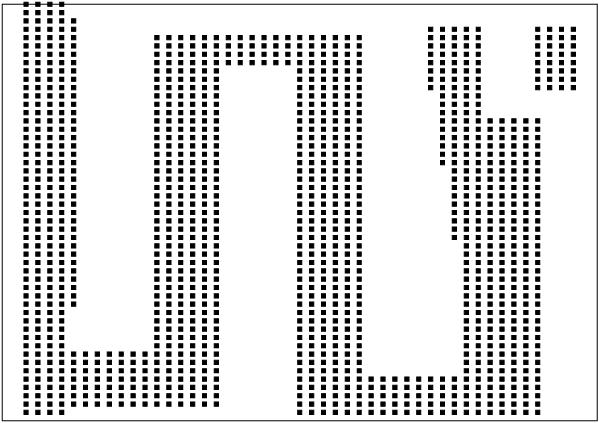
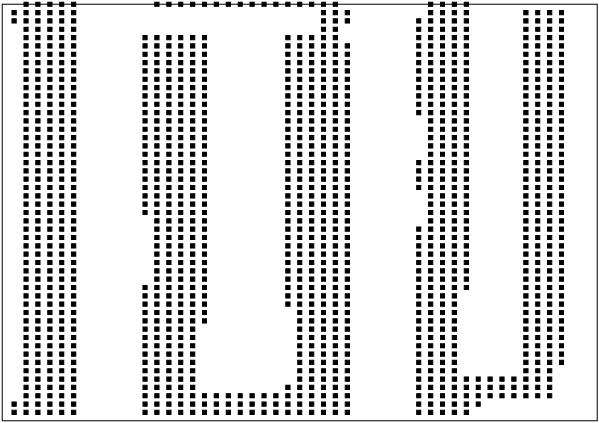
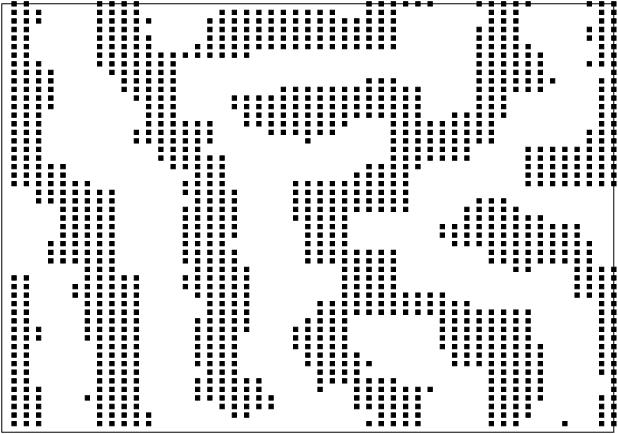
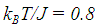
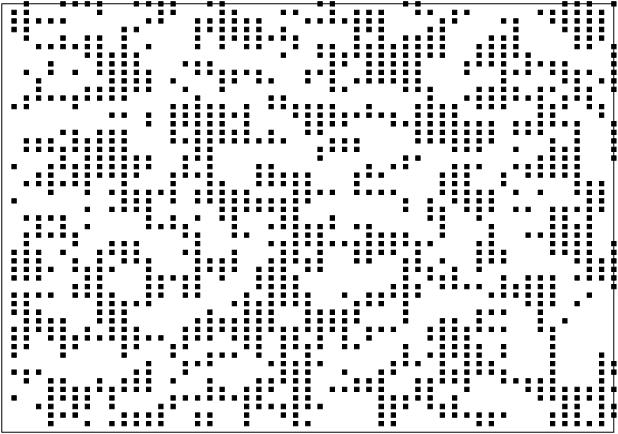
This behaviour is due to the presence of DOMAINS inside the ferromagnetic material. In bulk material, the magnetic fields arising from various domains usually cancel out, leaving the material unmagnetized.
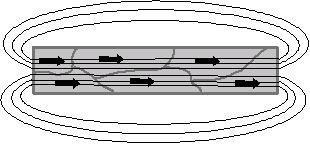
The figures above show that,in the absence of external magnetic field, the presence of domains in a ferromagnetic material, results in zero macroscopic magnetization. When external magnetic field is applied, the domains align in the direction of external field and there is net magnetization.
In what we have studied till now, if one lowers the temperature, the size of domains keeps increasing, and at very low temperature there is only one domain. So, this model cannot describe a real ferromagnet. What it misses out is the magnetic dipole interaction which is long-ranged and tries to align the magnetic moments anti-parallel. This interaction, however, is much weaker than the exchange interaction.

Also,  is very weak compared to exchange interaction. But for
spins which are not nearest neighbors, there is only magnetic
interaction, as exchange interaction, being short ranged, is zero.
is very weak compared to exchange interaction. But for
spins which are not nearest neighbors, there is only magnetic
interaction, as exchange interaction, being short ranged, is zero.
is stronger for close-by spins, and weaker for far-away spins.
This distance goes as 1/r, where r is the distance between the spins.
We have a discrete lattice, so this condition should translate to:

The Program with effect of dipole interaction
 .
.