BEHAVIOR
Penguins usually walk or hop and toboggan along on their breasts, pushing with wings and feet. They swim with great speed and agility. The flippers are their sole means of propulsion; the feet are trailed behind or used in steering. Some species progress by porpoising, which is swimming underwater some distance, emerging in a graceful arc to take a fresh breath, and submerging again. Penguins feed on fish, cuttlefish, crustaceans, and other small sea animals. In captivity the king and emperor penguins normally do not learn to pick up their own food, and after they have been taught to feed by strenuous forced feeding they must be fed by hand each day.
Penguins are gregarious birds and are found in flocks even at sea. On land the colonies often number in the hundreds of thousands. Although the birds have suffered greatly at the hands of humans, who have slaughtered great numbers for their blubber and, more recently, for their skins, the inaccessibility of the Antarctic region has helped preserve the group. Natural enemies of the penguin include leopard seals, killer whales, and, in the case of young chicks and eggs, skuas.
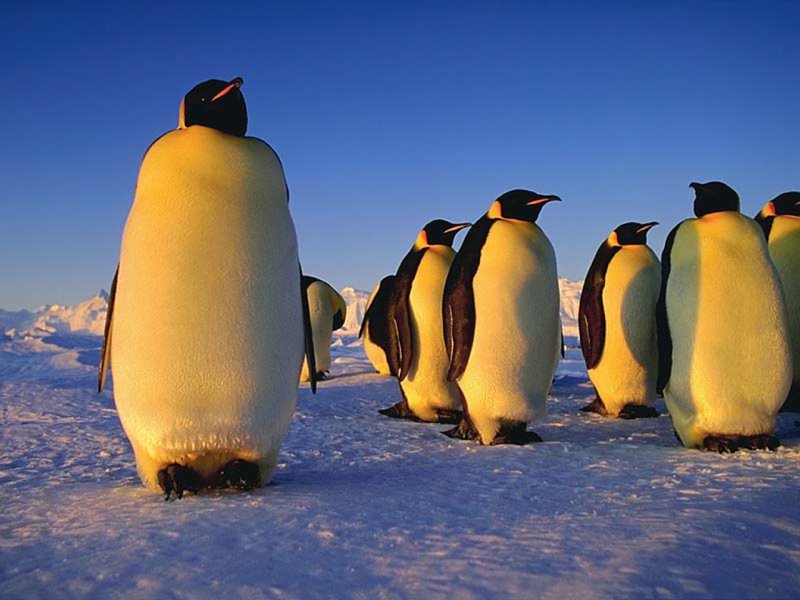
BREEDING
The greatest concentrations of penguins are seen in rookeries.Several species of penguin may be found nesting in a single rookery, but usually the species are well segregated. At the mating season the penguins of the Antarctic region appear along desolate, ice-bound, or rocky coasts and hop, jump, waddle, and toboggan toward favored breeding sites. In many of these areas smooth paths have been worn over hard rock formations by countless generations; the birds use precisely the same paths as their antecedents to approach the rookery. Often the paths seem to be the most circuitous and difficult routes to the rookery, and in some cases the sites are located many kilometers from the ocean. More northern species may be resident in the area of the rookery. The emperor penguin breeds in one of the world�s most inhospitable regions during one of the coldest periods of the year, laying and incubating its eggs in temperatures as low as -62 degree Celsius to -82 degree Celsius.
Penguins indulge in strange postural displays and calls in the process of finding mates within their own species. The gentoo penguin raises its flippers and calls or bows in a manner peculiar to the gentoo; the jackass penguin bows, shakes his head, and brays in a characteristic jackasslike call; and the courtship display and clear trumpeting of the king penguin are specific to that species; members of the genus Spheniscus, which do not meet in the wild, will readily hybridize in zoos.
Penguins vary in their nesting methods, and some species build no nests at all. The Humboldt and jackass penguins prefer a sheltered retreat, such as a burrow, and utilize sticks and other debris to form the nest. Others, such as the Adlies, incubate their eggs in the open on nests formed of stones or sticks. King and emperor penguins build no nests; in these species the bird holds its single egg in the top of its feet, hunching down over it so that a fold of abdominal skin covers and warms the egg. Most species of penguin lay a clutch of two eggs, which are white or greenish in color. Incubation periods vary according to species. King penguin eggs require more than 50 days of incubation before hatching, whereas jackass eggs hatch in 32 to 36 days.