Formation of Meteor Trails
This section explains more about meteor formation,distribution, and
what causes a falling star.
When a meteor enters the atmosphere of the earth, friction between the particle and the increasingly dense air causes meteor
particle to boil off. The particle collides with the air molecules forming trails of positive ions and free electrons used
to reflect the radio waves. The reflecting process is primarily due to the effect of the electrons, since the positive ions
are too massive to vibrate under the influence of an electric field.
The electron density of the ionized trail is commonly assumed to be Gaussian in the radial direction and the ionization may
or may not be uniform in the axial direction. The length of the ionization region of a trial is approximately 20-40 Km
from start to finish. It was found that useful ionized trails occur in an altitude of about 80 to 120 Km above the
earth's surface.
Trails with useful electron densities for reflecting radio signals were found to be plentiful enough to provide
communication in the lower portion of (VHF) bond ranging from 30 to 100 MHz over a range of roughly 2000 Km. The minimum
range limitation was found to be 400 Km. Ionized trails were found to have a lifetime of only a few tenths of a
second, creating the need for rapid exchange of communication. The transmission rate had to be very fast (a burst of data)
to take advantage of ionized trail. Hence the term "meteor burst" was coined.
Meteor Distribution
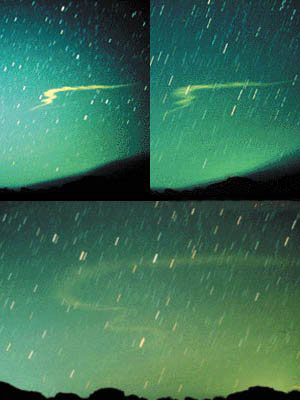 Earth is continually bombarded by meteors. One hundred billion meteors have been estimated to enter the earth's
atmosphere in a 24-hour period. The distribution of meteor is often divided into two classes: Shower meteors and Sporadic
meteors.
Shower meteors are collections of particles all moving at the same velocity in well-defined orbits or streams around the
sun. They are believed to be remnants of comets. When earth's orbit intersects a meteor stream a meteor shower is
observed. The streams intersect the earth's orbit at the same time each year. The paths of shower meteors appear to radiate
from the same point. The constellation in which this point of divergence, or radiant, seems to lie is used in naming the
meteor shower. One of the most well known shower in Northern Hemisphere is the Perseids (refer to Perseus constellation),
which occurs in August of each year.
Sporadic meteors do not have well-defined streams; instead they have random orbital distribution. The majority of orbits
tend to group toward the elliptic plane (the path of earth in its orbit around the sun). Meteors tend to move in the same
direction of that of the earth and the planets.
Meteor arrivals are assumed to be independent of the previous arrivals and to satisfy Poisson statistics.
Earth is continually bombarded by meteors. One hundred billion meteors have been estimated to enter the earth's
atmosphere in a 24-hour period. The distribution of meteor is often divided into two classes: Shower meteors and Sporadic
meteors.
Shower meteors are collections of particles all moving at the same velocity in well-defined orbits or streams around the
sun. They are believed to be remnants of comets. When earth's orbit intersects a meteor stream a meteor shower is
observed. The streams intersect the earth's orbit at the same time each year. The paths of shower meteors appear to radiate
from the same point. The constellation in which this point of divergence, or radiant, seems to lie is used in naming the
meteor shower. One of the most well known shower in Northern Hemisphere is the Perseids (refer to Perseus constellation),
which occurs in August of each year.
Sporadic meteors do not have well-defined streams; instead they have random orbital distribution. The majority of orbits
tend to group toward the elliptic plane (the path of earth in its orbit around the sun). Meteors tend to move in the same
direction of that of the earth and the planets.
Meteor arrivals are assumed to be independent of the previous arrivals and to satisfy Poisson statistics.
What causes a falling star?
A "falling star" or a "shooting star" has nothing at all to do with a star! These amazing streaks of light you can
sometimes see in the night sky are caused by tiny bits of dust and rock called meteoroids falling into the Earth's atmosphere
and burning up. The short-lived trail of light the burning meteoroid produces is called a meteor. Meteors are commonly
called falling stars or shooting stars. If any part of the meteoroid survives burning up and actually hits the Earth, that
remaining bit is then called a meteorite.
At certain times of year, you are likely to see a great number of meteors in the night sky. These events are called meteor showers and they occur when the Earth passes through the trail of debris left by a comet as it orbits the Sun. These showers are given names based on the constellation present in the sky from which they appear to originate. For example, the Leonid Meteor Shower, or Leonids, appear to originate in the constellation Leo. It is important to understand that the meteoroids (and therefore the meteors) do not really originate from the constellations or any of the stars in the constellations, however. They just seem to come from that part of the sky because of the way the Earth encounters the particles moving in the path of the comet's orbit. Associating the shower name with the region of the sky they seem to come from just helps astronomers know where to look!