A Brief History of Bangladesh
Bangladesh, one of the south Asian countries got independence from the colonial occupation of Pakistan in December,1971 by the steel-hard, organized leadership of Sheikh Muzibur Rahman. In 1947, undivided India gave birth two independent countries, Pakistan and India, strengthening by the disputed hypothesis of two nations' theory, which interpreted as two pieces of lands were required for the people with two religions, Hinduism and Islam. Mohandas Karamchand Gandhi (Mahatma) worked hard to transform his dream of undivided India into reality but unfortunately the drama was concluded by his mournful killing as the consequence his efforts did not watch the face of success. Bangladesh broke down her fundamental religious fence and established herself on the pillars of democracy, socialism, nationalism and secularism.
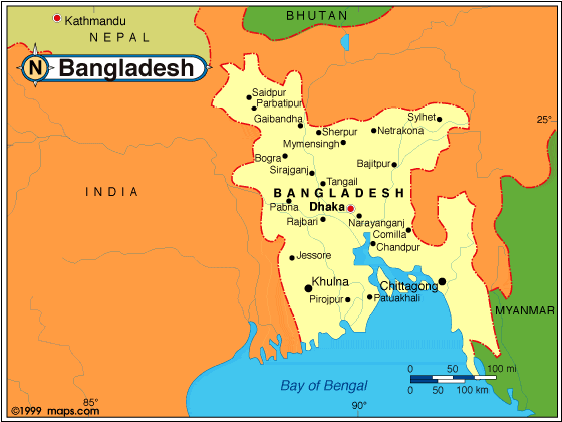
Bangladesh in the World Atlas:
The National Flag of Bangladesh
A blood-red rising sun situated upon a rectangular piece of deep green background, is the feature of the national flag of Bangladesh. The flag is the reflection of her geographical and cultural heritage.

The National Anthem
The national anthem of Bangladesh was written by the Nobel awarded poet Rabindranath Tagore. The anthem expresses the dreams and feelings of Bengali nation.
Listen national anthem of Bangladesh.
Founder of Bangladesh
Sheikh Mujibur Rahman kept fighting against the discrimination of colonial occupation of Pakistan, which was turned into freedom fight. In 7th March, 1971 Sheikh Mujib called the nation for liberation war against organized, armored barbarism and autocracy.
Listen the speech of Mujib exploded for freedom
Infrastructure of Mind and Life-philosophy of Bengali Nation
About 5000 years ago the Dravidian founded the platform of Bengali nationalism. They had organized irrigation system for agriculture. After the fall of this civilization the Arians dominated the society and established a new form of civilization. They had society with different casts and races for different professions. They had religion, guided by the higher cast Brahmins. Hinduism was the main guiding philosophy of Bengali nation for a long time. About 2300 years ago Buddhism came into being with the great call for searching knowledge and wisdom should be the supreme aim of human life. The way of a Buddha life is to synchronize with nature, carry out the teaching of non-violent philosophy and not to be the cause of any type of harm for any other life. In the sects of Hinduism, Buddhism and Jainism a prominent number of sages, saints and scholars were born in the south Asian subcontinent who influenced the Bengali nation to great extent. These great persons had enormous contributions in the different fields of knowledge, such as, philosophy, religion, science, literature and music. Most prominent persons, who have direct or indirect influence to construct the infrastructure of the core of Bengali mind and spirit are- Sri Krishna, Gautam Buddha, Mahavira, Atish Dipankar, Sri Chaitania, Ramakrishna Paramahamsa, Swami Bibekanad, Mohandas Karamchand Gandhi, Sir Jagadish Chandra Basu, Rabindranath Tagore, Nazrul Islam, Lalan Shai, Hason Raza and so on. On the other hand, a large number of muslim sages and saints arrived in south Asian subcontinent with the new mission of peace and harmony. Actually they are muslim in sect but secular in mind; they are mystic, appeared for the salvation of all creatures of the globe; they called the people to watch the internal beauty of sufi philosophy, among them- Mainuddin Chisti, Mozadded Al-Fesani, Nizamuddin, Kutubuddin, Shah Makhdum, Khan Jahan Ali, Shah Jalal, Shah Amanat and so on.
Remembrance
Wherever I stay, the sky, smell of air, music of rivers of this wonderful little land keep glittering on the mirror of my memory. My soul always longs for her presence. Every now and then I feel the spontaneous flow of her heavenly motherhood into my exile heart.

I can not but to remember this magnificent sunset.
