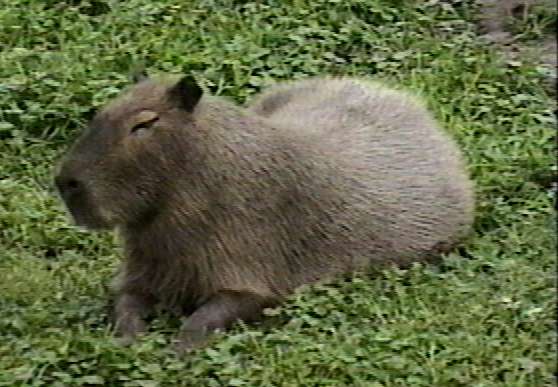
Capybaras can be found in South America east of the Andes. They can be found as far north as Panama and as far south as northeastern Argentina. They are found near heavily vegetated swamps along ponds, lakes, and rivers. The name "Capybara" literally means "master of the grasses" in the language of the Guarani Indians. It is also called the caprincho and water hog. It is the world's largest rodent and can way up to 145 pounds. The front legs and rear legs are different lengths, the front legs being shorter. They have toes that are slightly webbed, the front legs having 4 toes and the back legs having 3. The skin of the Capybara is tough and thinly haired. The colors of the hairs range from brown to red.
These giant rodents are grazers. They selectively eat plants with high protein content, and use their incisors to clip the plant at ground level. They further augment their nutrient intake by having a very efficient digestive system, involving hindgut fermentation and mastication. Capybaras are social animals, living in groups of about 20 animals. These groups consist of a dominant male,
several adult females, and the offspring. The subordinate males can be found at the outer limits of the group. Males that have no family group may live by themselves. Family groups tend to be larger in more arid areas, with several hundred aggregating ground water holes. They are most active during the morning and evening, wallowing in shaded wet areas during the hottest part of the day. They are excellent swimmers, and can swim with their eyes, ears, and nose just above the water's surface. If predators attack it when on land they will run much like a horse and seek shelter in the water. They may then hide among the aquatic vegetation with only their nostrils above the water. Their natural predators are caimans, anacondas, and jaguars. Animals mate in the water just before the start of the rainy season. The gestation period is about 150 days with a litter of about 4 on average. The females give birth on land and the babies are weaned at about 16 weeks. All the females in the family group help take care of the young. Sexual maturity is reached at about 18 months. They may live a life span of 8 to 10 years in the wild. Capybara's communicate to each other by soft whimpers, clicking noises, and an alarm bark. There is also a purring noise to show subordinance.
The Capybara's main threat is over-hunting. They are commercially bred for both meat and leather and the wild populations are also hunted extensively. This over exploitation has caused populations to fall in some countries, but overall the populations have been rather stable. Capybaras tend to thrive on cattle ranches because of the safety from predation, and the grass is burned increasing the quality of the grass. Capybaras are also raised commercially and this has the additional benefit that wetland areas are not drained, but are preserved. The future of the Capybara as a species seems secure and C.I.T.E.S. has no special status for this species. The populations found in the wetlands along the rivers of the Amazon Rainforest though are suffering from the destruction of habitat and increased hunting as roads are being built into the rainforest increasing their accessibility to hunters.