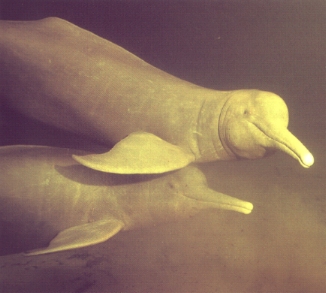
�����This species of freshwater dolphin can be found in the Amazon River Basin in the countries of Brazil, Peru, Bolivia, and Venezuela. They are mainly found in the tea-colored, slow-moving waters (blackwater) of the Amazon Basin. They live in the main river channels during the dry season which is July to November, and move out into the flooded forests during the wet season which is December to June. Some individuals sometimes become trapped during the dry season in stagnant pools but since fish are also trapped, they often survive. This dolphin is called by many names, including Amazon River Dolphin, Boto Vermelho, Bufeo, Tonina, and Pink Dolphin.
�����The Boto is also the largest of all river dolphins. It has a very large melon, slightly curved beak, and bulging cheeks. They have heterodont dentition, with straight, conical teeth in the front and molar-like teeth in the back. The Boto also has stiff hairs on their beaks. Scientists believe that the hair are used as sensory organs which make up for its poor eyesight. All dolphins originally have hair but lose it soon after birth.The coloration of the Boto is unique among ceteceans (whale family). The young are born with a dark gray color. The dolphins though become lighter colored as they age, circulating blood beneath their skin gives them their pink coloration. Botos living in clear water are usually darker than those living in turbid waters. Botos swim more slowly than other dolphins, moving at rates of 1.6 to 3.2 km/hour. Though they have been known to have short bursts of speed at up to 23 km/hour. They are occassionally seen jumping above the surface. Botos rarely dive for longer than 2 minutes at a time. Echolocation is a major tool for finding food and navigating in murky waters for these dolphins. They can change the shape of their melon like a beluga whale, from flat to bulbous. Botos, unlike most dolphins, also can turn their heads at 90 degrees to the side which looks like their "scanning" the river. They can do this because their cervical vertebrae are not fused like other dolphins. They also have the ability to paddle one flipper forward and one backwards at the same time.
�����They feed on a variety of fish, crabs, and river turtles. During the wet season, when prey is scattered, they usually are alone or in pairs. During the dry season though when prey becomes congregated they can be seen in groups of up to 15. The breeding season is in late October and early November. The gestation period is about 8.5 months. Most baby botos are born during the months between June and September.The length of the time that baby botos nurse is unclear. They can see quite well with their small eyes, but can't see downward because of their bulging cheeks. To overcome this, they will simply swim upside down to see what is under them. They are reported to be curious and playful, becoming tame in the wild with humans. They're longevity is about 30 years.
�����The Boto is surrounded by many legends in the Amazon Rainforest. One legend says that the spirit of a drowned person enters
the body of a dolphin, which can change into young men on land. Another legend has it that children born with spina bifida, a
disease in which the skull fails to close during pregnancy, are known as boto's babies. The natives fear that harming the Boto
will cause their children to be born with the disease. The species name was created from a term used by a native Bolivian tribe
"Inia", which is the name they give to these dolphins. Also from a French naturalist, Geoffrey St. Hilaire, who worked for
Napoleon Bonaparte to collect zoological specimens, and he was the first to discover this species.
Unfortunately for these dolphins, the escalating development in the Amazon Basin has increased pressures on these animals.
Small irrigation projects cause the drying up of small lakes and ponds, while hydroelectric dams have disturbed both the Boto
and its prey. Botos are also seen as competition by fishermen and are sometimes killed. The fat being used for lamp oil, and its
eyes and genitilia as love charms. This species also is caught in seine and gill nets like dolphins found in the oceans. Mercury,
used to refine gold along the Amazon River, is being found in high concentrations in the fish the dolphins consume. C.I.T.E.S.
lists this species as threatened. In 1988 the Boto Dolphin was given full protection in the countries of Brazil and Bolivia, and
partially protected in areas of Venezuela, Colombia, and Peru.