Good question.
Shakespeare may not have been a chemist, but he did encorporate chemistry into many of his works. Witches brewed potions, friars talked about the chemical properties of different flora, and people poisoned each other every chance they got. Many of the deaths in Shakespeare's tragedies were due to poisonings. In the Renaissance, even common people knew what was poisonous and what was a remedy, so poisonings were a common way to kill off people you didn't like.
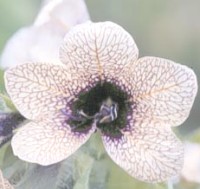
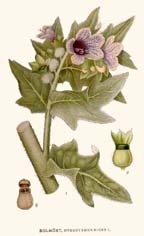
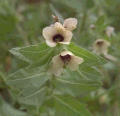
Through much research and lots of frustration I finally found somewhere- (see the bibliography)- that the poison used in Hamlet was called "hebanon". Too bad there was nothing on the internet about "hebanon". All sources told me that "hebanon" is actually henbane. Any witches will know the plant I'm talking about. It looks a little like this:
What does Henbane Look Like?: It's a hairy little thing with white and black/purple flowers. It has purple veins.
Does It Have Any Uses Other Than Death?: Yes. It's only deadly if it is injested, (especially the seeds), in large quantities. It has been used to treat stomach cramp and intestinal crapms, toothaches, whooping cough, ulcers, tomors, scar tissue, and asthema. It has been used in Asian medicine to treat meningitis, scabies, epilepsy. Nervous conditions and eye imflammation are the conditions homeopathic medicine used it for. These are treated with different parts of the plant, and are prepared in many ways. The main similarity is that they all use a very small amount of henbane.
What are the Symptoms of Henbane Poisoning?: If you have taken too much henbane (over 0.5 grams, or 3 grams a day), you should notice your skin turning red, dry mouth, an irregular heartbeat, and enlarged pupils. As it gets worse you'll feel sleepy, then restless, hallucinate, experience hyperactivity, and finally fall asleep. And if you took too much, you'll die. Simple as that.
So, How Does This Stuff Work?: It has sedative-like properties from the tropane alkaloids, namely hyoscyamine and hyoscine.