 |
| Freddy and other members of the Breeder's Committee went to see the Nylands and Pan's Truls (a brown tabby and white kitten) After seeing Truls in the fur, it was soon apparent that Pan's Truls was indeed the cat that they were looking for. Pan's Truls became the "model" cat and a standard of points was formulated. This standard is still in effect today. |
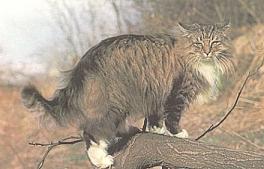
| The Norwegian Forest Cat (NFO) is truly a natural breed, originating from the farms of Norway. Its exact origins will never be precisely established, but one thing is certain, the Forest Cat was produced by Mother Nature. The NFO has been around for centuries. Like a small but beautiful version of the lynx, the Norwegian Forest Cat is part of Norway's fauna. There are many tales about Forest cats to be found in Norwegia folklore. It is even reputed that these cats were the family pets of the Vikings. One of the things I found most fascinting about the Norwegian Forest cat is its history. Norway is a land of rugged mountains, tranquil lakes, wild forests, and glaciers. The winters are loong, harsh and dark. The summers are cool and brief. From this dim, difficult terrain emerged the Norse Skogkatt, literally meaning the Norwegian Forest Cat. Some say the basic type, with all the characteristics unique to the breed, existed as early as 2000 years ago. This cat was long-legged, intelligent, and brave, equipped with a double semi-long coat (a long one would easily be caught in brush and a short one would not offer relief from the constant cold). The top coat was glossy and waterproof and never matted and the inside coat was soft, cotton-like and dense. It insulated the cat well and kept them warm even in freezing temperatures. Their pays were large and heavily furred so that they did not get cold in deep snow, with thick claws used for fishing and climbing. |
| HISTORY |
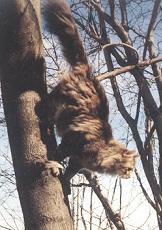
| Forest Cats are famed for running down trees head first! |
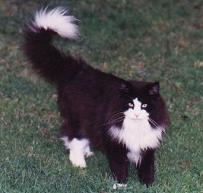 |
| Pan's Polaris - found on many pedigrees and one of the very early NFOs |
 |
| Over the years, there have been many references to Forest Cats. Mention of Forest cats can even be found in a number of folk tales where they are referred to as "Huldrekat" which translates as "Fairy Cat". They are also known as "Eventyrkatten" which means "Fairytale Cat", which is most appropriate as it is in Norwegian Fairytales that many of the first references of Forest Cats can be found. Some tales have described the Cats as "wood" or "forest" cats with thick, bushy tails. Possibly the first documented Forest Cat was a children's book. The Norwegian author Gabriel Scott wrote a book in 1912 entitled "Solvfaks". The Norwegian Forest Cat as we know it today has developed through natural selection, as only the toughest cats wiht the thickest waterproof coat, longest legs, etc. would be able to survive in Norway's harsh climate |
It was not until the 1930's that the Forest Cat were looked at with interest. But, with the outbreak of War, this interest was put on the back burner. In the early 1970's, interest was once again shown in the Forest Cats. By this stage it had become apparent that Forest Cats were facing extinction, and that if they were to be saved from disappearing altogether a specilised breeding programmed had to be developed. In 1975, enthusiastic Norwegian breeders formed the Norsk Skogkattring (the first Norwegian Forest Cat Club). In those early years, many difficulties arose in establishing a breed standard. Carl Frederick Nordane (Freddy) was a driving force in getting the breed recognised. Freddy a member of the specially formed Breeder's Committee) say photographs of a cat called Pans Truls. These photographs made the Breeder's Committee believe that a widely accepted and agreed official standard was achievable. Pans Truls lived with the Nyland family near Oslo. |
| Pan's Truls |
 |
 |