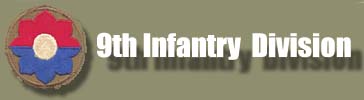
Rebirth of the 9th Division, inactive for more than 20 years after its demobilization in 1919, was on 1 August 1940 at Ft Bragg, NC. The division was planned as an "assault" unit, and received amphibious warfare training in early 1942. They were redesignated the 9th Infantry Division on 1 August 1942. They included the 39th, 47th, 60th Infantry Regiments, the 15th Engineer Combat Battalion and the 9th Medical Battalion.
The 39th Infantry Regiment was the first to ship overseas, departing New York on 26 September 1942. The 39th went first to England to await the North African invasion. The 47th and 60th Infantry Regiments shipped out on 27 October 1942 directly for North Africa.
The Division saw its first action on 8 November 1942, when the 39th Infantry Regiment landing east of Algiers, the 47th at Safi and the 60th at Mehdia. The first of many outstanding achievements was the division artillery’s 100-hour forced march. From Tlemcen, Algeria covering a distance of 777 miles, on slippery, winding roads to the Kasserine Pass at the Tunisian front. Rommel’s thrust was blunted, than stopped cold. The Division Artillery was credited with halting the German advance against American troops, earning the Division’s first, of 19, Distinguished Unit Citations.
The 9th entered combat as a division for the first time on 28 Mar 1943 in southern Tunisia in the El Guettar, where bitter battles were fought for Hills 290, 369 and 772. On 11 April the division moved northward and attacked in the Sedjenane sector, enveloping the Green-Bald Hill positions. Djebel Dardys, Mrata and Cheniti were other triumphs on the way to Bizerte. Finally entering that city on 8 May 1943.
The 9th then embarked for Sicily. Outside the Palermo Harbor on 1 August ’43 the 9th’s third birthday, the transports were under a two-hour aerial attack. The 9th suffered no losses. The 39th Regiment led the assault on Tronia. They advanced east, to occupy Randazzo, key point in the enemy’s last line before Massina. The Division stayed until 20 August when it was announced, officially that Sicily was free of the enemy.
About this time The Stars and Stripes hailed the 9th for "the kind of leadership and spirit that make a fighting outfit". The 9th was then withdrawn to England, departing the Mediterranean Theater on 25 November 1943, to begin preparations for Normandy.
The Division entered the Normandy campaign across Utah beach on 10 June 1944 (D+4), with the 39th being temporally attached to the 4th ID. During this period, the 39th cleared the beaches from Taret de Ravenoville to the Montebourg-Quineville ridgeline. Which had been used by the Germans to shell the Utah beach area. The Division was first committed to action on 14 June, in an attack toward St. Colombe. The 9th then on 16 June, reinforced with 1 regiment from the 90th Infantry Division, attacked to establish a bridgehead across the Douve. Along with elements of the 82nd Airborne Division, the 9th secured jumpoff points along Douve. On 17-18 June, reaching the West Coast of Cotentin peninsula, the 9th cut off all German retreat to the south. The 9th began its drive to Cherborg, attacking the main fortification belt. On 26 June the 47th and 60th regiments broke off to clean up Cap de la Hague, securing it quickly and ending the fight to secure the peninsula.
The 9th arrived in the Taute sector, south of Caretan, on 9 July 1944. On 11 July the German Panzer Lehr Division, in the Le Desert sector hit the 9th. Advancing slowly against determined resistance, the Division reached the Periers-St Lo road on 18 July, after sustaining very high casualties.
At one point the 82nd Airborne was too spent to exploit an attack. The 9th moved into the positions and pushed 13 miles in two days, to be the first Allied force to liberate the Belgian town of Momignies.
The 9th began its attack on Hitler’s Deutschland on 14 September 1944. The 47th was the first Allied unit to completely breach the Siegfried Line. The 39th and the 60th meantime drove into the Hurtgen Forest. The Americans troops came to refer to the Hurtgen as the "Death Factory" continuing for 3 long months. On 6 October the 39th and the 60th Infantry Regiments began their first attacks on Schmidt. By 16 October the advance was halted, at Germeter, with a gain of but 3,000 yards, at a total cost of 4,500 men.
When the German Ardennes Offensive struck, on 16 December, the battle was a bitter one for the 9th. The Division first repulsed a German attack in this area aimed at expanding the base of the "Bulge". It held a defensive sector from Kalterherberg in the Hurtgen to Elsenborn in the Ardennes through out January 1945.
After house to house fighting through several small towns the 47th seized Wollselfen.
The 9th was the first to establish a bridgehead east of the Rhine after crossing the Remagen. In helping close the Ruhr pocket, the 9th withstood a savage attempt to break out, then moved in to mop up.
The 9th Division was with the 9th Army in north central Europe when V-E Day was announced. The division’s fifth birthday, 1 August 1945, found just about all of the veterans gone. They had participated in 8 campaigns, spent 304 days in combat, and suffered over 22,000 casualties and 4,581 deaths. These men who wore the 9th’s Division Octofoil must never be forgotten.
The 39th Infantry Regiment was organized at Camp Syracuse, New York on 1 June 1917 by transfer of veteran troops from the 30th Infantry Regiment. In December, the 39th was assigned to the 4th Infantry Division and in the spring of 1918, sailed for France as part of the American Expeditionary Force in World War I. The regiment fought with such valor and distinction during this war that it earned its famous nickname "Fighting Falcons".
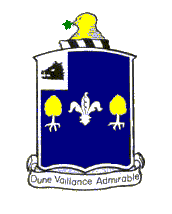
During the lull between wars, the regimental crest was designed and approved. Each of the devices in the crest holds significant meaning for the regiment. The shield is blue for infantry. The fleur-de-lis is from the coat of arms of Soissons, a town in France recaptured by the 39th Regiment in 1918. The two trees represent the Groves of Cresnes, the sight of the regiment's first military success in France during World War I. The boar's head on the canton is taken from the crest of the 30th Infantry Regiment and indicates the 39th was organized with personnel from the 30th Infantry Regiment. The crest is a falcon's head, for Mount Faucon in Muesse-Argonne. The falcon holds, in its bill, an ivy leaf, from the shoulder sleeve insignia of the 4th Infantry Division to which the regiment was assigned during World War I. The motto "D'une Vaillance Admirable" is a quotation from the French citation which awarded the Croix De Guerre with Gilt Star to the regiment for its distinguished service in World War I. The motto best translates - "With a Military Courage Worthy of Admiration".
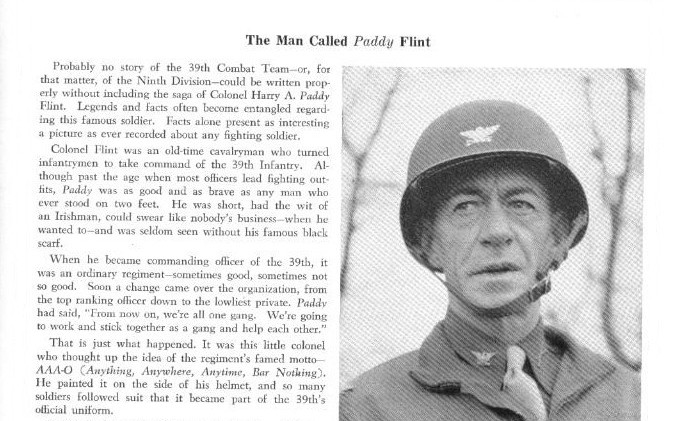
During World War II the regiment fought as part of the 9th Infantry Division. The Fighting Falcons of the 39th became the first unit of United States combat troops to set foot on foreign soil when they stormed the beaches of Algiers in November 1942. During fighting in Sicily, Italy, the regiment came under the command of the legendary Colonel Harry A. "Paddy" Flint who gave the regiment its triple A- Bar Nothing slogan …Anything, Anywhere, Anytime - Bar Nothing. The regiment took great pride in the AAA-O slogan, displaying it on their helmets and vehicles, even in combat. When questioned about the soundness of the practice, Colonel Flint confidently declared, "The enemy who sees our regiment in combat, if they live through the battle, will know to run the next time they see us coming." Later in the war, the 39th landed at Utah Beach and fought through France. The Fighting Falcons joined the 47th Infantry Regiment in capturing Roetgen, the first German town to fall in World War II. The 39th fought valiantly through the Battle of the Bulge, helped secure the Remagen bridgehead and roared across Germany as the allied forces finished off the last of the German resistance. When the dust settled following VE day, the 39th Regiment held campaign streamers from some of the bloodiest and most hard fought battles of the war - Algeria, Tunisia, Sicily, Normandy, Northern France, The Rhineland, Ardennes-Alsace, and Central Europe. It was cited twice by the Belgians for valorous actions and awarded the Belgian Fourageré. It also received two French Croix de Guerre with Palm, the French Fourageré, and three Presidential Unit Citations.