(back)
 (Home)
Software Cost Estimation
The purpose of software cost estimation is to predict the total development effort required to produce
a given piece of software in terms of manpower and duration.
Select one of the method:
 | |
| |
| |
|
I.
Basic COCOMO Model
It is a static single-valued model that computes software development effort ( and cost ) as a
function of program size in estimated lines of code.
· Carpark Management System project is an organic mode project delivering about 2000 lines of
code.
Estimated
Effort, E
= ab(KLOC)bb
=
2 x 2.51.05
= 5 person-months, where KLOC is estimated number of delivered lines of
code for the project (expressed in thousand);
coefficients ab = 2.4, bb = 1.05 since the project is in the
organic mode.
Estimated
Development Time, D
= cb(E)db
=
2.5 x 5 0.38
= 4.61 months , where coefficients cb = 2.5 bb, db = 0.38
since
the project is in the organic mode.
Estimated Productivity, P = LOC / E
= 2000/5
= 400 lines of code
per person-months
Estimated Average Staffing, AS =
E / D
= 5/4.61
= 1.1 FSP where, AS is a measure of the equivalent number of
people working on this project at a given time. Unit for Average
Staffing is
FSP (Full-time-equivalent Software Personnel)
Back to Top Back to Top
It is an extension of the Basic COCOMO Model to compute software development effort as a function of
program size and a set of "cost drivers" that include subjective assessment of product, hardware,
personnel, and project attributes.
· Carpark Management System project is an organic mode project delivering about 2000 lines of
code that nominal. The programming language experience is consider low that required to produce
a high software reliability with the database size is rated low.
Estimated Effort Adjustment Factor, EAF
= 1.00 (nominal) x 1.07 (programming language experience) x 1.15 (required
software reliablity) x 0.88 (database size)
= 1.08
Estimated Effort, E
= ai(KLOC)bi
x EAF
= 3.2 x 21.05 x 1.08
= 7 person-months
Since the development time, D, is calculated from the Intermediate COCOMO Model estimates
of effort but using the Basic COCOMO Model equations,
Estimated
Development Time, D
= cb(E)db
=
2.5 x 7 0.38
= 5.24 months, where
coefficients
cb = 2.5 bb, db
= 0.38 since the project is in the organic mode
Estimated Productivity, P = LOC / E
= 2000/7
= 286 lines of code
per person-months
Estimated Average Staffing, AS =
E / D
= 7/5.24
= 1.3 FSP where, AS is a measure of the equivalent number of people
working on this project at a given time. Unit for Average Staffing is
FSP (Full-time-equivalent Software Personnel)
III.
Advanced COCOMO Model ( COCOMO II Model)
It incorporate all characteristics of the intermediate version with an assessment of the cost driver's
impact on each life of the software engineering approach. We recommend the Post-Architecture Model
here because it is the most detailed estimated model. The effort is expressed the amount of time one
person spends working on the software development project for one month (PM).
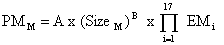
B =
1.01 + 0.01 ∑ SFj
where:
A = constant, Provisionally set to 2.5,
B = scale factor that accounts for relative economies or diseconomies of scale encountered for
software projects of different sizes. Since our project is small(2KLOC) , the economies and
diseconomies of scale are in balance. Thus, set
Scale Factors (SFj)
:
I.
Precedentedness (PREC) = Nominal 2.43
II.
Development Flexibility (FLEX) = Nominal 3.64
III.
Architecture/Risk Resolution (RESL) = Nominal
2.53
IV.
Team cohesion (TEAM) = Nominal 2.97
V.
Process Maturity (PMAT) = Nominal 2.73
Cost Driver (EMi) :
I.
RELY (Required Software Reliability) = High
1.15
II.
DATA
(Database Size) = Low 0.93
III.
CPLX (Product
Complexity) = Nominal 1.00
IV.
RUSE (Required Reusability) = Nominal 1.00
V.
DOCU (Document to match lifecycle needs) = Nominal 1.00
VI.
TIME (Execution Time Constraint) = Nominal
1.00
VII.
STOR (Main Storage
Constraint) = Nominal 1.00
VIII.
PVOL (Platform Volatility) = Low 0.87
IX.
ACAP (Analyst Capability) = High 0.83
X.
PCAP (Programmer Capability) = High 0.87
XI.
PCON (Personnel Continuity) = Nominal 1.00
XII.
AEXP (Applications Experience) = Very Low 1.22
XIII.
PEXP (Platform Experience) = Low 1.12
XIV.
LTEX (Language and Tool Experience) = Nominal
1.00
XV.
TOOL (Use of Software Tools) = Nominal 1.00
XVI.
SITE (Multi-site
operation) = Very Low 1.25
XVII.
SCED (Required Development Schedule) = Low
1.10
Emi = EAF = RELY x DATA x CPLX x RUSE x DOCU x TIME x STOR x PVOL ACAP x PCAP
x PCON x AEXP x PEXP x LTEX x TOOLx SITE x SCED
= 1.26
B = 1.01 + 0.01 (PREC x
FLEX x RESL x TEAM x PMAT)
= 1.01 + 0.01
(2.43+3.64+2.53+2.97+2.73)
= 1.15
Estimated Effort, PMM
= 2.5 x 21.15x 1.26
= 7 person-months
Estimated Development Time =
 ,
where TDEV is the time to develop
,
where TDEV is the time to develop
with an estimated effort PM,
A = 3 (Constant)
= 3 x 7 0.33+0.2(1.15-1.01) x 0.85
= 5.39 months
(All
calculation with Values at COCOMO II.1997)
Back to Top
Function points attempt to quantify the functionality of a software system. It characterizes the
complexity of the software system and thus can be used to forecast how long it will take to develop
the
system and how many people will be needed.
· Our Vehicle Parking System project will have 20 simple, 10 average and 3 complex user inputs.
There are 10 simple, 4 average and 4 complex user outputs. There are 20 simple and 4 average
user requires.
Also, there are 1 database file and 1
external interface of average complexity.
Each factor on a scale of 0 to 5 is rated as below:
0 1 2 3 4 5
|-------------------|-----------------|-----------------|-----------------|------------------|No Incidental Moderate Average Significant Essential
Influence
Factor:
1.
Does the system require
reliable backup and recovery?
---------------- 4
2.
Are data communications
required?--------------------------------------------
5
3.
Are there distributed
processing functions?
-------------------------------- 0
4.
Is performance critical?
------------------------------------------------------------- 4
5.
Will the system run in an
existing, heavily utilized operational
Environment?
-------------------------------------------------------------------------
4
6. Does the system
require on-line data entry? ------------------------------- 0
7.
Does the on-line data
entry require the input transaction to be built
Over multiple screens or operations?
---------------------------------------- 0
8. Are the master file
updated on-line?
----------------------------------------- 0
9. Are the inputs,
outputs, files, or inquires complex?
-------------------- 3
10. Is the internal
processing complex?
------------------------------------------- 0
11.
Is the code designed to be reusable?
----------------------------------------
3
12. Are conversion and
installation included in the design?
------------- 3
13.
Is the system designed for
multiple installations in different
Organizations?
--------------------------------------------------------------------
0
14.
Is the application
designed to facilitate change and ease of
Use by the user?
-------------------------------------------------------------------
5
Degree of Influence, DI
DI = 4+5+4+4+3+3+5 = 31
Technical Complexity Factor, TCF
TCF = 0.65+0.01xDI
Estimated Function Points, FP
Estimated Function Points
, FP
= UFP x TCF
= (20x3 +10x4 +3x 6+ 10x4 +
4x5 + 4x7 + 20x3 + 4x4 +1x7 + 1x10) x 0.96
= (60+40+18+40+20+28+60+16+7+10)
x 0.96
= 287.4
Once function points have been calculated, they are used in a manner analogous to LOC as a measure of
software
productivity, quality, and other attributes:
Estimated Productivity
Estimated Productivity = FP /
person-months
= 287.4/7
= 41.06
(All calculation with reference to Values at COCOMO II.1997, Table II-3)