Maurice Collis
Philapolis index
Maurice Collis
Cortes and Montezuma
The convergence of Cortes and Montezuma is the most emblematic
event in the birth of what would come to be called "America." Landing on
the Mexican coast on Good Friday, 1519, Hernan Cortes felt himself the
bearer of a divine burden to conquer and convert the first advanced civilization
Europeans had yet encountered in the West. For Montezuma, leader of the
Mexicans, April 21, 1519 (known in their sophisticated astronomical system
as 9 Wind Day) was the precise date of a dire prophesy: the return of Quetzalcoatl,
a fearsome god predicted to arrive by ship, from the East, with light skin,
a black beard,
robed in black exactly as Cortes would.
http://www.wwnorton.com/nd/fall99/Collis.html
Montezuma II (or Moctezuma) was trained as a priest and
rose to become
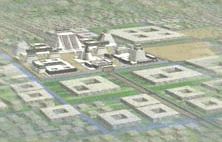
leader of the Aztecs in 1502. At the time the Aztecs
controlled most of
what is now Mexico and Central America, their capital
being at the great
city of Tenotchitlan (Mexico City). The story goes that
when Cortes arrived
in 1519, Montezuma thought the Spanish conquerors were
descendants of
the god Quetzalcoatl. Montezuma allowed the Spaniards
to enter
Tenotchitlan unopposed, and he was captured and held
hostage by Cortes.
Montezuma was either killed by a rock in the head from
a crowd of his own
people, or he was stabbed by the Spaniards, depending
on who tells the
story.

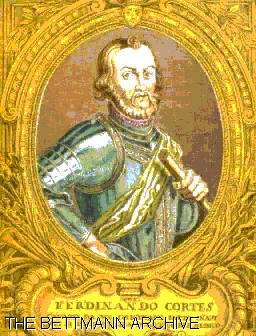
Hernando Cortes was born in the village of Medellin in
Entremedura, Spain, in 1485. At the age of 14,
he left home to study law at the University of Salamanca
and returned home two years later. He
wandered the seaports of Cadiz, Palos, Sanlucar, an d
Seville and in 1504 joined an expedition of five
ships that sailed for Santo Domingo in the New World.
Cortes wanted to become a conquistador (a
conqueror as well as an explorer) for Spain.