

There are nine types of scientific probes carried in a starship's standard complement. They are typically used to supplement a starships sensors, and perform remote tasks that are too dangerous for to send personnel into, or for which personnel cannot be spared to do.
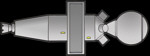
Class Two
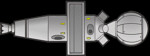
Class Two probes are equipped with a full EM/subspace and interstellar chemistry pallet for in-space applications. It is based on Class 1. In addition, Class 2 has enhanced long-range particle and field detectors and imaging system.
Class Three
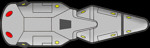
Class Three probes are planetary probes, with a full range of terrestrial soft landing to subsurface penetrator missions. Gas giant atmosphere missions are survivable up to 450bar pressure.
Class Four
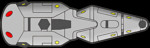
Class Four probes are stellar encounter probes, modified from Class 3. These probes are equipped with triply redundant stellar fields and particle detectors and a stellar atmosphere analysis suite. There are six ejectable/survivable radiation flux subprobes, deployable for nonstellar energy phenomena.
Class Five
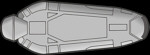
Class Five probes are medium-range reconnaissance probes, with extended passive data-gathering and recording systems. These probes have a full autonomous mission execution and return system and is capable of atmosphere entry and soft landing. They is coated for low observability and may be modified for tactical missions with a custom sensor countermeasure package.
Class Six
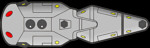
Class Six probes are comm relays and emergency beacons, modified from Class 3. They provide 9270 RF and subspace channels, with a 360� antenna coverage and 0.0001 arc-second high-gain antenna pointing resolution. These probes feature an extended deuterium supply for transceiver power generation and planetary orbit plane changes.
Class Seven
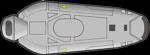
Class Seven probes are remote culture study probes, modfied from Class 5. They are applicable to civilizations up to level III and have low observability coatings and hull materials. The maximum loiter time is 3.5 months. A low-impact molecular destruct package is tied to antitamper detectors.
Class Eight
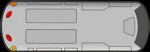
Class Eight probes use a modified photon torpedo casing. They are equipped with a standard sensor pallet and mission-specific modules. Their applications vary from galactic particles and fields research to early-warning reconnaissance missions.
Class Nine
Class Nine probes use a modified photon torpedo casing. They are equipped with a standard sensor pallet and mission-specific modules. Their typical application is an emergency log/message capsule on homing trajectory to the nearest starbase or known Starfleet vessel position.