 |
| Giselle |
| Composer: Adolphe Adam / Giselle Choeography: Helgi Tomasson Asst. to Tomasson: Lola de Avila Senic, costume, lighting: Mikael Melbye Asst. lighting: Lisa J. Pinkham Source Page |
 |
|
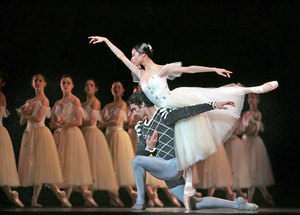
| Yuan Yuan Tan dances the title rose in the San Francisco Ballet's "Giselle," while Pierre-Fran�ois Vilanoba plays Albrecht who betrays her love. Chronicle photo by Christina Koci Hernandez |
 |
| Tomasson was wise in waiting to stage Giselle until his 13th season, after delivering Swan Lake and Sleeping Beauty; it remains the subtlest of the surviving full-length ballet classics, the one whose fragrance is the hardest to distill and the easiest to lose. / 1999 Review |
| SIDE NOTE: "Freud and the Ballet"
Most conductors think "Giselle" is a piece of fluff. But MTT thinks it is a masterpiece. Although the ballet score's sentimentality is hard for us to accept today, the work marks the very beginning of art looking at internal, emotional explanations of behavior. Art has always predicted the future; in this case, music predicted Sigmund Freud. MTT interviews former prima ballerina Natalia Makarova, the greatest Giselle of our time, about dancing the "heart on the sleeve" role/ Source |
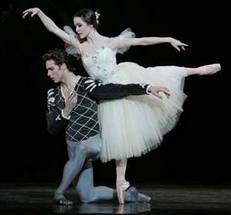 |
| Tina LeBlanc and Gonzalo Garcia in Tomasson's Giselle. Photo by Erik Tomasson. |
| Isadora Duncan Dance Awards 2007-2008 Season
Outstanding Achievement in Performance - Individual Maria Kochetkova as Giselle in �Giselle� New at SFB in 2008 Maria Kochetkova in Giselle |
| 1947 �Following World War II, the company supported assumed the title San Francisco Civic Ballet Association. In 1947 "Giselle" is staged, but insolvency the following year forced dissolution of the Association and the enterprise became known as San Francisco Ballet. Lew Christensen, the third brother, started commuting between New York City and San Francisco in 1949, and in 1951 he shared co-directorship with Willam. 1996 �When San Francisco Ballet accumulated a sizeable deficit, Chris Hellman, assuming the Chair Directorship in 1992, made it her business not only to reduce the deficit but also mount a campaign roughly titled "Preserve our Jewel", an endowment campaign of some $8 million dollars co-chaired by her husband F. Warren Hellman. Hellman, English-born and a one-time soloist with Festival Ballet, brought great distinction to her task. As a retiring gift to the company, she and her husband underwrote Tomasson's 1999 production of "Giselle," and the story goes the Hellmans bought the opening night house for the San Francisco Ballet and School staff, artistic directors of San Francisco's major companies and the press./ History |
| SFB's new production, staged by artistic director Helgi Tomasson, must be one of the most elegantly ornate versions of the ballet anywhere. First seen April 8 (1999) at the War Memorial Opera House, it is said to have a price tag of $800,000. This sumptuous production--from its minutely staged acting to its carefully detailed sets, costumes, and lighting by Danish designer Mikael Melbye--enables this Giselle to set a new benchmark for dedicated elaboration....his present production basically follows the version that stems from Marius Petipa's 1884 production in St. Petersburg of the 1841 original--staged in the Western world for the Diaghilev Ballet and by Anna Pavlova's company--or from the productions of Petipa's last regisseur, Nicholas Sergeyev.
Tomasson's staging has two major innovations--apart from ghost Wilis in the second act who actually fly, a neat touch redolent of the age of the Romantic Ballet, and as I recall not used since the Royal Ballet attempted it in 1946. Tomasson makes the so-called Burgmuller Peasant Pas de Deux (it is to music by Friedrich Burgmuller but was interpolated for the Paris premiere) in the first act into a pas de cinq for three women and two men; toward the end of that act he introduces a full-scale pas de deux (an adagio and two variations, but no coda) for the doomed Giselle and her faithless lover, Albrecht. Although I am assured that the music for this duet was discovered by San Francisco conductor Emil de Cou in a Paris Opera version of the score dated 1854--and it sounds authentically in keeping with the original Adolphe Adam music--to my knowledge it has only been staged in this century in productions by Mary Skeaping and Alicia Alonso. Just as did the making of that Peasant Pas de Deux into a quintet, this new duet for Giselle and Albrecht adds to the dancing possibilities--especially for Albrecht, who normally has little to dance until the second act. On the debit side, while stylishly choreographed and pleasant, it holds up the ballet's action. Other stagings have made that Peasant Pas de Deux into a pas de quatre, notably Peter Wright's various versions for Britain's Royal Ballet. Here, Tomasson, has given each of the male dancers a solo, and has inserted a solo (to a Burgmuller piano piece called "Shepherd's Return," orchestrated by de Cou) for one of the three women. Interestingly, in view of Tomasson's opening up of cuts in the score, he decided not to include the fugue in Act II ...not nowadays customarily ...Tomasson's staging was carefully considered, showing coherent and expressive dramatic detailing, and the mime, often nontraditional in its realism, has rarely been better realized. / Review |
| ...The joyous peasant pas de cinq in the first act, devised by Tomasson to showcase more dancers than the traditional peasant pas de deux, featured dynamic performances from corps member ./ 2005 Review |
 |
 |
| This site and all related sites are for entertainment and reserch and contains information that anyone
can get by using a search engine, such as Google./ This site is a sub-site of SF ART World // Creative Commons Attribution-Noncommercial-No Derivative Works 3.0 License. |
| 1999 (6), 2000 (3), 2002 (8), 2005 (3), 2008 (3) |
|
|