 |
| Duo Concertant |
| Composer: Stravinsky Music: Duo Concertant Choreography: George Balanchine Lighting Designer: Ronald Bates |
 |
|
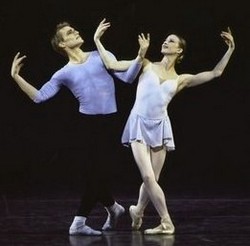
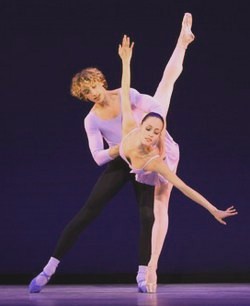
| Stravinsky composed Duo Concertant for piano and violin in 1931-2. It was not until after his death in 1971 that George Balanchine decided to make a ballet to it. This pas de deux subtly showcased the work of Alina Cojocaru partnered by Johan Kobborg.The dancers listen to the music and then gradually and gently start to move, music and dance becoming united./ Review In "Duo Concertant," Balanchine poses a question regarding the relative primacy of music or dance, � la Strauss's "Capriccio" (Strauss was concerned with the competing claims of words and music). The ballet begins with the two dancers leaning against the onstage piano, listening to the pianist and a violinst, and the dancers don't perform until the first movement..."Duo Concertant" concludes with a darkened stage, the dancers partially illuminated by spotlights. Watching the ballet's final section, one imagines Balanchine recalling experimental cabaret performances in St. Petersburg or Paris during the 1920s./ Review |
| The performance was brilliant, an attenuated pas de deux that seems, as interpretated by Ms. Kistler and Mr. Hubbe, a gentle romance. Lighting design (original design by Ronald Bates) overwhelms the final movement and changes the ballet experience strikingly. Early in the movement the stage goes dark. The dancers are spotlighted so that first only Miss Kistler's face, then her arm, then his and her joined hands, and then their hands slipping from one another are spotlighted and they become isolated. The ballet and its denouement, carry an unexpectedly strong emotional impact. At other performances, this ballet has seemed less satisfying and the lighting changes more intrusion than technique. The magic of this ballet is very fragile./ Review |
| Balanchine�s 1972 miniature essay on love and loss, Duo Concertant, became a heart-stopping thing; Clarinade, the master�s 1964 response to a clarinet-and-jazz-band piece, rose from ballet oblivion to an alarmingly saucy sexiness.
Not enough attention has been paid in the dance world to the stager of a ballet, to the final �eye� that calibrates performers, lighting, conducting, tempi; that is, to what Diaghilev did. With the same steps and costumes, one can throw a ballet indifferently onstage, or put it on lovingly. |
 |
 |
| This site and all related sites are for entertainment and reserch and contains information that anyone
can get by using a search engine, such as Google./ This site is a sub-site of SF ART World // Creative Commons Attribution-Noncommercial-No Derivative Works 3.0 License. |