From The Irish Setter Quarterly - Winter 1984-85
High Tails
Starting Your Training Program- Jeannie Wagner Wellington, Ohio
RECENTLY I was questioned why and how I came up with the title for this column. I searched for a long time to come up with a suitable title that would infer a dog on point but yet would not restrict my thoughts strictly to field dogs. I actually came up with the title after teasing a friend about the high tail her dog carried while in the show ring. This particular dog has never seen a game bird and is now a finished champion. The term "high" is relative and does not necessarily mean or endorse the 12 o'clock tail that is preferred by some trialers. As far as I'm concerned, a high tail means anything from level (as the standard calls for) on up.
If you are new to trialing you will find that the dog's tail in relation to his style on point is an ever ongoing controversy. This controversy will never have a solution as long as there are people with differing opinions.
The tail of a pointing dog is of great importance and something that a novice should be aware of. The higher a dog holds his tail, while on point, makes it easier to see him in the cover. This is why so many advocate the 12 o'clock tail. It doesn't take too many mistakes in handling or training to cause a dog with adequate style to lose everything and become down-tailed, possibly start blinking birds, or become soft on point.
In starting your training program, keep in mind the Irish Setter is a very intelligent animal, but like his Gordon cousin, he matures very slowly in both mind and body. Care must be taken not to push him too fast at a young age. Something else to keep in mind is that he never forgets. Be thorough in your training and try to prevent him from learning bad habits. Once he has learned a lesson he will never forget them whether they were good ones or bad ones. Bad habits are extremely hard to correct and are better prevented.
The best age that I have found to start formal field training is between the ages of 10 to 12 months old. Before this time, while your puppy is growing up, let him enjoy his puppyhood. Start teaching him all the things a good family dog should know; his name, to come when called, fetching a ball or stick (especially if you wish to have him retrieve birds), housebreak him, and teach him to walk on a lead. Most of all, let him enjoy being a puppy! Take him for casual walks in the country and let him run in the open fields on his own. Let him investigate new sights, sounds and smells. Encourage him without putting any pressure on him. If he should happen to find a bird and bump it out, let him chase and enjoy.
If you intend to also show your pup in conformation, the training you do for the ring can be beneficial. To use this training as an asset for field training, you can introduce the field command "whoa" in the place of "stay" while teaching the dog to stand still while stacking. This will later be utilized when teaching the dog to stand still on the starting line and to stay steady on his birds.
If you are also an obedience buff, do go easy on the obedience training. Don't push sitting on heel position until after you have your dog solidly pointing his birds. On the stand stay exercise, you can utilize the whoa command in the same manner that we did for the conformation training. If your goal is a three-way dog, be sure not to confuse your pup by trying to do too much too soon. Keep your training times for conformation, obedience and field separated until the dog is competent enough to understand the differences. I've found it useful to use different types of collars for each event. I use a plain buckle collar for field, a metal choker for obedience, and a martingale lead for conformation. The dog soon learns that different collars are associated with different commands.
Whether you are starting a puppy or an older dog for VC work, all training must start at the beginning and gradually proceed forward. You will need the following equipment: a buckle collar, a whistle, a22 blank pistol, a 15-20 foot check cord, a stake-out chain, and a good supply of pigeons.
ARMED with this equipment and your eager trainee, you are now ready to begin. It is always helpful, when possible, to train with an experienced handler and dog. The advantages of running a young or inexperienced dog with an experienced one are great. The older dog already knows where and how to hunt the cover. He will also pick up the whistle commands in the same manner. When you must train alone, you should encourage the dog everytime he does the right thing by praising him with your voice. Discourage undesirable action, such as checking back too often, in the same way. He will soon learn what you want him to do.
Exercise and conditioning nowbecome an important part of your training program. A pup should be run about 15-20 minutes and no longer. Short periods of conditioning everyday will do more for your pup than running him for an hour once or twice a week. You have to gradually build up muscles and lung capacity so that when he is a mature dog he will be able to run the 30 minute heats required of a gundog.
Your field dog is an athlete and must be conditioned as one. It is very important not to over-tire him or let him become bored. You want him always running at his optimum. Be sure while exercising your dog to keep him in front of you. Discourage any attempts he may make to circle around behind him. Also strongly discourage checking back. Any time he turns to come back to you, use your whistle to push him on. Be sure to praise him when he is out front working independently. If you are lucky enough to live in an area that has wild game birds, the contact he may make with this game will help encourage him to stay out front and hunt.
If you have never used a whistle, it is not hard to learn what to do. You will utilize the whistle while you are running the dog. Every handler has his own set of whistle commands, so there are no set rules to follow. Basically the whistle is used to get the dog's attention or to release him from a whoa command. Use the whistle to teach the dog to come in when called, to change direction or to push him on ahead. I personally use a long blast to release the dog from the line, two short tweets to push him on ahead, and a series of long tweets to turn him or call him in.
All pointing dogs must have some "yard training." The pointing instinct is natural but it must be nurtured and refined. After you are done exercising put your dog on the stake-out chain where he can watch you. Find an area likely cover and plant your pigeon. We use pigeons for yard training because they are inexpensive and easier to use than game birds.
To plant your bird you must first dizzy him so that he will stay where you put him. First tuck his head under his wing and then gently swing him in a circular motion. It takes a little practice to get this procedure down pat. Now plant the bird in a spot that you can remember and easily find again. It is very important to know where the bird is when working with a young dog. Be sure not to bury the bird under the grass so deep that it will be hard for the dog to catch scent, but also be sure that he cannot easily see it. You want him to find and point the bird by scent and not by sight. It is best to make him use his nose right away and not get used to sight pointing.
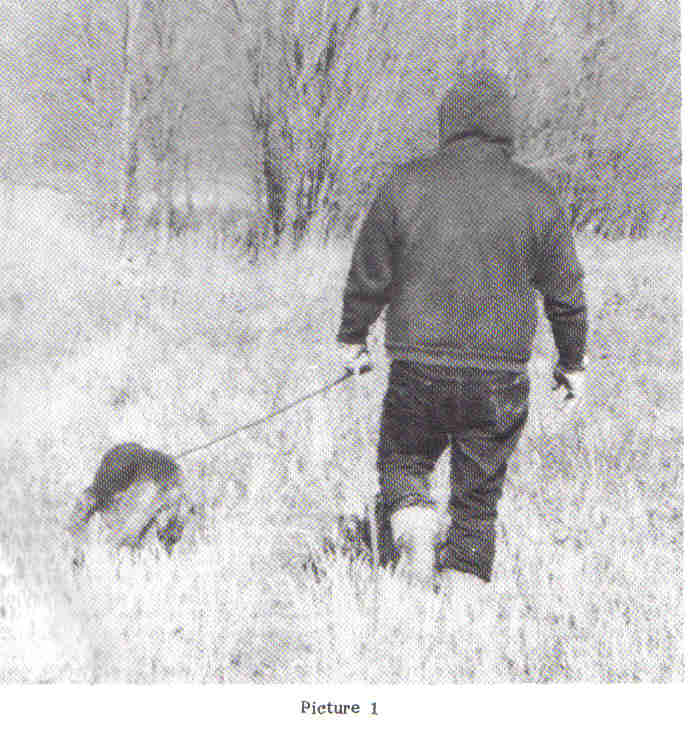
Go back now and put your puppy on the check cord. Determine which way the wind is blowing and then take your pup down the field and circle around until you are facing directly into the windward side of where you planted the bird. (Picture 1)
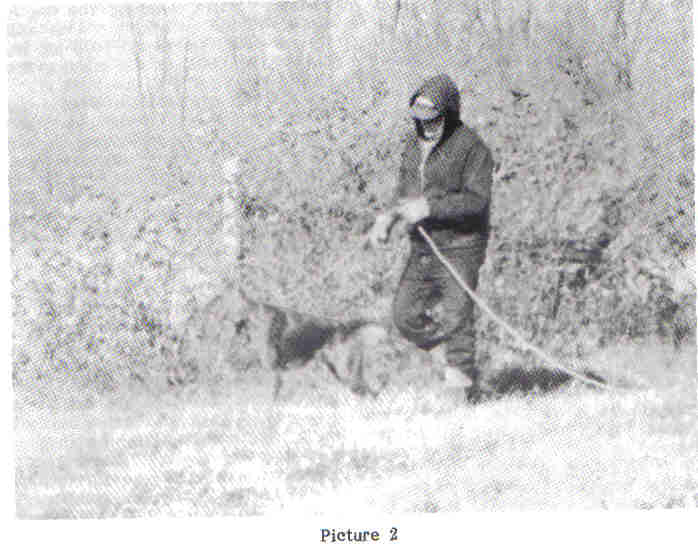
Now bring your dog directly into the area that you planted the bird in. As soon as he begins to indicate the presence of game, be ready to stop him if he does not stop and point on his own. Do not let him charge in on the bird or catch it on the ground without having first stopped and pointed. (Picture 2)
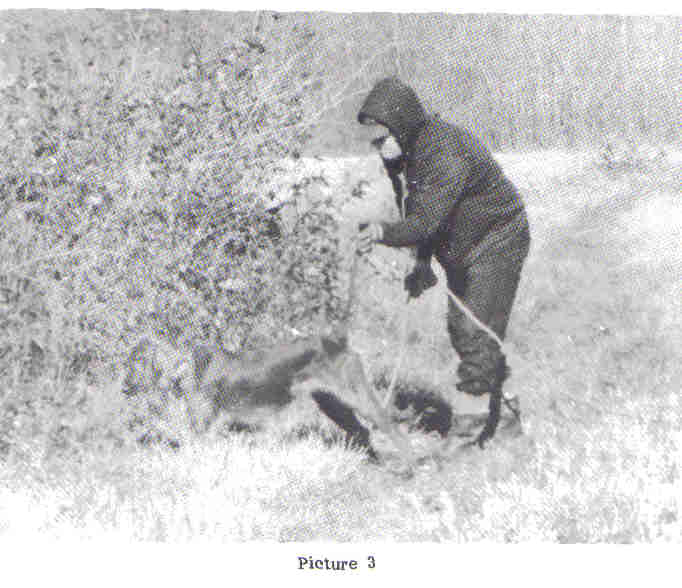
Once he has established a point, gently stroke his tail in an upward motion and push forward slightly. This action will intensify his stance and give him confidence that he is doing it right. During this time do not talk to the dog or nag him with "whoa" commands. This will only serve to break his concentration and confuse him. (Picture 3)
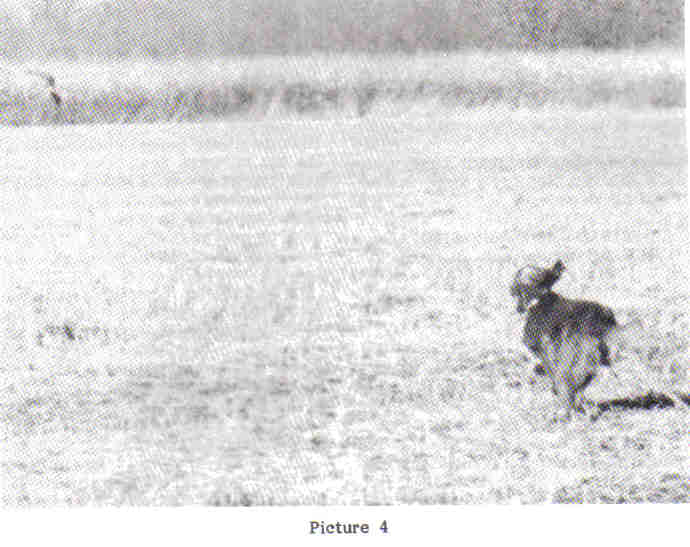
Do not make him stand on point for too long. Restrain him and then flush the bird out and let him chase. While he is happily chasing the bird, fire your blank gun. By doing this he will soon associate the gun shot with the pleasure of chasing the bird and will not be afraid of the loud bang. (Picture 4)
Do not plant more than two birds a training session when working with a puppy. One of the hardest lessons for a novice to learn is to know when to quit. Once your dog is pointing it is inevitable that you to see him do it over and over again. DON'T DO IT! Too many birds will cause the young dog to start hunting too much and he will not want to run. He may also, if marginal on ability, become bored and quit pointing, or he may lose some of his intensity on point. You want to do everything possible to encourage optimum performance in short but regular training sessions. Remember, this is a baby that you are working with. You don't expect your kindergartener to do high school work, so don't expect a pup to be a gundog. Let him enjoy being a puppy. More stringent training will come when he moves up into derby at 15 months old. It is very important to take one step at a time. If you are working with an older dog just starting out, he must be treated the same as if he were a pup. Begin at the beginning and gradually move up. This is why it is so important to start your field training while the dog is still a puppy. You lose too much time if you wait until the dog is older.
Next time: derby training. Models in the pictures for this article were my 12 month old puppy, Teddy, and trainer, Jim Basham.
Until next time, happy hunting.
Note: Jeanne Wagner (Karrycourt) co-bred and co-owned Dual Ch. AFC Karrycourt's Rose O'Cidermill ROM
(From The Irish Setter Quarterly - Winter 1984-85)