april, 1996
irish setter club of america, inc. memo to members
Structural Engineering of the Dog's Leg
How you can pick a puppy who won't have-joint problems?
It's a heartache when you buy a dog, and two years later it has to be put down because he has a crippling genetic disease. But it doesn't have to be. A little knowledge on the parts of the buyer and the breeder can help eliminate the problems of hip dysplasia and stifle injuries.
The stifle joint is the canine equivalent of the human's knee, but in the rear legs. A breeder who cares about her dogs will consider not just the animals' pedigree and temperament but also their genetic history. Dogs to be bred should be free of skeletal deformities and lameness. This is typically referred to as "soundness."
The structure of the animals to be bred can not be over-emphasized. It is a critical factor in breeding sound and healthy dogs. A reputable breeder will take the time to analyze an animal's structural components. A sensible buyer can also learn some easy tips for analyzing the structural health of a dog. The simplest methods for analyzing the dog's structure measuring bone lengths and joint angles with a plumb line.
We have all had or known dogs which had hip dysplasia or other hind end lameness problems.
Many of these dogs were bred as "livestock," with little consideration given to the health and welfare of the dog.
The primary role of the dog's skeleton is to provide a rigid structure which can withstand and transmit the forces and loads involved in movement and play. Bones adjust to handle normal forces and loads. Soft tissues such as ligaments cannot make that adjustment. When the load becomes too great, ligaments are strained, torn or ruptured.
Here's an example. You have a 1/2 ton pickup truck and a one ton pickup. You can put 2000 pounds in the bed of a one ton pickup and the vehicle can handle the load without stressing the structure of the vehicle or other mechanical parts because it was designed to handle a 2000 pound load. Put that same 2000 pounds in the bed of a 1/2 ton pickup, and it will work fine for a short time. Eventually, though, the vehicle, which was designed to only handle a 1000 pound load, will break down because the structure of the vehicle and the mechanical parts are over-stressed. You'd have to put your 1/2 ton pickup to sleep.
Skeletal structures are inherited, and each breed of dog has a slightly different skeletal configuration. Just compare a Basset Hound to a Great Dane!
Skeletal structures of the different breeds are designed to handle different functions. For example, Bassets, Corgis and Dachshunds have a similar structure -long on body, short on legs, which enabless them to go to ground after vermin. Whippets and Greyhounds are designed for running.
The structure of the animal determines the efficiency in which loads can be handled and distributed over the frame. For example, if the bones of the hind leg are incorrectly positioned, more of the load is distributed to the soft tissues than in a leg that is structurally correct. Injury can occur. This holds true for all breeds of dogs.
Length, size, shape and positioning (angulation) of the bones are influenced by genetic make-up of the dog's parents. Growth and muscle tone are more influenced by environmental factors such as good nutrition and exercise. The dog's physical activity determines how much load is placed upon his skeletal frame, while the distribution of the load over the frame is determined by the length and angle of the bones themselves. Here's an example. A structurally correct pelvis (croup) will show a 30 degree angle when viewed from the side.
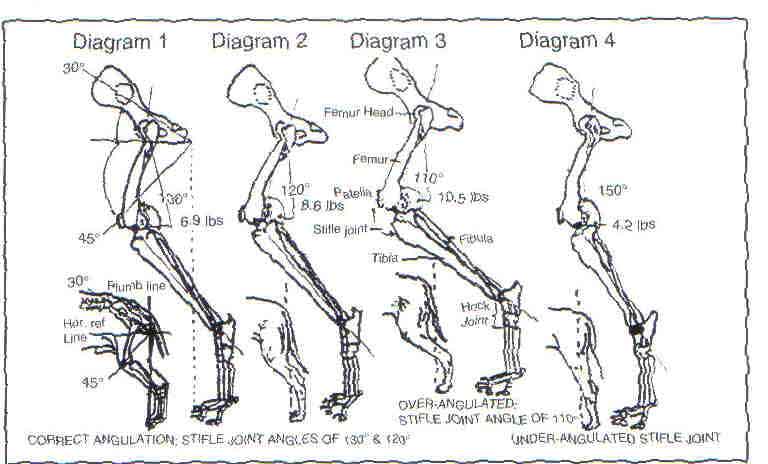
To measure the angle, first draw an imaginary horizontal reference line running form the point of the shoulder back to the dog's buttocks. At the buttocks, look to see the angle at which the pelvis lies relative to the horizontal line. (See diagram 1).
The ideal situation is 30 degrees off the horizontal. A dog showing a 40 degree pelvis angle (a steep croup) is structurally inferior. This is because this steep angle will interfere with the action of the hind leg. It will also cause the load to be distributed to non-weight-bearing structures-ligaments and tendons.
Let's now take a look at the anatomy of the hind leg.
The hip joint is a ball and socket-type joint. The round head (ball) of the femur (thigh) fits into the hip socket (acetabulum) of the hip bone.
The femur moves in several ways. To understand this, look at your own legs. First, sit down and put your feet flat on the floor. Spread your legs apart. That's called abduction. Close your legs up tight - that's adduction. Bend your leg - that's flexion. Straighten it - that's extension. Rotation and circumduction are other movements of the femur and involve moving the leg in circles.
What influences the movement of the femur? Its length, its angle relative to the hip bone, and the muscles of the rear. The croup muscles help hold the femur head in alignment with the hip.
There are also three round ligaments which attach the head of the femur to the hip socket. During locomotion the femur wants to rotate. The three strong hip ligaments limit the femur's movement and keep the femur in the correct position.
Both the muscles of the rear and the ligaments help the leg absorb and transmit loads during movement
The Stifle Joint
The stifle joint is the second joint in the hind leg. It has the same basic functions and movements as the human knee.
Two ligaments are located within the stifle joint: the anterior and posterior cruciates. These give stability to the joint
as they connect the femur to the tibia. They cross each other like the letter "X". They also prevent extreme movement between the femur and tibia. When the leg is extended and bearing weight, the cruciate ligaments are taut and most vulnerable to injury.
Flexion and extension are the primary movements of the stifle joint. During extension, the femur rotates slightly inward and the load upon the tibia shifts forward.
During flexion, when the leg is bent, the femur rotates slightly outward. This relieves the tension on the cruciate ligaments. And because the ligaments are relaxed, injuries are less likely to occur.
Examples
If you look at the diagrams, you'll see how forces act upon the joints. (These are first order approximations, based on a 60 pound dog.)
Diagrams, 1, 2 and 4 all show a dog whose femur and tibia lengths are the same. Diagram 3 is a dog who is over-angulated - like the German Shepherds you see in the show ring, it has a steep croup, 40 degree pelvis angle, and femur shorter than the tibia.
The bones in diagrams 1 and 2 are sound, stable structures. The leg correctly transmits the load from the foot to the hip because the bones are of equal lengths.
During extension, when this leg is bearing weight, the tibia and femur are almost in a straight line. This allows the load to be transmitted from the foot directly through the femur head into the hip socket.
In diagram 3, the dog has a shorter femur, longer tibia and shorter cruciate ligaments. The differing bone lengths and shorter ligaments cause the leg to be bent 20 degrees more in the at-rest position. Because the femur meets the tibia at such a severe angle, the stifle joint will now absorb a 45% greater load than the stifle joint in diagram 1.
During extension, when the leg is bearing weight, the load cannot be transmitted equally through the bones of the hind leg to the hip. Because the two bones are not equal in length, the application and direction of the load change. The directional change in the load causes almost half of the load to be absorbed by the stifle joint and the cruciate
ligaments. These ligaments will eventually wear out and become strained, torn or ruptured. Only surgery can correct the resulting lameness.
Hip problems also result from a shorter femur and longer tibia. As the direction and application of the load changes, more movement of the femur head in the hip socket takes place. This increased joint movement stresses the three round ligaments of the hip, which in turns increases the joint movement further. Eventually the round head of the femur loses its shape and wobbles within the hip socket. This is one of the causes of hip dysplasia.
Diagram 4 represents a dog with a very straight hind leg (under-angulated). This leg is not prone to cruciate injuries because there are less forces acting upon the stifle joint. However, because the leg is straight, the kneecap moves abnormally. This is referred to as upward fixation of the patella.
Summary
What we have tried to show you is the importance of a structurally sound hind limb. How the structures are built and how they bear weight can predispose a dog to ligament and soft tissue injuries. Unequal bone length is probably the most overlooked structural deformity in the breeding - or buying - of dogs.
When the femur and tibia are not of equal length, the cruciate ligaments and the three round ligaments of the hip are in danger of injury. This is very important to keep in mind when you are considering breeding or buying a dog.
Whether you are looking at a puppy or a mature dog, you can use a simple piece of string to measure the bone lengths and a protractor of judging joint angles. If you really want to get fancy, ask your family doctor to give you a goniometer - a classy name for a protractor made for measuring joint angles and the range of movement of a limb.
Look at the diagrams and the plumb lines we drew. These will help show you where to place your string to measure the lengths of the tibia and femur, as well as the angulation of the hind limb. Your vet can also help you determine where each bone begins and ends and how to measure the joint angles.
Once you literally have a feel for the bone structure, you can start taking measurements. A good rule of thumb is to be concerned if there is more than a 10% variation between the length of the femur and of the tibia. Stifle angle below 115 degrees or above 135 degrees should be avoided.
A good, sound dog will give you a lifetime of fun, with plenty of romping and playing - and no unnecessary heartache.
Copyright 1992 Nan Weitzman, THE SERIOUS BREEDER, GENETICS, Reprinted from The Serious Breeder™ column in Good Dog! magazine.
(Originally printed in the April 1996 issue of the ISCA Memo to Members - Permission to reprint granted by the Editor of the ISCA Memo to Members)