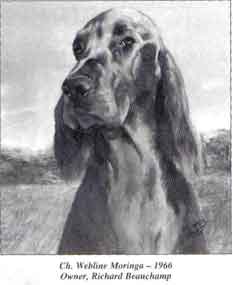
 Breed Type...... (What Does It Include?)
Breed Type...... (What Does It Include?)
by Rick Beauchamp
North Hollywood, California
The danger in writing about judging and what the judge struggles to find in the breeds he judges is that one is dealing with ideals. What the breed should have. What the judge should do. After the judge once commits his belief to the printed word there is an underlying expectation on the part of the exhibitor that the judge will then always make every entry he passes upon come out "right."
In some entries, there is no "right." This is not to say anything goes however, but the judge can only choose from what stands before him on the day. No matter how committed a judge is to type, soundness, showmanship or a combination of all three, there are some classes in which there is very little quality and a great deal of mediocrity. Then too, there are those breeds in which fault of one kind or another becomes so prevalent it becomes accepted by the average exhibitor as the norm -something that comes with the territory.
There are those among our judges who have experienced how things once were in a breed and are reluctant to let the status quo suffice. For them, "That's how all the dogs are now" is no valid excuse. On the other hand, the newer exhibitor may have only experienced a breed in its present state. To the latter, the absence of qualities that were once considered an intrinsic component of breed type may then not constitute as grievous a fault.
What then should be done? Should the judge whose experience is steeped in the tradition of the breed simply ignore the now commonly accepted fault or faults or should he insist that his winners conform to what is actually correct in the breed? The former offends a good judge's sense of ethics and integrity. The latter offends the exhibitor who has become accustomed to winning with a dog its serious flaws notwithstanding. The dilemma weighs heavily on a conscientious judge.
Deciding whether the fault is one of type or of general soundness helps some judges resolve this dilemma. It should, however, be understood that in some breeds sound construction and movement are a part of breed type. This is particularly so of the Irish Setter whose construction represents the ideal in free and tireless ground-covering movement.
Can you have a worthy Irish Setter without correct sporting dog construction and the movement it permits? I think not. It is paramount to the essence of the breed.
And what do I mean by essence? The bottom line, the basics-those qualities that give a breed a distinctive place among all breeds. Not just those things that make a breed attractive, but the things which explain the breed's reason for being.
I find the Irish Setter among the most attractive breeds being shown today. The breed's beauty is legendary. But do we honor the integrity of the breed if we ignore the fact that first and foremost this is a sporting dog and therefore governed by distinct anatomical rules which govern all members of that group?
Have we forgotten what makes this breed a sporting dog and are thereby putting our emphasis on those qualities that make it simply a creature of beauty? This is not to say the Irish Setter's beauty is of no consequence. To the contrary. However, many of us see a part of the Irish Setter's beauty in the perfection of its construction, the balance of its parts-in the stamina and endurance its correct make and shape afford.
What I am proposing is greater awareness that a basic part of Irish Setter type is in its sporting dog heritage. We must include that heritage in how we determine what constitutes the essence of the breed.
How does this heritage affect the essence of the Irish Setter? Let's take a few steps back in time and see.
Sporting dogs were created to accompany their owners (or their own friends for that matter) out into the field assist these people in bringing in game. It should be easy to see that first and foremost these dogs had to be amiable and tractable. They had to "hang around" whoever it was that they were working for and not dash and gobble up every bird in sight.
Early on there were hounds aplenty available for the huntsman but once hounds got the scent they were prepared to chase the prey to the ends of the earth or until they had an opportunity to kill it. This was fine for some game but when it came to fowl, hounds having no wings proved to be little value.
Sporting dogs on the other hand were developed to search for game all day need be and to do so within reasonable proximity of the hunter. Their job-simply find the game and let the hunter know where it was. Game once found, certain members of these sporting dogs would crouch down (set) in front of the birds until the hunter could rush up and throw a net over the birds. Later nets were replaced guns, but the Setter's job remain basically the same. All this is elementary to students of the Irish Setter but it important to be reminded of the breed background because it took a particular kind of dog to do this work and the Irish Setter proved beyond a shadow of a doubt it was capable of doing it.
Certainly it can be seen here that well balanced ground-covering construction would have to be a hallmark of this wide ranging, tireless hunter. The Irishman not only worked in the fields of his homeland but also in the bogs and marshlands. The breed's legs, musculature and balance gave it the ability to do so. Would these characteristics be any less a part of the Irish Setter's essence than its red coat?
You simply can not have a top class Irish Setter without this distinctive construction. It is every bit as much a part of breed type as the beautiful head and expression we all cherish in the breed. The Irishman's make and shape would be entirely inappropriate for the Dachshund or the Bulldog would it not? It belongs to the Irish Setter therefore it is a part of breed type.
I think the average Irish Setter owner recognizes the silhouette the properly constructed Irish Setter must take. If not, there is no better way to learn it than the marvelous Irish Setter Illustrated Standard produced by the Irish Setter Club of America. I will not take the time or space to reiterate here what has been so marvelously done in that publication.
Nor will I waste your time describing rearquarter angulation. It should be fairly obvious that Irish Setter breeders know what it is and how to get it. More often than not you will find plenty (as in too much) of it in the average showdog. What seems not to be understood is how important proper balance of front and rear construction is to correct type, form and function.
Breeding for correct fronts-those which balance well made rears has been neglected for so long there are many, breeders and judges included, who have had scant opportunity to see this construction in the flesh. Somewhere along the way, fronts have simply become that part of the anatomy that helps produce those abruptly sloping toplines that have came into vogue.
Accompanying this article is a drawing of the Irish Setter (reprinted from The Irish Setter Illustrated Standard with the permission of the Irish Setter Club of America). Note the length and layback of the shoulder blade (scapula). Particularly note the length of the upper arm and how its angulation places the elbow directly under the highest point of the withers.
It is the relative length and placement of these bones which creates the ideal Irish Setter front. This portion of the anatomy should be clearly understood by every person who breeds, exhibits or judges the breed. Note the same relativity and angulation of the bones (femur, tibia and fibula) in the rearquarter. They correspond to what one finds in the correct Irish Setter front.
Without this construction at both ends, the Irishman will not be able to perform in the manner which the standard of the breed dictates. Would you not consider this an important part of what the breed is? Certainly it would have to be given as much consideration as color, expression and amount of coat?
I find little to admire in the generic showdog-the dog which succeeds simply on its soundness and attitude. On the other hand I truly believe there is nothing more beautiful than the Irish Setter which combines these same qualities with what is right for the breed and at the same time upholds the tradition of true sporting dog quality.
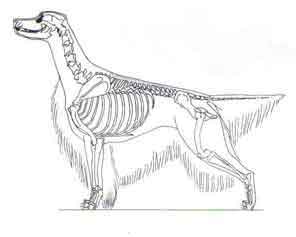
In this skeletal drawing you can see the correct proportions of front and rear, length to height. Bear in mind that the standard clearly states that overall balance is rated more important than size alone. However, because the Irish Setter was bred for endurance in the field, dogs measuring more than an inch over or under the ideal height are not correct.
|
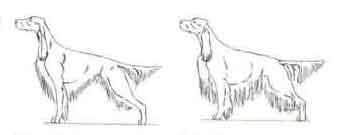
| The first dog is
underdone and weedy. Note the extreme tuck-up and
lack of substance in body and leg bones. The second dog is overdone, somewhat coarse and cloddy without elegance. |
(Originally printed in the April 1996 issue of the ISCA Memo to Members - Permission to reprint granted by the Editor of the ISCA Memo to Members)