 |
|
|
|
|
|
|
|
|
|
|
|
|
|
|
|
|
|
|
|
|
|
|
Seth Coleman |
|
|
|
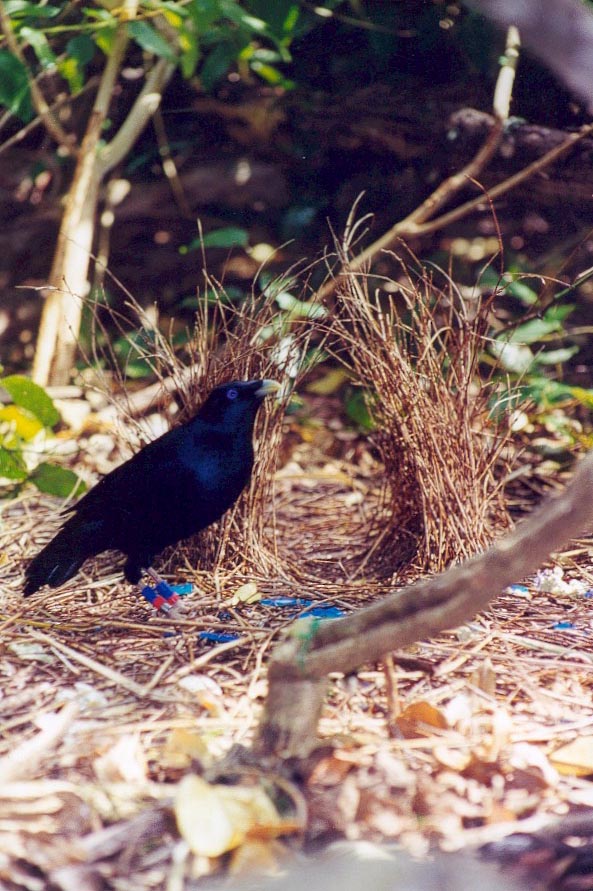
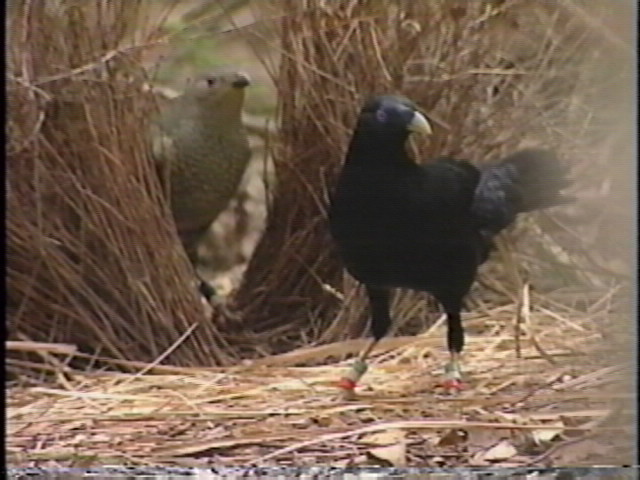
Dissertation. My research on satin bowerbirds (Ptilonorhynchus violaceus) focuses on two general issues in sexual selection: (1) the underestimation of the complexity of female mate choice, and (2) the paucity of information regarding the ontogeny of complex sexual displays. Resolving these issues is critical to understanding evolution by sexual selection, yet neither issue has received much scientific attention. Male satin bowerbirds build specialized stick structures--bowers--where courtship and copulation take place (Fig. 1, 2). Males decorate the area in front of the bower with various objects collected from the environment (Fig. 1). These objects include blue feathers and flowers, yellow flowers and leaves, snake skins, insect body parts, and various brightly colored artificial objects. When a female arrives, the male begins an elaborate courtship consisting of multiple dancing elements coordinated with various vocalizations including interspecific vocal mimicry (Fig. 2). Female satin bowerbirds have complex mate searching patterns involving numerous courtships with different males before each female chooses a single male as a mate. Females use long-term memory and prior mating experience in making subsequent mating decisions. So far, I have found that young and old females use different male display traits in mate choice, that females with different levels of mating experience proceed through mate choice in very different ways, and that young male satin bowerbirds use display trait 'tutors' and refine their displays over many years prior to being assessed as potential mates. |
|
|
|
|
Behavior, Ecology, Evolution, and
Systematics Program
Department of Biology
University of Maryland |
|
|
|
|
|
 |
|
|
|
|
|
|
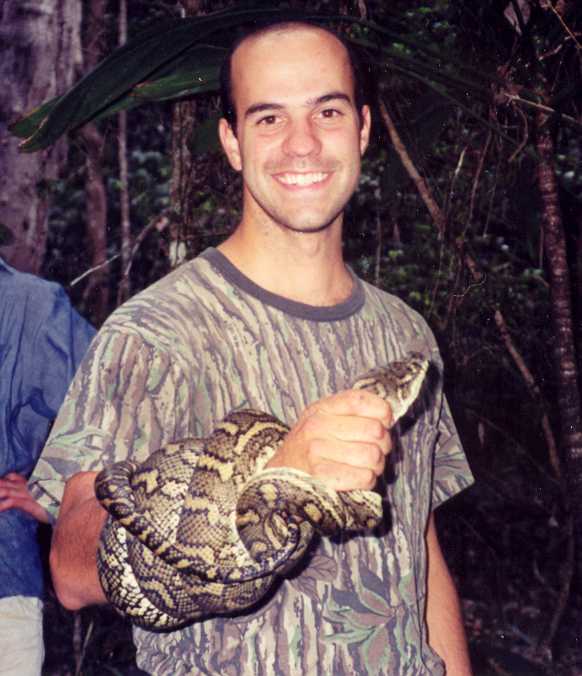
Wallaby Creek. I conduct research at Wallaby Creek in Northern New South Wales, Australia. My advisor, Dr. Gerald Borgia has studied satins at WC for more than 20 years. WC has abundant wildlife including: Eastern grey kangaroos, 6 species of wallaby, padamelons, koala bears, dingos, echidna, 5 of the top 20 most venemous snakes and lots of non-venemous constrictors (I am holding (harassing?!) a carpet python in the picture above), many frogs, lizards, and insects, and over 220 bird species.
The field season runs from September through December. During Sept-Oct, we band as many birds as possible so that we can identify each individual in the population (notice the bands on the male's legs in Fig. 1). The satin's mating season is Nov-Dec, so during this time we closely monitor all behavior at bowers. We record all courtships and copulations as well as bower destruction and decoration stealing.
The field season is rigorous (no electricity or running water, work 6.5 days a week, 11-hour days, ticks and land leeches galore (yes, LAND leeches)), but if you are interested in being a volunteer field assistant, please contact Dr. Borgia ([email protected]).
|
|
|
|
 |
|
|
|
|
|
Fig. 1. An adult male satin bowerbird standing on his bower platform. |
|
|
|
|
|
For more information on bowerbirds,
becoming a field assistant, or the research
going on in the Borgia Lab, please visit the Borgia Lab website: |
|
 |
|
|
|
|
http://www.wam.umd.edu/%7EBorgia/Bower.html |
|
|
|
|
|
|
Fig. 2. The female stands inside the bower while the male displays on the bower platform. |
|