| |
 |
Padma-asana

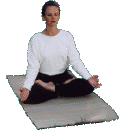
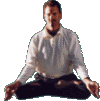
 |
|
|
Posture: |
|
Padma-asana - The Lotus
Posture |
|
|
|
"Place the right foot on the left thigh and the left foot
on the right thigh...with the soles upward, and place the hands on
the thighs, with the palms upwards...This is called
Padma-asana, the destroyer of all diseases. It is difficult
of attainment by everybody, but can be learned by intelligent
people in this world.
 |
| The Lotus Posture
(Padma-asana) Instruction: |
|
|
 |
|
Sit on the floor with the legs stretched out
straight in front.
|
|
|
 |
|
Bend the right knee and grasp the right foot with
both hands and place it on top of the left thigh bringing the
heel as close to the navel as possible.
|
|
|
 |
|
Bend the left knee and grasp the left foot with
both hands and place it on top of the right thigh bringing the
heel as close to the navel as possible.
|
|
|
 |
|
TBoth knees should be on the ground and the soles
of the feet are pointed upward. The spine is held straight but
not rigid.
|
|
|
 |
|
The position of the legs may be switched after a
period of time if the posture becomes uncomfortable.
|
|
|
| Comments: |
|
|
When sitting in the
padma-asana the hands should be placed in one of the
following three positions:
Place one hand on top of the other, both palms up, and rest
the hands on the heels (this is known as the dhyana-mudra).
This variation is recommended for meditation.
Place the hands on the knees, palms down.
With palms up, place the hands on the knees, form a circle
with the thumb and forefinger and extend the remaining fingers
straight ahead (this is known as the chin-mudra).
Recommended for pranayama (Yogic breathing).
The padma-asana facilitates relaxation,
concentration and ultimately, meditation. The posture creates a
natural balance throughout the body/mind. When the knees are
stretched enough to remain in the padma-asana without
discomfort the posture creates a feeling of effortlessness and
ease that will soothe the nervous system, quiet the mind and bring
about the condition of one-pointedness.
|
|
|
Durations/Repetitions: |
|
|
The length of time to sit in the
padma-asana depends on your intention. In the course of a
typical asana routine you might hold it for several minutes
or until you experience discomfort in the legs. When used as a
meditation posture you hold it for the duration of the meditation.
| |
|