| 1.Bleeding from nose, ear or throat. This implies basilar skull 2.fractures and calls for proper medical attention. |
| 3.Drowsiness or deepening of the coma. 4.Vomiting 5.Convulsion |
While dealing with such cases, the following should be adhered to:
| 1.Wash your hands first. Wear disposable gloves and press a clean pad / gauze firmly and evenly over the wound to control bleeding. Bandage the head to keep pad in place. |
| 2.Check the patient's conscious level, heart rate & respiratory rate. |
| 3.Look for ENT (ear, nose or throat) bleed. |
| 4.Ask for nausea, vomiting, dizziness and headache. These, if present, means a bad sign and points towards an intracranial complication. (as mentioned previously). |
| 5.Always suspect associated neck injury and be careful during the transport of the victim from the site of injury to the hospital. |
Neck Injury
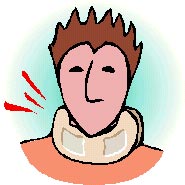 In poly
trauma, neck injury should always be suspected. When it is present, shifting
or turning the patient can be dangerous. This is so because in attempting to
move the patient, the fractured parts of the neck bones (cervical vertebrae)
may move or displace and in the process injure the adjacent spinal cord. A
quadreparesis may ensue and a hemi section of the spinal cord may progress
to a complete transection. In cases of neck injury, the following measures
should be remembered:
In poly
trauma, neck injury should always be suspected. When it is present, shifting
or turning the patient can be dangerous. This is so because in attempting to
move the patient, the fractured parts of the neck bones (cervical vertebrae)
may move or displace and in the process injure the adjacent spinal cord. A
quadreparesis may ensue and a hemi section of the spinal cord may progress
to a complete transection. In cases of neck injury, the following measures
should be remembered:
 |
Do not move patient. Minimal handling is the rule. |
|
|
If CPR is required, support neck & move the patient as a whole. Head, neck & spine should be aligned. Use jaw thrusts for positioning head for CPR. |
|
|
Before transport, use bandages to support neck & head. |
|
|
Urgent orthopedic or neurosurgery opinion is required. |
Sprains
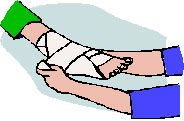 Sprain is an
injury to the ligaments or tissues around a joint. There is pain, swelling,
discoloration of the part and deformity. There may be associated chip
fractures and these should be specifically looked for.
Sprain is an
injury to the ligaments or tissues around a joint. There is pain, swelling,
discoloration of the part and deformity. There may be associated chip
fractures and these should be specifically looked for. When there is a sprain, the following should be done:
|
|
It is vital
to give rest to the part. Immobilize the joint with crepe bandage. This
will take care of the swelling as well as the pain.
|
|
|
Ice application may be useful. |
|
|
Keeping the
limb elevated also aids in early decrease of the edema.
|
|
|
For ankle
sprains that are common, a figure of '8' bandage gives a lot of relief.
|
Dislocation of Joint
In this, there is displacement of the bone from the joint. The victim has
severe pain and inability to move the affected limb. There may be an obvious
deformity. The most common joints to dislocate are the shoulder, elbow, thumb
and the jaw.
The victim should be reassured. Some mild analgesics can be provided to
diminish the felt pain. The limb should be supported in the most comfortable
position. Bandages and slings may be used for the purpose. Shift the patient
to the hospital. Do not try to relocate the dislocated joint as it may further
aggravate the dislocation.
Muscle
strain
In this, the muscle is overstretched and torn. There is severe local pain and
swelling. The part is painful during movements.
The part affected should be immobilized and elevated. Place it in the most
comfortable position. Ice can be applied. If in doubt, consider an associated
fracture. Shift to hospital immediately.
Muscle
Cramps
These are due to faulty use of the muscles. Excessive loss of salt in the
sweat and vomiting and loose motions could also lead to cramps. There is
severe pain and the victim cannot move the affected part. The contracted
muscles fail to contract.
| 1.The patient should be reassured. |
| 2.Analgesics should be given. |
| 3.The part should be supported and massaged. |