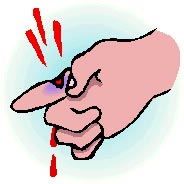
 Bleeding is the
flow of blood from a blood vessel. Bleeding is distressing and if severe, it
could lead to shock. Loss of around 30 % of the adult patient's blood (around
1.5 liters) could prove fatal. Hence it is important to halt bleeding
immediately.
Bleeding is the
flow of blood from a blood vessel. Bleeding is distressing and if severe, it
could lead to shock. Loss of around 30 % of the adult patient's blood (around
1.5 liters) could prove fatal. Hence it is important to halt bleeding
immediately.
The bleeding may be external as from a wound or open fracture. This is obvious
loss of blood. It may be internal as in spleen rupture, intracranial
collection. This is not seen externally, but suspicion of such a bleed is very
important. In fact, if a person with injury has weak peripheral pulses, an
internal bleed should be immediately thought of.
The site of bleeding is also important. If it is arterial, it is bright red in
color and spurts. It also reveals the pulsating flow. Venous flow is slow
flowing and dark red in color. The capillary bleeds are just oozes and the
flow is slow and even.
It is important for the rescuer to know that attempts to halt the bleeding
immediately are of utmost importance. At the same time, wound, if present,
should be handled with clean hands to minimize the infection. When blood loss
continues, medical help is required.
General measures to be adopted are
Place the patient
in a comfortable position. Elevate the leg end in order to increase the venous
drainage to the heart. This will help decrease the shock. Wash hands and wear
disposable sterile gloves. Place sterile gauze, clean cloth or pad over the
wound and press firmly for at least 10 minutes. Apply firm dressing over the
area.
If bleeding
continues, apply pressure on a main artery abovesite of bleeding with your
fingertips. Watch out for shock. Covering him/her with blankets should
decrease the patient's body heat loss. Maintain the airway patency.
Some doctors
advocate application of ice over the bleedingwound. It causes vasoconstriction
and hence less bleeding. But it also decreases the formation of the clot.
Specific treatment:
If the bleeding is
minor and external, rinse it under free flowing water. Apply pressure over the
wound with sterile gauze or pad. Put an adhesive antiseptic dressing. If there
is a major external bleeding, apply direct pressure
with sterile pads.
If it is gaping, bring the two ends together before application of pressure
over the wound. Remember to remove any foreign body. Immobilize the part.
Reassure the patient. Loosen the clothes. A tourniquet may be
used to control severe bleeds from major arteries in the limbs.
If available -
give 1 )ing.Styptochrome 1 amp. 2) ing.Botrapase 1 amp. or ing.Reptilase
1 amp. 3) ing.Dicynine 1 amp. Repeat the injections every 3-4 hrs until you
consult a doctor.
If the bleeding is
internal, keep the victim in a head lowposition. Reassure. Loosen the
clothing. Warm blankets to cover the victim. Immobilize the part and elevate
the limbs. Give cardio-respiratory resuscitation if required. Transport to the
hospital immediately. DO NOT FEED THE PATIENT LEST ANESTHESIA IS NEEDED.
======================================================================================
Send your
Medical Problems for Free Advise & Treatment
Feed Back
Sign Guestbook
 View Guestbook
=======================================================================================