Shortly after
Aaron and Russell were taken into custody, Emiliano Morales and Jeremy Herrera
were put on the drug AZT. After his fight with Aaron McKinney, Emiliano had gone
to the hospital, where he required 21 staples to repair his cut skull. The
doctor explained to him that Matthew Shepard had been H.I.V.-positive and that
because Emiliano had had blood contact with the gun, which had been covered in
Matthew's blood, there was a small chance that Emiliano could have been
infected. The doctor said that he-as well as Jeremy, who had some abrasions on
his hands-needed to start an immediate course of medication.
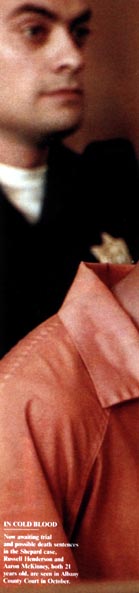
 For some of those close to Aaron and Russell the news about the
risk of infection helped them persuade themselves that Matthew was actually the
dangerous one. Matthew had seduced Aaron and Russell into committing a crime,
and now his ghost was trying to poison them. Deanna Johnson, who is a close
friend of Russell's grandmother's, says that she has "very mixed feelings" about
the crime. "You know that murder is wrong, but you feel basically that [the
homosexual] lifestyle is not right.... Matthew was not a saint-Matthew and his
lifestyle. I heard he was having tests done quite frequently.... I am not
familiar with people like that. Sometimes I've heard when people have [AIDS]
they want to take as many people with them as possible." She says that she
didn't think "there were many gay people" in Laramie. But after the murder "a
lot of them came out of the woodwork."
For some of those close to Aaron and Russell the news about the
risk of infection helped them persuade themselves that Matthew was actually the
dangerous one. Matthew had seduced Aaron and Russell into committing a crime,
and now his ghost was trying to poison them. Deanna Johnson, who is a close
friend of Russell's grandmother's, says that she has "very mixed feelings" about
the crime. "You know that murder is wrong, but you feel basically that [the
homosexual] lifestyle is not right.... Matthew was not a saint-Matthew and his
lifestyle. I heard he was having tests done quite frequently.... I am not
familiar with people like that. Sometimes I've heard when people have [AIDS]
they want to take as many people with them as possible." She says that she
didn't think "there were many gay people" in Laramie. But after the murder "a
lot of them came out of the woodwork."
Everywhere in Wyoming,
homosexuality is so near and so far away-visible and invisible. As with many
prejudices, homophobia allows for individual exceptions. Tyler Kern, who dated
Matthew for a short time in the fall, was also a friend of Chasity's and
occasionally hung out with her, Russell, Aaron, and Kristen (although he never
came out to them). According to sources close to the defense, the defense plans
to argue that neither Kristen nor Chasity grew up in a homophobic atmosphere,
and in fact both had close family members who were lesbians. Chasity's job at
U.W. involved doing some clerical work for the L.G.B.T.A., and she was friendly
with Jim Osborn, who at the time chaired the group. There was speculation about
repressed homoerotic desire between Aaron and Russell; according to this theory,
they were bonding over mutilating a beautiful man.
Aaron's friend Odius
doesn't find the fact that Aaron's and Russell's girlfriends have close family
members who are lesbians paradoxical. Like many people in Laramie he thinks
lesbianism is "much less repulsive" than male homosexuality. At other times,
however, he thinks "it's all wrong altogether ... because of God and what the
Bible says." He says that "Aaron believed in God like most people."
"A
kid on the street, they feel someone opposes them-it's him or them," he says.
"Anger is in all men's hearts; some are afraid to do what's in their hearts....
Nine times out of 10 you're afraid to do what you say you're going to do, and
this time he wasn't. Just the right situation, the right time.
"What
would I think if I heard all the voices in your head?" he asks me. "What would
you think if you heard mine? Haven't you ever wanted to hit someone?"
It
remains to be seen whether Matthew's death will endure as a symbol of the
violence of homophobia, but awareness of prejudice is part of the legacy of
Matthew Shepard. Obviously, the killing was about homosexuality, perhaps
sharpened by class envy and by drugs as well. But could Aaron and Russell have
murdered someone else for some other reason? They cracked open Emiliano's skull
the same night while shouting slurs. At the deepest level, murder is simply
about murder, about having the capacity, rage, and will to do it, and about
finding a victim who can be dehumanized by the shallowest of spells-"gay,"
"faggot," "fairy." The spell seems to have been already wearing off by the time
Aaron got home that night. "I deserve to die," he told Kristen, his victim
growing cold, his feelings returning to himself.
On December 28,
District Attorney Cal Rerucha elected to seek the death penalty against both
Aaron and Russell. Some of Matthew's friends wonder if it was what he would
want. Brian Gooden recalls how "when people would make comments, like 'Hey,
faggot,' he wouldn't react.... If anyone lived the Christian ideal of turn the
other cheek, it was Matt. I sincerely believe that Matt would have forgiven
those people." But Judy says that Matthew believed in the death penalty for
heinous crimes. "I believe in my heart that if this had happened to a friend of
Matt's he would think the death penalty was just."
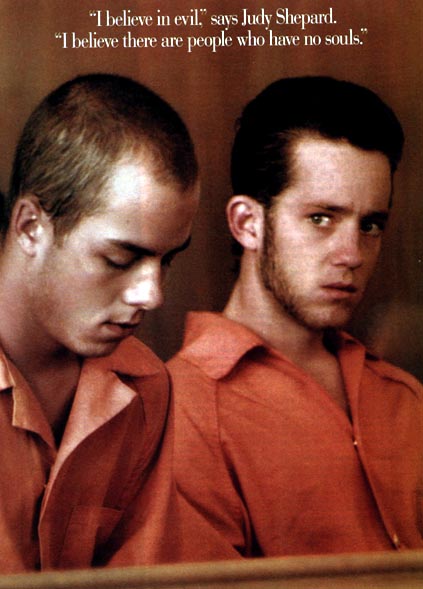
She recalls the way
Aaron appeared at the hearing. "It looks like his eyes are dead-dead inside,"
she says. "I believe in evil. I believe there are people who have no souls. I
believe there are people out there who have no feeling for what's right or
wrong-who enjoy hurting others."
"Did [Matthew] ask you to stop?" the
police had asked Aaron.
"Well, yeah," he replied, "he was getting the
shit kicked out of him." Judy feels that if Aaron had any remorse he would not
have used that phrase to describe what he did to her son. She also thinks about
how Aaron and Russell took Matthew's shoes that night, as the rapists had done
in Morocco. "It was one of the tangible things he could point to that had been
taken from him in Morocco. He complained about it endlessly-'my favorite pair of
shoes.' I had this visual image of Matt pleading with Aaron and Russell not to
take his shoes."
For Tiffany Edwards, the idea that Aaron and Russell
may have been exposed to H.I.V. from Matthew would be "Karmic, instant, ultimate
justice."
No one close to Matthew knew that he was H.I.V.-positive-or
thinks that he himself knew. The infection, detected in the hospital, is thought
to have been a very recent one. Judy Shepard recalls that since the rape her son
had been tested periodically and the results had been negative. Tina, Romaine,
and Brian all feel that Matthew-who supported Romaine through her brother's
death from AIDS-would have confided in them. "He wasn't a secret-keeper," his
mother says. But there is a great deal of concern that, as Brian puts it, the
revelation of his illness "could be used against him somehow-make people think
his death was less tragic because he was going to die anyway." H.I.V.-positive
people often have to fight against the stereotype of certain doom; Brian and
others emphasize that a healthy young person like Matthew might live with H.I.V.
for decades, by which time there may be a cure.
Matthew's friends agree
that the stigmatization of people with H.I.V. would not be something Matthew
(who worked for AIDS causes) would want to collaborate in by censoring the fact
of his infection as if it were shameful. His friends express the same hesitation
when speaking about some of his other troubles-his depression and rape-fearing
that these things could also be obliquely blamed on the victim. But the people
closest to Matthew are committed to remembering him as he was. They have faith
that, for most people, troubles make a portrait more, not less, human and deepen
the poignancy of a death.
"He wasn't a saint," Judy says. "He was just a
young man in search of himself." She is disturbed by comparisons between Matthew
and Jesus. "You must understand, it's like putting him on a pedestal that just
won't work," she says. "I'm concerned that if people find out that it's not
true, they'll be disappointed or angry or hate him."
Since Matthew's
death, his family has received more than 8,000 letters and cards, all of which
Judy plans to reply to. Presents continue to arrive as well-mementos from the
vigils, a quilt of signatures from a college in Pittsburgh, CDs, original music,
poems, stuffed animals, angels, ornaments, books on grief.
Many of the
letters have enclosed checks, for small and large amounts, which has led Dennis
and Judy to establish the Matthew Shepard Foundation to support things that
Matthew believed in-mental health, gay support groups, AIDS causes, human
rights, homeless teenagers. Many political groups have been lobbying for their
support, but Dennis and Judy want to study issues such as hate-crime legislation
before taking a position on them. Judy says she has never seen herself as
someone who is comfortable in the public eye. Growing up in the small town of
Glenrock, Wyoming, Judy wanted to be just what she became. "I want to go back to
my former career as a housewife and mom," she says, "but I can't. When Logan
said this was Matt's destiny, I said to him, 'What is our destiny? What corners
are we going to turn?' Matt's just pushing me down this path because he thinks I
can do it-he's with me."
Judy recalls how, when Matthew would overdraw
his bank account, "he'd say, 'Someday when I'm rich, I'll pay you back for all
the overdrafts.' And then he'd say, 'Do you think I'11 be rich? Do you think
I'11 be famous?' I would say, 'Absolutely-God would not put you through all this
and not let you be famous.'"
She is a strong woman: she cries
frequently, while talking about Matthew, but she brushes the tears from her face
and keeps talking. Hers is the grief of one confident of love given and
received-so different from how one imagines the grief of another mother: Cindy
Dixon, stumbling through the snow knowing that her only son-a prisoner-had
reportedly refused her visit. Russell Henderson was not allowed to attend his
mother's funeral. It was feared the crowd would hurt him.
In Laramie,
elementary-school kids signed and wore yellow cardboard badges which said that
they had pledged never to hurt another person because they were different from
them. A graduate of Laramie High School says that she used to call her brother a
fag whenever she was mad at him, but that recently her mother had told her not
to use that word anymore.
"We were the last group it was O.K. to hate,"
Kim Nash, a member of the L.G.B.T.A., says. "Because of Matthew's death it's a
little less O.K."
The Saturday following the attack, the L.G.B.T.A.
marched for Matthew at the homecoming parade after the football game. Although
Matt Galloway was apprehensive, he went and marched, along with hundreds of
others, wearing yellow armbands and carrying No HATE IN OUR STATE signs. "It was
the greatest experience of my life," he says. "People came up to me and thanked
me." After the killing, he got caught up in talking to the media, "but I had to
come to terms with Matthew's death for myself," and on the first quiet day, "I
went and locked myself in my house and ... cried for three hours straight." He
decided he wanted to get to know some of the gay community, and he went to
dinner with three of Matthew's gay friends, "and they were some of the most
beautiful people I've ever met." After his television appearances he got some
calls from gay men asking if he was available, and he found himself telling them
that he was straight, but that if they were interested in being friends, he was
too.
Tina Labrie struggles not to let herself be consumed by sadness.
"There are days I think of joining Matt, but I know he'd be very disappointed if
I showed up in Heaven." After Matthew's death she got permission from her
landlord to adopt Matthew's cat, Clayton. "I finally found the best friend of a
lifetime and then he's gone. They stole my friend," she said, her voice pained
and puzzled.
Romaine Patterson feels that the press and the national
attention have "helped lift me out of the pit of personal sorrow." In the coffee
shop where she works, she hears people discussing the murder-gay people and
straight people. At a vigil in Denver the day Matthew died, Romaine stood on the
steps of the capitol in front of a photo of Matthew which was attached to a
replica of the wooden fence-a fragile defense against loss-and told the crowd:
"The person Matthew was shines in all your faces. I am sure Matthew feels your
love. Thank you all for being here tonight to help Matthew take one more step
towards his goals and dreams."
Doc O'Connor remembers the phone call he
got from his mother the day Matthew was found. "Her voice is teary. I think
somebody in my family's died. She says, 'It's such a shame about that Matthew
Shepard-and you knew him.' "
"I'd only known him four days," he says,
"but the thing is we had a good connection." He says he remembers how Kristen
didn't seem upset when she told him that Aaron had beaten some gay guy. He knows
that "Krissy might have got six months' probation if I didn't tell the police
what I knew.... I like her-she's a nice girl--but she's got to get her just
deserts."
"Matthew knew he was going to die," Doc says. "He said he was
going to get beaten or strangled-he wasn't sure which. The last time we talked,
he said, 'When I get done in because I'm gay, if one gay person and one straight
person come together and stop to think that we're both people, that would be
something'-he would have accomplished something. And then, four days later, the
whole country comes together. He's bigger than kings and queens. One person told
me he wanted to look it up in the Book of Revelation. Matthew Shepard-that's a
pretty spiritual name. Who do you know who is as big today-who reached out and
touched as many people as Matthew Shepard of Laramie, Wyoming, population 27K?"