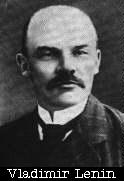
Lenin's Theoretical Innovations
Lenin accepted most of Marx's thought without alteration. He prided himself upon his Marxist orthodoxy, attacking any new idea that struck him as heretical. But probably his greatest hatred was reserved for the so-called Revisionism of Bernstein and other avant-garde socialist intellectuals who admitted, among other things, that contrary to Marx the absolute living standard of workers had vastly improved under capitalism.
The scientific concept, dictatorship, means neither more nor less
than unlimited power resting directly on force, not limited by anything,
not restrained by any laws or any absolute rules. Nothing else but that.
|
...an "imperialistic" war, which meant a war by which the bourgeoisie of the big powers aimed at securing monopolistic, colonial, and semi-colonial markets for their export trade and their capital export, and cheap raw materials... But this very imperialism, by providing colonial "extra-profits" for the bourgeoisie, put it in a position to bribe the upper strata of the proletariat; these strata, so bribed, naturally behave as "traitors." (World Communism)
Marx was not really mistaken, but simply underestimated the duplicity of
the bourgeoisie. But Lenin went one step further, and argued that even if
they were not being "bribed," workers by themselves would never
initiate the socialist revolution. As Richard Pipes explains,
"The longer
he observed the behavior of workers in and out of Russia, the more
compelling was the conclusion, entirely contrary to the fundamental premise
of Marxism, that labor (the "proletariat") was not a revolutionary class
at all: left to itself, it would rather settle for a larger share of the
capitalists' profits than overthrow capitalism...