|
Cañón de la Angostura is included without enthusiasm. On the plus
side
the canyon is very beautiful: steep walls with a wild profusion
of greenery hanging over a lively stream.
The first issue is accessibility. For most drivers it calls for high
clearance and
in wet weather
4WD. The surveyor did see a taxi making
its way down so presumably the road is passable for cars
but he didn't
see the taxi going back up.
Walking down from the highway is a possibility
but the return
requires an elevation gain of 315 m in 4.4 km. People live along the
road but there's no way of knowing how long you'd have to wait to hitch
a ride.
The other issue is the trail. Mainly you have to follow the stream
bed with numerous crossings. You should expect to wade
so short pants
and sneakers would be good choices.
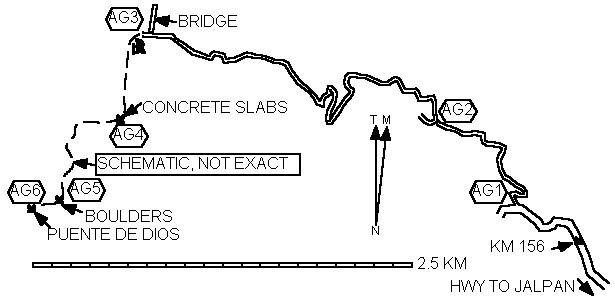
Where the canyon is at its narrowest and the stream at its deepest
concrete slabs have been attached to one of the canyon walls to form a
walkway. They look as though they could break away under a person's
weight and
in fact
one of them has broken away. Experiments have
shown that people submerged suddenly in cold water have an irresistible
reflex to inhale
which causes instant drowning.
If you decide to do this hike
find the foot trail on the left side
of the stream as you face upstream. Follow it until you can proceed
only by crossing. After that
keep going upstream as well as you can.
When you see three large boulders that have rolled into the bottom of
the canyon and stacked against each other you're near the end. The end
is at a dirt clump in the canyon bottom through which the stream has
eroded a channel so it can pass through,
called Puente de Dios. It may
seem irreverent to identify such a modest geological artifact with the
Almighty
but that's its name.
The map shown here is schematic because the surveyor's GPS receiver couldn't work in the narrow canyon.
|