
This game is a numeric version of the famous Mastermind TM board game invented in 1950’s. In the original game the code to be broken is a combination of 4 colored pegs chosen out of 6 different colors. Many variations of the game exist like 5 peg combinations of 8 different peg colors, etc. Guess-It uses numbers instead of pegs of different colors so there are 10 different (0-9) possibilities for each of the 4 digits in the code. In Mastermind pegs of same colors can be used in the code but in Guess It, no two digits of the code can be the same. Also number “0” can not be used as the first digit. The plus and minus signs are similar in meaning to black and white markers in the Mastermind game. Each PLUS (+) given in respond to a tried code symbolizes a digit which is the same and located at exactly the same place in the secret code while each minus (-) means a digit in the tried code exists in the secret code but is positioned at a different location. I chose this set of rules for the mere reason that that was the popular version we used to play on paper with each other during boring secondary school classes (way back in the 20th century). Even though the ratio of possible combinations has not yet been proved to be a valid measure of difficulty, Guess-It can be thought to be 3.5 times more difficult than standard Mastermind game on average.
|
|
|
|
|
|
The table below shows a typical remaining possibility set in the game just after the first guess is made and responded. Though even this has not yet been mathematically proven, a player whose first guess contains number zero (0) in it and is responded back with just a single minus (-) can be said to have made a terrible start to the game.
| Markers | - | - - | + - | + | Null | - - - | + - - | + + | + + - | + + + | - - - - | + - - - | + + - - | + + + + |
|---|---|---|---|---|---|---|---|---|---|---|---|---|---|---|
| Remaining different possibilities - first guess contains "0". | 1320 | 1050 | 660 | 480 | 360 | 198 | 180 | 180 | 66 | 24 | 6 | 6 | 5 | 0 |
| Remaining different possibilities - no "0" in first guess. | 1260 | 1155 | 660 | 420 | 300 | 253 | 207 | 165 | 69 | 23 | 9 | 8 | 6 | 0 |
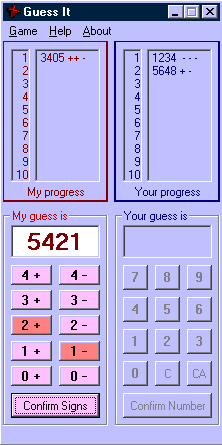
All over the net, one can find various derivations of Mastermind game including online Java applets. In most of these games, the computer is there only to hold a secret code and score your guesses accordingly with plus and minus signs. While computers are very good in accurately rating your guesses (comparing a guessed number to the secret code for correct number of plus and minus signs is quite prone to human errors), they are also very good at vigorously enumerating through millions and millions of different possibilities.
Guess It is one of the few interactive versions of this game where the computer also tries to find your secret code and it stands out from the rest of the crowd by the simple fact that it really THINKS. The usual approach (they call it heuristic) is choosing a number randomly among the remaining possibilities. Guess It uses a very powerful algorithm and basically compares the usefulness of every single number in finding the secret code in the NEXT move. I must admit that the best strategy possible (the one I designed that is!) is only slightly better than the heuristic approach but is still better. Very often you will find yourself suddenly being beaten by the computer after some seemingly irrelevant guesses. In hundreds of times I played Guess It, only once it happened to find my number at its 7th trial. Usually, it hardly takes the computer more than 5 trials to find a number. I would be glad if you ever witness an 8th move and inform me about it.
There are three versions of the same game available for download. The first one is a self-installing file with all the necessary Visual Basic Run Time libraries, uninstall property, etc and will work on all PCs with all kinds of Windows systems (and obviously it is large). The .exe file in this one is native VB code and very fast (6 seconds thinking time at most on a 1.4 GHz P3). The second one is just the .exe file, again in native code and will work on most computers with Visual Basic installed. The third one is in P-code, is slower than the first two (50 seconds thinking time at most) but will work in Windows NT systems. My suggestion is to download the second file first. If it starts on your system then everything is fine. If not, then you should either suffer with the slow version (the third one) or download the 2 MB self-installing one (the first version) if you find that to play too slowly.
 |
Guess It Fast version with all VB runtime files and uninstall property |
|
|
|
|
|
|
|
|
|
|
|
|
|
|
|
|
Last updated 15 Sep 2002
