Uncharted Waters 2: New Horizons
Reviewer: Piccolo
System: SNES
Developer: Koei
Year of Release: 1994
Genre: RPG/Simulation
Number of Players: 1
Save: Battery-based, one file
ESRB Rating: n/a
|
I've never bought a Koei game. They've been around since the NES, but I was never interested in a game that mostly involved numbers and micro-management. However, this gem of a game has given me new respect for the company and the genre.
|
In America, only popular series or genres such as one on one fighting, action, or adventure are heavily publicized. So, it comes to no surprise that a Sailing Simulation RPG such as this was not given much press over titles like Donkey Kong Country. Those that did review it gave it a favorable one, but to this day, many people have never heard of this game. But enough complaining why this game wasn't popular.
|
I, too, had passed this game over during its initial release. Years later, I read a good review or two on it. I was intrigued simply by the fact that a sailing sim game based on the Age of Exploration had not been made before. But it was an infamous "boring" Koei sim game. I put it on the back burner, only to learn that Yoko Kanno had composed the game's soundtrack. Yes, THE Yoko Kanno behind Vision of Escaflowne's score, among other works. Well that was the clincher. I had to get this game. Unfortunately, because of its low sales and most likely limited release, I found it hard to obtain a copy. I kept up the search, and eventually Funcoland got in a copy. So, I eagerly began playing.
|
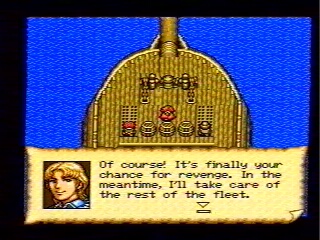
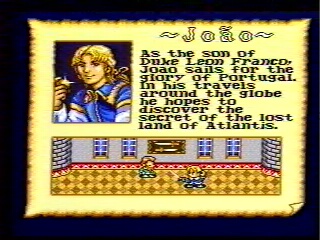
The game's opening is simple, but well done. A full-screen image of large ship lay in the shadows, floating on some wavy water. A ray of light highlights it, and it becomes solid gold. The waves change to a spectrum of color, and the game's logo zooms in, twists and turns before coming into focus. This is followed by an introduction of six sea bound adventurers. Text explains their background, as a sprite-based animated cinema plays below. The sprites in this scene reminded me of Final Fantasy VI's, although with animation that is more fluid. This animated intro takes back seat to Yoko Kanno's "Wind Ahead", a light, jazzy, and enjoyable song that gives a good impression of getting ready to cast off.
|
The six main characters in this game are from a variety of countries around the eastern hemisphere, and each has a very different reason for setting sail. Pietro wishes to be an adventurer, sailing around the world discovering treasures and lost civilizations. Catalina, a pirate from Spain, betrays her country to defeat the man who she believes is responsible for murdering her brother and fiancee. Ali from Africa simply wishes to make a living trading goods. The British naval officer Otto is ordered to destroy his rival country's fleet. Joao, the son of the single main character from the first Uncharted Waters game, is sent on a world-spanning adventure fit for a king. And finally, Ernst from Holland embarks on a quest to map the entire globe. Each of these people is supported by a first mate, usually a personal friend, and can hire other characters during the course of the game as the player sees fit. Every one of these characters has an in-depth storyline, fitting for any plot-based RPG. There are many plot twists, and other characters from different scenarios may make cameos as rivals or allies. They are not as long as, say, Final Fantasy IV's, but in the end, each character finishes what they set out to accomplish.
|
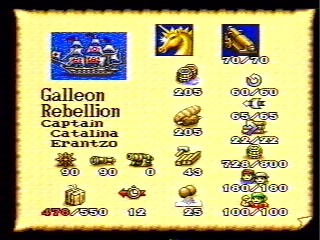
The player will spend a good amount of their time managing all the facets of a fleet. A player can allot percentages of crew to navigation, lookout, or combat. They can upgrade the type and number of cannons. They can hire just enough crew members to move the ship forward and save on supplies, or they can max out their crew capacity to go at top speed and fight as best as they can. A Commodore can contently be the captain of a single ship, or command a massive fleet of up to ten ships. You can pilot a tiny Balsa ship, or spend a fortune and get a Frigate or two. And this is just scratching the surface of the simulation aspect of the game.
|
Money, of course, will be a major factor in this game. You won't just travel to the next town and buy the best weapon, armor, and curing item; rather you will regularly be spending money upgrading and maintaining your fleet. Each character, depending on their traits, can earn money in a variety of ways. Pirates raid merchant ships and sell off treasure they find, adventurers are paid for their discoveries, cartographers are paid when they find new territory, and of course traders do their best to buy low and sell high. However, Catalina the pirate can become Catalina the trader if she is short on cash (and on good terms with the countries she is trading with -- obliterating a friendly country's ships is not good politics). The boastful adventurer Pietro can become a rouge pirate simply by getting a tough ship and commanding all hands on deck to man cannons. If you're really low on gold, you can even gamble via playing Black Jack with someone in a pub. Performing routine tasks gives much of this game a feel of filling the role of a real to life commodore, rather than being another youth who saves the universe from evil.
|
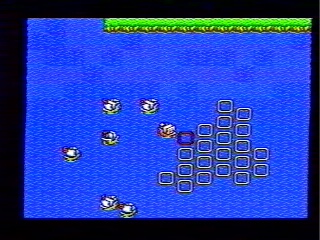
If you're a pirate under your own flag or under marquee, you'll be fighting quite often. Naval battles are initiated by giving the command to attack the fleet as you near it on the overworld map, or by being attacked by another fleet. The game switches to a closer view, and you see each of yours and the enemy's ships. Navigation on the battlefield has the freedom of a board game rather than being pinned to one spot on the screen. You may go up to 4 or 5 places forward by planning your path via a series of arrows. After you finish moving, you can attack ships if any are nearby. You'll fire cannons if you're within range, or if you're right next to the ship, their crews will clash. Each ship has two sets of 'hit points': the damages to the ship and the number of crew remaining alive after each cannon volley or close-range combat. If your ship is quite tough, you could opt to keep your distance and pelt the enemy flagship with cannon balls. If you're not that strong but have a good number of crew, you could get up close and try to take out the enemy crew. Alternatively, you could maneuver yourself right next to the enemy flagship and challenge the enemy commodore to a one on one duel. Now, this is where it gets into more standard RPG combat. You and your enemy are equipped with a sword and armor. You alternate between attacking and defending each sword strike. When it is your turn, the game deals out a hand of 'cards'. They are valued from 1 to 9, with 9 being the strongest. Offensively, you can chose to do an Overhead Strike, Sideways Lash, or forward Thrust. Defensively, you can Block, Parry, or Dodge. This creates a sort of rock-scissors-paper game. For example, your opponent lashes, but you parry and no damage is dealt to you. You can also buy different classes of swords, such as a rapier from Spain for thrusting or a katana from Japan for lashing. Hopefully you've bought a good sword and armor, because you may have to deal with low-numbered cards and your opponent may get a good hand and overpower you. If this sounds confusing, here is an example: You choose a Level 6 Thrust card with your rapier. This will do pretty good damage, if your opponent does not have a higher- numbered card, or stops the attack via the right type of defense. Each combatant does not have a set number of hit points; rather, a seesaw system is used. So, you may get some weak attacks and defenses, and be on the brink of death, but start to get lucky and overpower the opponent. It will be an uphill battle though, as it will take some effort to get that seesaw to tip in your favor.
|
Graphically, this game has its high and low points. The globe represents the real world quite well. You'll recognize places such as Italy and Florida as you sail by. You can even take that vacation to Hawaii you always wanted to. Enjoy your stay at a Japanese port without having to read a single kanji (Sorry, anime and manga have not been invented yet). There is a day and night cycle. While most of the game's 50 or so ports are laid out differently, and several countries have their own tile set, the buildings and landscape are simply drawn. The mountains look like something out of Dragon Warrior, not Final Fantasy's. However, every main character, NPC ship captain, vagabond sailor, and even barmaids have their own specific portrait. Each treasure, weapon, and armor looks different. When you buy a Balsa ship, you'll scoff at it's shoddy looking construction. But you'll drool when you see the massive sails on the legendary Full-Rigged Ship. It's this sort of attention to detail that makes this game so involving.
|
While the title screen's music is quite memorable, many of this game's tracks are nowhere near the level of sophistication you'd expect from Yoko Kanno, or even the Super Nintendo. Certain port's themes will repeat quite often and get on your nerves. Fortunately, the ending music is right up there with the title screen's. Even though this isn't a Music review, I must mention that there is an arranged version of this game's soundtrack, and it makes each of these tunes come alive. Every one of the tracks on it radiates pure Kanno goodness.
|
Menu navigation is one of this game's lowest points. Animated icons represent the main menus, but the sub-menus are text based. With no on-screen help, it will take a bit of trial and error to figure out what does what. However, people who run a port's various shops and cafes will give you pointers and tutorials on basics when you start a new character's scenario. It pays to take notes in this game.
|
A newbie player may find it easy to get turned off by this game. They could get lost in menu navigation, or forget what statistic is for what. Their single ship could get overpowered by a fleet of half a dozen ships from a battle fleet and hardly have a chance to counterattack. They could run out of money, or run out of food and water supplies in the middle of a voyage and perish. Or they could have a tough time off the west coast of Africa and get wrecked by a merciless storm. If the player were to just persevere, they would find this game a rewarding experience. Attack merchant ships with little defense, find a good trading route, land on shore and wait out storms, and don't forget to allot a good amount of crew to combat. Take out a loan from the local branch of the Marco Polo Bank if you need to. This game has hardships just like those in the 1500s, and when the player finds solutions to their problems, they may enjoy this diamond in the rough as much as I do.
|