
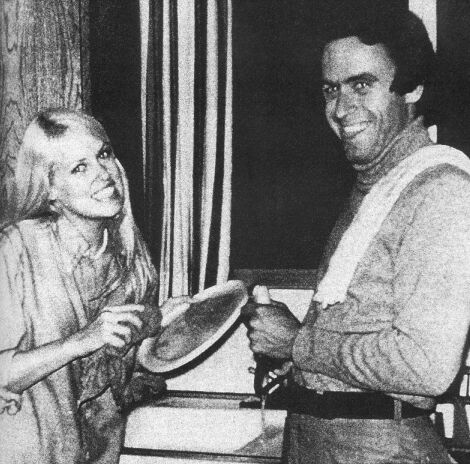
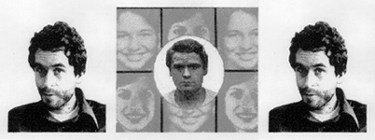
Ted Bundy was an attractive, well-educated, and charming young man. However, all of these outwardly expressed qualities were just a fa�ade. Inside Bundy's mind lay a Dr. Jekell and Mr. Hyde personality. Bundy was a master of deception and a king of disguise. Over the years of his life, he was able to continuously fool those closest to him. Ann Rule, famed true crime novelist, went as far as to say that if she had a daughter; she would encourage her daughter to date Bundy (Rule). There were no visible signs of the madness that lurked underneath the handsome, well-groomed face of Theodore Bundy. He was literally a monster that was hidden inside the body of your average well liked and articulate young man.
Theodore Robert Bundy was born on November 24, 1946 in Burlington, Vermont. His mother, Louise Cowell, was 21 years old and unmarried when she gave birth to Ted. Louise was from Philadelphia, but left the area to give birth to her illegitimate child. Louise would later return to Philadelphia with Ted. However, the Cowell family agreed to say that Ted was adopted by Louise's parents, thus avoiding any unnecessary talk around town. In the town's eyes, Louise was Ted's older sister, not his mother. Ted's origin was always a touchy subject with the Cowells. One family member was quoted as saying, "It was never spoken of." "It" of course being Bundy's origin (True Crime 10).
Almost from the beginning, Bundy led a life of lies and confusion. At the age of four, Ted, and his mother moved to Washington. By 1951, Louise had fallen in love and married a man named John Bundy. In less than a year, Ted was taken away from his most loved relative, his grandfather, and he gained a stepfather and a new last name. These were events that would not affect an adult in a negative manner, but place these actions on a five year old child that is already questioning his origin, and combine the added teasing that Ted received from cousins and one could get a potentially dangerous person.
Ted's intelligence was immediately noticed when he began school. Along with Ted's intelligence, his teachers also noticed Ted's short temper. Throughout grade school and high school Ted appeared to be an average adolescent. Ted did well in school, went to church, and was active in his Boy Scout troop. "He was attractive, and well dressed, exceptionally well mannered," recalled a female classmate. No one was aware of the turmoil that lurked below the surface of this young man (True Crime 11).
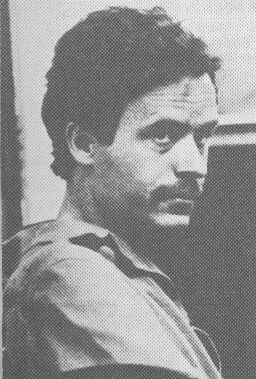
Ted's criminal career began early. As a teenager, Ted would peer into women's windows as they undressed. Ted was also picked up by police authorities on several occasions for suspicion of burglary and auto theft. Ted had an extreme desire for the finer things in life. His parents could not afford to buy these things for him, so he would steal them. Ted's hidden need to acquire material items would remain with him throughout his whole life. It was this hidden need that drove him to mold himself into the sort of person that would be capable of obtaining such fine things. He wanted to be suave, stylish, respectable, wealthy, and a handful of other qualities that he was not. It was this fake persona that people saw when they met Ted. In essence they were meeting the Dr. Jekell aspect of Bundy.
Carol DaRonch was a normal 18 year old girl blessed with good looks and a perfect body. November 8, 1974 was an average day for Carol in her home town of Murray, Utah. The teenager was at the local mall shopping when she was approached by an attractive man claiming to be a police officer investigating a burglary that involved her vehicle. The man asked her to accompany him to her car to verify if anything was missing. Carol agreed and led the man to her car in the parking lot. Upon inspection of her vehicle Carol informed the man that nothing was missing. The alleged police officer then asked the young woman to go to the police station with him to help file a report. Carol's caution flag went up immediately, however the young man was able to calm her fears and Carol agreed to go with him. Upon entry into the man's car, Carol realized she had made a terrible mistake. The VW Bug took off with Carol trapped inside. The calm, cool, collected man was no longer present. "His eyes were wild, his face congested with rage. In that instant Carol DaRonch knew with cold certainty that she was going to have to fight or die" (True Crime 7). Carol chose to fight. She fought her way out of the car and escaped from Ted Bundy and his Mr. Hyde personality that few would live to talk about (True Crime).
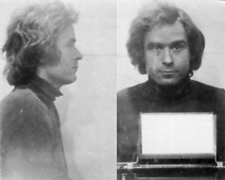
Before Carol's brave escape, it is believed that Bundy had already killed at least 12 women (Lane and Gregg 75). On the same day that Carol escaped, Bundy, still driven by the desire to kill, abducted Debbie Kent from a high school theater event that was only 17 miles away from his earlier abduction of Carol. Debbie was not as lucky as Carol. Debbie's body would never be found. It would not be until October 1975 before Carol would receive some hope for finding her abductor. Bundy had been found in Salt Lake City, Utah and was linked back to Carol's abduction case. The police arranged for a police line up and Carol provided a positive identification of Bundy. This was the first break investigators received in the Bundy case. The police suspected Bundy in several abductions and possible murders, however there was no proof that would stand up in court linking him to the crimes. Carol provided the police with the first solid evidence that was needed.
Bundy was arrested and charged with the abduction of Carol DaRonch. On February 26, 1976, Bundy would be found guilty of kidnapping and sentenced to one to 15 years in prison. At this time Colorado was also preparing to seek an indictment against Bundy for the murder of three women in the Colorado area. Bundy's little world was beginning to crumble around him, so he took matters into his own hand.
On June 7, 1977 during a court recess in his trial, Bundy escaped from a second floor window. He remained on the run for over a week only to be recaptured. This temporary set- back did not deter Bundy in the least. On December 30, 1977, Bundy would make his second and final escape attempt. This time Bundy was able to gain a 17 hour lead on investigators. Bundy's final killing spree would lead him to Florida and continue until February of 1978.
Bundy, driven by his newly found freedom, fled from Colorado to Michigan. Deterred by freezing temperatures, Bundy decided to head for some place a little warmer, like Florida. Bundy decided that Tallahassee would be the perfect spot for him to start over. Determined to lead a non-criminal life, Bundy hopped on a bus and set out for Tallahassee, Florida. The college atmosphere provided by Florida State University would be the prefect hiding grounds for the wanted killer.
Ted acquired a residence and tried to lead a normal life. However, this did not last very long. Bundy was in need of a higher quality of life and he began to steal again. It was not very long before Bundy had the desire to kill again. On January 14, 1978, Ted Bundy struck again. This time his victims were from the Chi Omega sorority house at Florida State University. During Bundy's reign of terror that evening, he fatally wounded two women and seriously injured three more. On February 9, 1978, Bundy would take the life of his final victim, Kimberly Leach, and continue to remain on the run. Once again Bundy eluded the police.
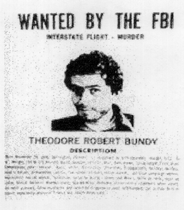
By this time Bundy was finally beginning to be linked to several murders around the United States. Every police agency was informed of Bundy's deeds and he was placed on the FBI's most wanted list. Bundy was finally caught during the early hours of February 15, 1978 by a Pensacola patrolman. Bundy gave the Pensacola police a false identification at first, then once discovered refused to tell them of his true identity. It was roughly two days before Bundy would reveal to the police who he really was. To Bundy's surprise the police had no idea who he was. The Pensacola police force would soon learn that they had the most wanted man in the United States (True Crime).
Several interrogations of Bundy took place after his capture. During one of these questioning sessions, Bundy admitted that his total kills numbered over one hundred. He would later withdraw this statement (Lane and Gregg). It has been estimated that Bundy killed 36 different women over the 42 years of his life. However, some believe that this number is much higher.
Bundy went from an attractive, well dressed, and articulate speaking man to a sloppy, slurring, disheveled mess over his killing spree. He began to come loose at his ends. Douglas states that the choice of his last victim showed a complete psychological degeneration (Douglas and Olshaker 383). Bundy could not contain the monster that lurked just below his surface. Over the course of his trial for the Chi Omega murders, Bundy showed no visible signs of remorse for his actions. The only time Bundy would be seen crying was over his own life.
Even though the police knew Bundy had committed the
Chi Omega murders
they needed solid evidence.
The only piece of solid evidence that was left at the crime scene were bite marks that were
made on Lisa Levy's left buttock.
An expert in Odontology, dental forensics, was brought on the case.
Dr. Richard Souviron sealed the fate of Ted Bundy with his testimony.
Souviron compared impressions of Bundy's teeth with the bite marks on Levy.
He concluded that Ted Bundy did in fact inflict the wound upon Lisa Levy (Evans 153).
On July 23, 1979, Theodore Robert Bundy was
convicted of two accounts
of first-degree murder.
He would later be sentenced to death by electrocution (Douglas and Olshaker 386).
Bundy became prisoner 069063 and his string of gruesome murders ended.
Through appeals Bundy was able to remain on death row until January 24, 1989, the day he
was executed (Lane and Gregg 74).
By the time of his death, Bundy was not the same person
that most remembered.
"He was weakkneed, if not wobbly," a witness observed.
"He looked old, tired, and gaunt." Not one ounce of the arrogant Bundy remained (True Crime 46).
Bundy's make believe world had come tumbling down around him and even Bundy would not be
left standing when it was all over.
Justice was finally served and many were able to rest easy on January 24th. Bundy's true monster was revealed to those who were
his victims and to the public during the days of his trial.
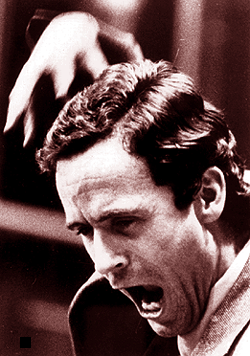
At one point in his trial Bundy had tried to leave the courtroom after an outburst.
Five officers approached Bundy and surrounded him in order to stop him.
With television cameras whirring, Bundy reared up
like a trapped animal, his mouth gaping, his face contorted with rage.
"You know how far you can push me!" he snarled.
After a few moments he regained his composure and resumed his seat, but the damage was done.
Ted Bundy had shown his true face. (True Crime 42)
Bundy was able to hide his inner monster for the most part.
However, it was little episodes, like the one above, that displayed his true colors.
Bundy was literally a monster hiding behind the mask of an attractive man.
He was able to fool many.
A Utah State Prison psychologist said, "I feel that Mr. Bundy is a man who has no problems,
or is smart enough or clever enough to appear close to the edge of "normal"" (Lane and Gregg 74).
"Normal" is not a word that could ever be used to describe Bundy.
He was anything and everything but normal.
Perhaps the true essence of Bundy can be learned by listening to his own words.
During one interrogation Bundy said to his interrogators, "But I'm the most cold-blooded
sonobitch you'll ever meet." Bundy later said, "Sometimes I feel like a vampire" (True Crime 37).
The vampire was finally caught, caged, and justice was served.
The man behind the mask would no longer roam the streets in search of beautiful young women.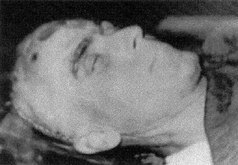
Douglas, John, and Mark Olshaker. Obsession. New York: Pocket Books, 1998.
Evans, Colin. The Casebook of Forensic Science Detection: How Science Solved 100 of The World's Most Baffling Crimes. New York: John Wiley & Sons, Inc., 1996.
Lane, Brian, and Wilfred Gregg. The Encyclopedia of Serial Killers. London: Headline Book Publishing PLC, 1992.
Rule, Ann. The Stranger Beside Me. New York: Penguin Group, 1989.
Schechter, Harold, and David Everitt. The A to Z Encyclopedia of Serial Killers. New York: Pocket Books, 1996.
True Crime: Serial Killers. New Jersey: Time Life Inc. Book Company, 1993.
