|
High-temperature superconductivity |
|
|
Members of the Group
Review Articles
Pseudogap models
Low temperature ``phase only''
effective action for d-wave superconductors
Vortex state in d-wave superconductors
Impurities in d-wave and s-wave superconductors
Grants
Teaching
International Collaboration |
Contact address :
Prof. V.M. Loktev
Bogolyubov Institute for Theoretical Physics
Metrologichna Str. 14-b
03143 Kiev
Ukraine
- Office: Room 341
- Phone: +38-044-266 91 39
- Fax: +38-044-266 59 98
- Email: [email protected]
|
|
| MEMBERS OF THE GROUP
|
Prof. V.M. Loktev,
Head of the Group
Bogolyubov Institute for Theoretical Physics
14b Metrologicheskaya Str.
03143 Kiev, Ukraine
E-mail: [email protected]
Prof. V.P. Gusynin,
Bogolyubov Institute for Theoretical Physics
14b Metrologicheskaya Str.
03143 Kiev, Ukraine
E-mail: [email protected]
S.G. Sharapov,
Bogolyubov Institute for Theoretical Physics
14b Metrologicheskaya Str.
03143 Kiev, Ukraine
E-mail: [email protected]
V.M. Turkowski,
CFIF, Instituto Superior Tecnico,
Av. Rovisco Pais
1049, Lisbon
Portugal
E-mail: [email protected]
|
|
| REVIEW ARTICLES |
|
|
| PSEUDOGAP
MODELS |
The discovery of high temperature superconductors (HTSC)
revealed new problems in solid state physics in general and in
the theory of superconductivity in particular. A combination of factors,
including unusual magnetic and electronic properties,
a lowered dimensionality, closeness to the metal-insulator transition and
relatively low carrier densities, makes the construction of an
appropriate theory both difficult and far from resolved.
It appears that the important features of HTSC
which are based on their low dimensionality and low carrier density
can be studied using the simplest pairing Hamiltonians such as
the 2D and quasi-2D attractive Hubbard models.
Using the modulus-phase variables appropriate to these models
(the importance of these variables was pointed out in
the quantum field theory for the Gross-Neveu model)
(see e.g.
cond-mat/9709034 ,
JETP 88 (1999) 685)
the presence of a new nonsuperconducting, but gapped phase
in 2D and quasi-2D models of superconductors with relatively small
carrier density was proved.
In particular, the analytic expressions
for Green's functions
(see JETP Letters 69 (1999) 141;
cond-mat/9811207,
JETP 90 (2000) 993
and cond-mat/0007271)
and other observable quantities were derived.
One can attempt to relate this phase to the pseudogap
phenomena (or at least part of them) observed in HTSC. The developed approach may be
regarded as the microscopical derivation of the
phenomenological theory of Emery and Kivelson, Nature 374 , 434 (1995)
which relates the pseudogap phenomena to the fluctuations of the phase of
order parameter.
|
|
|
Low temperature ``phase only''
effective action for d-wave superconductors
|
While the mechanism of superconductivity and
unusual nature of the normal state in high-temperature
superconductors (HTSC) are not yet understood, there is a
consensus that the zero field superconducting state has a d-wave
superconducting energy gap, with nodes along the diagonals of the
Brillouin zone.
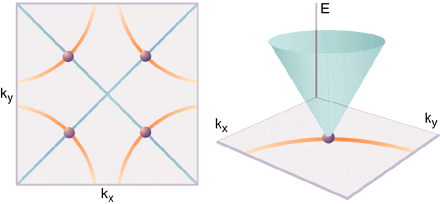
The presence of the nodes
results in a large compared with conventional s-wave
superconductors density of low energy quasiparticle excitations
even at the temperatures much smaller than the transition
temperature. Although these excitations are
reasonably well described by Landau quasiparticles their presence
brings in a qualitatively new quasiparticle phenomenology not
encountered in conventional superconductors.
Recently we have derived and compared (cond-mat/0012511,
Phys. Rev. B 64 (2001) 134519)
finite temperature time-dependent effective actions for
the phase of the pairing field, which are appropriate for a 2D electron
system with both non-retarded d- and s-wave attraction.
As for s-wave pairing the d-wave effective action contains
terms with Landau damping, but their structure appears to be different
from the s-wave case due to the fact that the Landau
damping is determined by the quasiparticle group velocity, vg
which for d-wave pairing does not have the same direction as
the non-interacting Fermi velocity, vF.
We have shown that for d-wave pairing the Landau term has a linear low
temperature dependence and in contrast to the s-wave case are important for
all finite temperatures.
We have also investigated the Carlson-Goldman (CG) mode (cond-mat/0109004,
Phys. Rev. B 65 (2002) )in two-dimensional
clean d-wave superconductors using the effective ``phase only'' action
formalism. In conventional s-wave superconductors, it is known that the
CG mode is observed as a peak in the structure factor of the pair
susceptibility S(O, K) only just below the transition
temperature Tc and only in dirty systems.
On the other hand, our analytical results imply that in d-wave superconductors the CG
mode can exist in clean systems down to the much lower temperatures.
|
|
| Vortex state in d-wave superconductors
|
Among many aspects of
this new physics a major role is played by these low energy
excitations in the mixed (or vortex) state.
Since all HTSCs are extreme type-II superconductors a huge mixed
phase extends from the lower critical field, Hc1 =10 - 100
Gauss to the upper critical field, Hc2 =100 T.
|
|
| Impurities in d-wave and s-wave superconductors
|
It is well known that a parent state of almost all HTSC compounds
is the Mott-Hubbard insulator with the charge-transfer gap. The metal-insulator
transition in these compounds is stimulated by the heterovalent doping or by
the change in the oxygen content. Both factors lead to the structural disorder
as an intrinsic property of these materials.
This means that they belong to the family of non-ideal (or impure)
crystals. The doped ions play a twofold role:
- supply the itinerant carriers in the conduction (valent) band and
produce the metallization;
- are the centers of localization and scattering which (this follows
from classical results of Anderson and Abrikosov and Gor'kov)
could suppress superconductivity, especially of d-wave type.
From the statement made one comes to a conclusion that the single-particle
localization processes and superconducting pairing should be treated in a
self-consistent way. It is important that in such a case the number of
the initial free carriers is equal to the number of scatterers, so HTSC as
metallic systems are "bad metals" where kF l ~ 1
(kF is the Fermi-momentum,
l is the free path).
The corresponding theory was developed
(Physica C 272 (1996) 151;
cond-mat/0104581,
Low Temp. Phys. 27 (2002) 767;
Europhys.Lett. (2002) (in press)) and the following results were obtained:
The superconductivity is possible between two characteristic
concentrations of dopants cmet and csup, where
cmet = Exp(-pi W /4 Vattr) and
csup= (Vattr/VL)2.
Here W is the bandwidth, V_attr and V_L are the pairing and localization
(in Lifshitz model) potentials, respectively.
Superconducting gap in these points is:
D = (c - cmet)1/2 and
D = (csup - c)1/2.
The density of states on the Fermi level is
N(e) = W e/c2 VL2
ln 2(D/e).
It is seen that dN(e)/de goes to 0 when e tends to 0.
This asymptotic behavior changes all thermodynamic properties at
low temperatures.
|
|
| GRANTS
|
2001-2003
The research grant of the Swiss National Science
Foundation (SCOPES)
|
|
| TEACHING
|
|
|
| INTERNATIONAL COLLABORATION |
|