‘THE DIVISION OF LABOUR’
Adam Smith
EARLY WRITINGS
Karl Marx
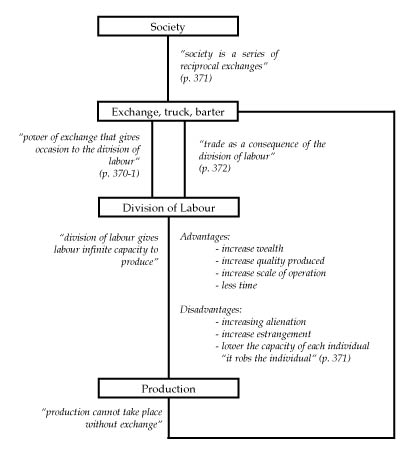
Division of labour, the splitting of a larger task into smaller tasks and then
having one person be responsible for only one or two of the smaller tasks, increases
the efficiency of the whole factory. Exchange and the Division of Labour are
mutually conditioned.
Smith noted that there were 3 circumstances that increased the quantity
of work:
- the increase of dexterity in every particular workman.
- the saving of time which is lost in going from one type of work to another.
- the invention of machines which enable one man to do the work of many.
Several reasons that explain the alienation of labour:
- Labour is not voluntary, it is forced labour.
- Life begins the moment you step outside the workplace, and stops the moment
you re-enter it. He feels at home when he is not working, and when he is working
he does not feel at home.
- Labour is external to the worker, the product of your labour belongs to
someone else. External character of labour for the worker appears in the fact
that it is not his own, but someone else’s, that it does not belong to him,
that in it he belongs, not to himself, but to someone else.