Reading Tashkent's symbols and signs in architecture identified the theoretical meaning of buildings and places. However, Tashkent is more than collections of architectural icons, spread on the geometric grid. It is about people: about the places where they learn and grow. It demands an active involvement of people. Tashkent's inhabitants add a human dimension to its aesthetic silent architectural beauty, by means of tactics and interpretations.
This chapter will take advantage of observations of the architectural tactics incorporated into the Tashkent's city fabric from the previous chapters and will attempt to demonstrate how people appropriate architecture, use it in ways it affords them to use it, like it or hate it, make do with it, and adapt to them. I will try to direct your gaze in certain directions to show how people respond to place, appropriate it to their needs and desires and guide you with appropriate words, interpretations and commentaries.
The art of building emerges from the art of living. (Rybczynski 1989: 50)
Picture here The architectural beauty and aesthetics of the building taken on their own will definitely confirm the architects' talent and professionalism however, it cannot be considered without reference to its context. Tashkent's context is everyday life. To illustrate this, we could admire the design and the structure of the Kh. Alimdjan Square, its solid geometric forms and its symmetry. However, without participation from the public, who understand and experience what hides inside these strong solids of buildings, on the pathways, streets and behind the dark corners, it will still be divorced from its circumstances and surroundings. People who live inside those high-rises, who work in banks, shops and small cafes and restaurants around the square face different realities, based on the activities they perform in the place.
For a square keeper, who swipes the tiled floor of the square, the place changes according to season, time of the day, etc. His square is never the same, as it is constantly altered by the activities of others. And it still remains his job, the duties that he has to do, rather than something he loves doing.
For a boy, who lives in one of those buildings with his parents, the place becomes the heart of the city, where he feels at home and where his memories reside. The fountain in the middle of the square is where he played with his friends after school. The path along the road reminds him of a girl he likes from school, who let him carry her school bag for the first time.
For an Uzbek business man, who visits the bank here the place is about money, interest rates and taxes. For him, it has nothing to do with intimacy or memories, which might live on the opposite side of the city, where his family is.
Buildings are places of human activities: some buildings are used for work, some for leisure, some become our homes. Through the signs they communicate to us and influence our lives. Different places suggest different possibilities. A transposition of the human plane onto an architectural site takes a place immediately to a different dimension of intimacy, memories and dreams.
Memories are another way of personalizing space, creating unique experiences, belonging to individual people, appropriating architecture to their individual purposes and needs. Memories of a place, through time influence people's perception of a place. For Laurier memories play an important part in commuting around the place. He mentioned that through memories the past is folded into the present (Laurier 1995: XXX), and influence our trajectories of traveling through a space.
Childhood determines the practices of space, arguments its effects and defaces their readable surfaces and creates in the planned city a 'metaphorical' city or a city of movement. A city built with accordance with all the rules of architecture and suddenly shaken by an unpredictable and incalculable force. (Blonsky 1985: 145)
A person of the present is subjectified to the places and subjects of the past, revisiting and re-evaluating them, through the different eyes however the past significance, the memories and values of those rarely change. To employ space is to repeat the joyous and silent experience of childhood. (Blonsky 1985: 144) A long forgotten, but familiar smell, or sound may trigger complex emotions and memories related to places.
We lived in an average Soviet apartment block that did not differ much from the others, only by the decorative ornament on the side. I remember men playing chess on the bench, surrounded by young then trees. And us, young children running around them, excited about the butterfly that suddenly appeared in this concrete jungle, like a ray of light or a sign of hope for a better future. I came back to that place, 17 years later, the trees are now higher than the buildings, camouflaging the raw concrete surfaces, but the men still sit on that bench finishing the chess match, like they've never left their sits.
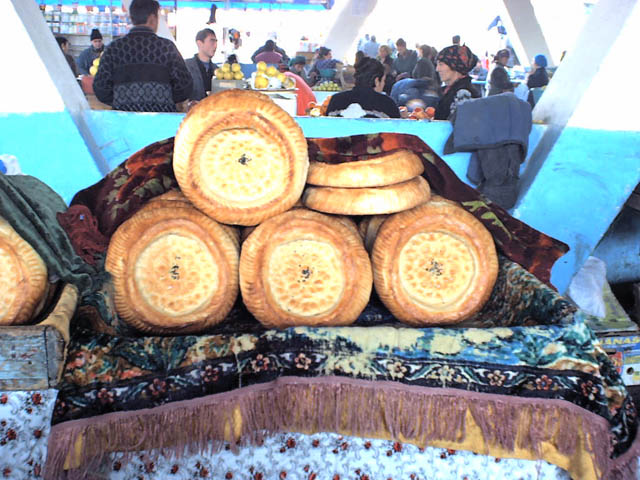
Another thing that stayed with me from my childhood till today is the smell of bread. I remember my mother, sending me across the road to a local bazaar to buy some bread. Uzbek loafs of freshly baked bread, that I held in my hands, so impatiently, just to get back home and let my mother cut it, waiting until she got to the middle and gave me the crusty bit.. (Natalia Serga)
Uzbek Bread - Lepeshka
(Photo by Alexey Burlak)When visiting certain places in Tashkent, we always know whether we respond positively or negatively to it and we can recognize the presence or absence of a sense of place. Although places can be very different, their environments have a sense of place, which makes them individual and memorable. For example, wisdom and harmony that can almost be seen in a silence of narrow winding streets of the old Islamic towns have a very different sense of place and order as well as effect on people than the drama and scale of skyscrapers in the modern part of Tashkent, which present a powerful overwhelming and grand experience of the sense of place.
For the average people in Tashkent modern glass architecture, is used as an escape from the everyday. Most people cannot afford this lifestyle on the regular basis, and when they can, to go and visit that building becomes an event of the month, and treated with the same level of importance as a wedding or other important occasion. They dress in their best outfits and give in to the grandiose experience. Waiters and Servants, Customer Service People, who attend to the slightest wave of their finger to avoid any dissatisfaction, are what they don’t usually experience in the everyday life. For the tourists and Tashkent’s foreign visitors such buildings are also important, as they feel familiar with such city; it represents their value system and lifestyle.
Inhabited space transcends geometric space. (Bachelard 1994: 47)
Detailed characteristics and analysis of architecture, as it was attempted in the previous chapter, almost destroyed the poetic unity of Tashkent. Poetry has a great quality to be suggestive, which gives it its indefinable, impermanent, tactical momentary power to encourage change. Therefore through poetry the universe comes to inhabit architecture, and allows the reader to go further and stretch the boundaries of his / her own imagination and fantasies, read the possibilities and potentials of places, rather than being constrained by rigid structures of the system.
In my opinion, it is better to live in a state of impermanence than in one of finality, because of the very nature of us, as human beings, that we never stop questioning things, learning, changing and improving. To exist is to change, to change is to mature, to mature is to go on creating oneself endlessly. Henri Bergson (Partington 1996: 65)
Michel de Certeau used walking to exemplify a way in which the ordinary person in the street manages to make he city constructed as a space of power, but made habitable by the ordinary and the 'weak'. In their walking the pedestrians are actively writing the city. Walking creates associative links, which forge new spaces, and relocates mapped space. It transforms the surfaces of the city so that they become sites of meaning. But they also make us question the presence of the city, by means of interpreting our individual politics (tactics), which soften the resistant meanings beneath the city's smooth surface.
It is interesting to notice here, that the special feature of Tashkent's environment is that there are not many people walking the streets during the day. Those you meet are mainly tourist or temporary visitors, trying to guide themselves around the city with the map I their hands. I was one of those people, for the purpose of this thesis, trying to rediscover the place I live in. This is very unusual for the local person, which is why I was immediately spotted to be a foreigner in the place.
The map is a moment when Tashkent seems like a science as it engineers a device for reading the city. We can trace out the streets and miss out on the street life if we rely too heavily on the A to Z index of the street directory or a map.
The reason behind this lack of readers of the city fabric can be simply explained by the weather. Adapted to the lifestyle and the weather conditions Tashkent's inhabitants walk the city after dawn, to escape the strong heat of the Eastern sun. The only places to see people in middle of the day are Eastern bazaars, or parks with shady alleys among the ponds, where we can relax while waiting for the sun to fall.
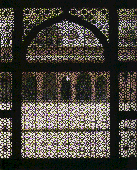
Local people's every day is not about walking; their major activities are performed inside architecture in places they work at. Hiding from straight light rays under the panjaras - the ornamental shades, as we explained earlier were applied onto the surfaces of buildings. Here they serve their practical function of protecting the building from the heat of the Central Asian sun.
Experienced from the inside panjaras cast ornamental shadows, creating games for imagination as the sun slides across the windows, changing shapes and figures reflected on the flat-cemented floor. This experience of them becomes very similar to the spiritual practices of the Islamic house, as illustrated below.
(Blair and Bloom YEAR: 273)An accumulation of insignificant events totals the everyday. These moments give architecture its history. Stories that people share with the city are inscribed in the city fabric. The theoretical picture and structural analysis of the place is distracted with inscriptions of people, their friends and many other meaningful and meaningless moments and events.
Stories are told and not lived; life is lived and not told. (Paul Ricouer)
My own trajectories, ways I travel the city every day create my own private city in a public domain. Stories that link me to the place do not belong to anyone but me, which helps me appropriate and find my own piece of mind in a city, in a labyrinth of buildings, streets and the crowd that I can differentiate myself from based on the stories and the events that happen to me in this place.
The boundaries of my city are also predetermined by the fact that I am a woman. It means that in my own respect for the Tashkent's Mislim culture, and more recently (10 years) out of fear of discriminatory racial behaviour against me (Being a 'white woman') I consciously make the choice to avoid some streets and areas in the city.
As we can see from the quotes of the people in Tashkent, presented further, they stress the importance of individual values and habits that connect us to the place with little moments and stories. Constantly eluding the plan imposed on them, these ordinary inhabitants of the city drive through it, walk into architecture, communicate, shop, get entertained etc. linking sites one to another, creating systems whose existence actually make the city.
- I never take that tunnel, when I am driving to work in the morning, even if its the shortest way to get there. There is always water dripping from the top, and I don't like it... (Reader, Storyteller No 1)
- Whenever I see that kind of building, I always know that there is a "underground" supermarket there, where I can get the best and fresh food... (Reader, Storyteller No 2)
- That's where my English teacher lives; I take her classes every Wednesday and Saturday... She is a lovely lady... (Reader, Storyteller No 3)
- My home used to be an apartment-cell, built by Soviet architects, who, I believe, specialized in politics and economics more than architecture... Half the space was unlivable and had to be reorganized... After the remodeling I did, my wife loves it and our friends love spending time with us here, we have a big entertainment area... It is better than going somewhere and returning late, because it’s not safe on the streets late at night, I would not risk it...
One thing that is not up to me to change is the lift. We live on the 7th floor, which is not that great if you are coming home and have to climb up to the apartment... (Herman Kan, Tashkent)One of the basic Situationist practices is the derive [literally: "drifting"], a technique of rapid passage through varied ambiances. Derives involve playful-constructive behavior and awareness of psycho geographical effects, and are thus quite different from the classic notions of journey or stroll. (Knabb 1958: 50) The exploration of a Tashkent is concentrating primarily on research for a psycho geographical urbanism. We simply move, walking a personal trip outside the usual surroundings. Pursuing the dynamism that belongs to tactics and suggestions, we can revived the poetic nature of living in the city.
History begins with footsteps. (Blonsky 1985: 129)
Walking after dawn allows us to experience the streets and read its intimate signs – this is the time when he city comes alive, when you hear loud music from the bars, cafes and restaurants, people dancing, having a good time. This is the best time to derive.
The Broadway, located in the center of Modern Tashkent, is among the places that attract people as a place for ‘civilized’ European style entertainment. There are many activities that happen in that place at once, you get drawn to the sites of spectacles that are identified as being the loudest or the quietest.
People watching someone stand on their hands makes you hold your breath and wait, expecting the crowd to go wild at the end of the show. Then karaoke singing becomes another spectacle, until something else triggers your attention and you get drifted to another site of the spectacle. Drifting through the place like this, you do not track your path. You become so involved in the street life that you forget about the surroundings. Buildings on this street face the two different realities. Functioning as business and commercial organizations, during the day, at night they become walls that constrain the spectacles.
The old city has many things to offer as well. Because this is where we can try the best local Uzbek cuisine. Most of the local restaurants are organized inside people’s homes, when they open the gates of their houses to welcome the visitors in, feed them and entertain them, like their own guests. The generosity, friendliness and welcoming attitude of Uzbek people are the national 'trademarks'.
Tightly walled, without windows facing the street, as you pass during the day, the houses are silent, keeping their secrets, life and excitement till after dawn. Then everyone has a chance to experience what hides inside - the sacred traditions and values of the homes of local people. The tables are set up in the middle courtyard. Ripened grapes hanging from the sides, the sound of water flowing in the small canals nearby, and the music, full of excitement add to the experience.
Therefore, walking, as suggested by Laurier, is recovered as another form of power - counter power, against the public domain of the city, creating the private routes inside his inhabited space. Walking becomes a double movement, a reflexive movement and a rhythmic movement. The commuter always returns to where he started, although this voyage fundamentally changes the traveler. (Laurier, 1995, Commuting 1)
The activities that make the city come alive cannot be completely localized. We can mark them on the city map, so that we can translate its traces and trajectories. Even though it is possible to link the points - traces of the journey that create a line on the map and how ever visible these traces are, their effect, that made them possible is in fact invisible. Furthermore, these fixations on the points transform hints into practices. They make them visible and therefore they loose their value.
The lesson drawn from derives, walking, and explorations of personal space in Tashkent enable us to expand the boundaries of the modern city, adding a psychological dimension to it. Within architecture itself, the taste for deriving may promote new forms of labyrinths made to suit intimate experiences of individuals, incorporate the symbolic narratives, histories and pasts will and possible by modern techniques of construction. Thus, the effects of more human architecture need to be promoted in the education of architects, and incorporated into a syllabus in the university courses in Tashkent. This topic is going to be explained in the next chapter.