Islamic Revival - Bricking up traces of Modernism
Interiors / Exteriors
The most striking feature of Islamic Residential Architecture is the focus on interior space as opposed to the outside or facade - the dominant form of true Islamic architecture is this hidden architecture. Generally, Islamic architecture is given to hiding its principal features behind an unrevealing exterior; it is an architecture that does not change its forms easily, if at all, according to functional demands, but rather tends to adapt functions to preconceived forms which are basically the contained inner spaces. (Grube 1966: ) In other words, it is architecture that must be experienced by being entered and seen from within. Because little furniture is traditionally used for daily life in Islam, decoration contributes to the creation of a sense of continuous space that is a hallmark of Islamic architecture.
Spiritual, religious nature of Islamic society have determines a spiritual private lifestyle. Plain, introverted Islamic houses express the need to exclude the outside environment while protecting that which is inside - the family and the inner life. The walled garden courtyard became a key feature of Islamic architecture. Its use lies in the nature of the climate in the Middle East - hot and dry. The arcaded shade, pools and fountains and glazed tiles gave a cool and sophisticated exterior/interior space within private and public buildings.
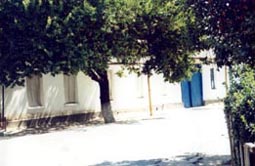
As it was mentioned above, in the Traditional Islamic Tashkent's Architecture all we might see of dwellings would be a blank wall facing the street and a small entrance for all the rooms face onto an interior courtyard. It expresses the privacy and protection of the warm family ties. Although tightly walled, it sends a welcoming message, as the door of the house is always open to any traveler, searching for shelter, and food. Doors of these houses are painted in bright colors, mainly blue and green, which also become symbolic, as these were adopted to be the national colors of Uzbekistan. The doors accommodated the symbolic entering and exiting. As the sun and moon enter the sky world in the east and exit it in the west, so shall the people enter the re-created inner cosmos of the house. The walls created a closed bounded space for the enactment of re-creating and sustaining the cosmos. The exterior walls of the house do not give away the spirit of the inner 'universe' and the house begins its essential unfolding, when we enter it.
What unfolds behind these walls enliven the boundaries between house and the outside world, opening a historical entity responsive to traditions, heritage and culture. Doors of those showing considerable wealth adapted ornament. Individually produced doors, at the local craftsman shop, become the sign of high economic status and the wealth of the house owner.
Walls
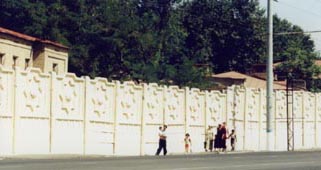
What can be observed in Tashkent today is that in the attempt to remove Modernist signatures from the Tashkent’s city fabric, contemporary Uzbek architects came back to the initial feature of Islamic architecture that was described above, and walled the Modernist architectural sites. This techniques has not been applied to cover up the entire city, however, certain parts of the city became enclosed in this structured boundary that is trying to imitate the old, turning their backs to the streets.
Windows
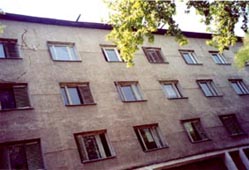
The windows have their special significance as well. Their serial arrangement on the Modernist building, three to five storeys high and in sequences of twenty windows or more, breaking up the plain concrete construction. This arrangement reflects Tashkent's past with its early modernist seriality, mass-produced and mass built apartment blocks. The windows in this way of looking at them are not for looking through but looking at them as part of the architecture - the city is repeated in them, mixed with sky. You see the same buildings reflected in every window, when a ray of light falls on them.
What we are so used to is when we walk we stare through the windows of the houses as we go by. Visible through each window are the furnishings of each house, on the odd occasion a person sitting watching television, reading something or looking back out at you. This is a very unusual experience for the people in Tashkent. There are large windows in the old apartment blocks in Tashkent, but from the outside the only thing visible is maybe flowers in the pots in front of the window, and everything else is tightly covered by thick curtain fabrics. This is a hard existence of the city, repetitive, impersonal and sad.
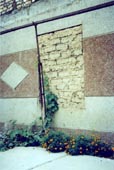
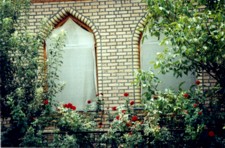
On the other hand, it is also consistent with the Islamic lifestyle, as it was noted before, a big concern for all Muslims is to protect the inner life, and as traditionally the windows facing the street were not common practice for Islamic communities, and they needed to adapt to the contemporary living since the Russian domination, curtains on the windows of the apartments became the modern day walls, protecting the sacred household from the street, pushing away the curious or jealous intruders. In some cases the windows were bricked or shaded from the outside, as it is seen on the images presented.
The Muslim living needs to be experienced from within, invited into the lifestyle and uncover the veil of secrecy to find a warm and welcoming atmosphere to those who wish well for the household and its inhabitants, experiencing the generosity and wisdom of the Islamic people. Which makes us see that architecture is not about geometry or power, it is about people and the experiences that happen in it.
Therefore, for the city's residents, whether they live in a Modernist apartment block of the 70s, still maintaining its signs of a soviet regime or stay in an Islamic house, the city is not about the buildings it is about activities like work, leisure, shopping, family, friends, events and situations that happen inside these buildings. Although very impersonal, static and heavy from the outside, these buildings come alive, creating an atmosphere of dynamism and movement from these activities, linking the body and our emotions to it.
To view these differences in architectural appropriation and re - appropriation of place in Tashkent is important. However, it is not enough, and in order to understand Uzbek Architectural trends and their relation to place it is not enough to only focus on the observations of their practice but examine the relationships between people and their responses to such architectural practices. Therefore the next chapter is going to discuss the vital activities of Tashkent's inhabitants that make the city and its architecture livable, taking into consideration the diversity of their interpretations.