Based on the findings from the previous chapters we observed that through history Uzbekistan experienced constant struggles between cultures, constantly needing to define and redefine their own identity. Religious and ethnic isolation of native Uzbek people, continuous suppression and refusal of their Traditional roots and beliefs lead to strong cultural separation. External conformity to the laws of dominant ideology counterbalanced the internal resistance of the foreign imposition and overwriting of already established laws of the region. This inter-ethnic unrest also became apparent in the built environment and urban planning techniques, that we identified in chapter two, being the clash between Islam and Modernism.
(Blair and Bloom 1997: 273)The aesthetic battle of these two rival approaches to the city and place-making in Tashkent, Modernism and Islamic Tradition required a compromise to resolve cultural and ethnic oppositions. The major elements of Islamic architecture are ornaments that establish a positive connection with the built environment, because they tend to encourage curiosity and discovery, questioning the nature of things and giving rise to imagination. Successful ornamentation includes rhythm, repetition and reversable positive and negative space, generating translational and rotational symmetries that never conform to their elements but reinforce multiple individual interpretations. Experiences of architecture involve intimate interaction with surfaces and spaces, which influences our emotions and physiological state and consequently our actions. This connection resides in the information content of space and its transitions. Even though surface qualities are usually assumed to be separate from the spatial geometry in a building, they are in fact interdependent, and both contribute to how people respond to their surroundings. Our visual and mental make-up is linked through human evolutionary processes to the informational richness of the environment. This biological background helps to explain some aspects of why human beings create ornament.(Salingaros 2001: The Sensory Necessity for Ornament.)
Islamic architecture has used this mechanism to establish a positive connection for centuries. However, because in the Modernist aesthetic ornamentation was considered a crime (thinking of what famous Austrian architect Adolf Loos, wrote in 1908, "ornament is a crime"), the emotional connection to architecture was neglected in favour of pure geometrical form. Hence, an environment lacking in texture, colour, and ornament can be punishing for a human being, because we seek meaning from our environment and are repelled by environments that convey no meaning, either because they lack visual information, or because the information present is disorganized (Salingaros 2001 - 2002: A pattern measure)
The necessity of ornament is psychological. There exists in man a certain feeling which has been called 'horror vacui', an incapacity to tolerate an empty space. The feeling is strongest in certain savage races, and in decadent periods of civilisation. It may be an ineradicably feeling; it is probably the same instinct that causes certain people to scribble on lavatory walls, others to scribble on their blotting-pads. A plain empty surface seems an irresistible attraction to the most controlled of men. Herbert Read - 1934 (Greenhalgh 1993: 13 #17)
Understanding the cultural significance of decoration and the way it revives the emotional link established between people and built structures Uzbek architects were presented with a design challenge: to adapt to the new regime and maintain the traditional and cultural objectives. In the search to reclaim their cultural identity and attempt to rediscover the originality of Tashkent's architecture, architects subverted the system from within, not by rejecting the architecture, but by transforming it, attaching symbolic significance to buildings. For Michel de Certeau such actions would be called tactics.
In de Certeau's book "The Practice of Everyday Life", he begins with the premise that disciplinary powers are infusing society with their grid of control more and more extensively . The question then is how an entire society can manipulate the mechanisms of discipline and conform to them only in order to evade them. (Weidemann 2000: Some Words on de Certeau) De Certeau is interested with what devices, actions, and procedures people use every day on the micro level in order to subvert, for brief moments, the disciplining powers. He finds the answer to this in "the tactic".
A tactic must: "...make use of the cracks that particular conjunctions open in the surveillance of the proprietary powers. It poaches in them. It creates surprises in them. It can be where it is least expected. It is a guileful ruse. (de Certeau 1988: 37) Tactic is an art of the weak. A tactic is determined by the absence of power, it must play on the terrain imposed on it and organised by the law of a foreign power. It is a manoeuvre within the enemy's field of vision and within enemy territory. It operates in isolated actions, it takes advantage of the 'opportunities' and depends on them (opportunities).
Such "Tactical trickery" of Uzbek architects, as suggested by de Certeau, played on the strategy that Modernism offers a simple universal constraint on built form, which is geometry. Therefore the next step here is to examine the way geometry generates opportunities for tactical ornamentation.
Geometry was the basis for both forms of architectural expression. Modernist geometry, on the one hand, had the formal structure of design, as it relied on ____________________. Islamic Architecture, on the other hand, also had a strong mathematical support, evident from the research done by Al-Khorazmi and other scientists, discussed in the first chapter, despite the fact that it draws its sources of inspiration from nature and spirituality. Isalmic scientific base rationally justified application of ornaments on the surfaces of architecture in Tashkent. That was the root of its success, to displace modernist style and offer something slightly more complicated than pure, rectangular forms. The underlying geometrical order of patterns that constitute majority of Islamic ornament have been rationally organised to fit Modernist obsession with pure shapes and forms and abstraction.
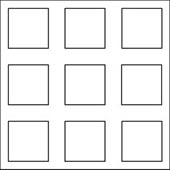
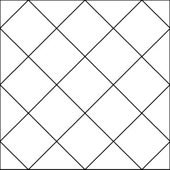
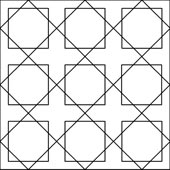
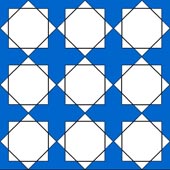
The following paragraphs will examine the construction of geometric patterns, by using one example.
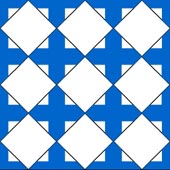
It is easy to notice that ornamental Islamic patterns although belonging to a different practice, complies with some norms set up by Modernist discipline. Careful observation of the illustrations below will uncover the structure of the one pattern motif, and further prove the connection between Islamic and Modernist geometries.
The constrution of a pattern Following this, ornaments attached to buildings were the ways of using the constraining order of the architectural modernist strategies, and establish within it a degree of individuality. This 'tactical' decoration allowed architecture to function in the metaphorical mode, remaining within modernist system, but functioning to respond to local audience and make it become less frightening and more welcoming. The effect of tactical decoration is demonstrated in the next example of a building in Tashkent.
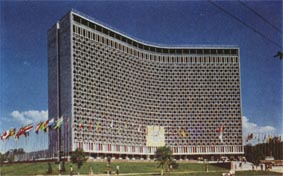
Tashkent, Hotel 'Uzbekistan', 1974
(Kadirova 1987: 213)One of the most attractive and prestigious buildings in Tashkent today, situated strategically in the business centre of the new city, is Hotel "Uzbekistan" (1973), one of the examples of this new form of architecture. The structural and stylistic forces that influenced the form of the hotel and generally architecture of Tashkent have some very distinct features like simplicity and geometry. There are plain monochrome surfaces, straight lines, that are evident in Modernist constructions. However, what differs is that we see the application of panjaras (shades), square shaped to create a continuous geometric pattern, that covers the surface of the hotel. Since Tashkent's culture and architecture had been subjected to an alien ideology and design aesthetics, Uzbek architects used the laws, practices and representations that were imposed on them by force and made something else out of them.
Ornamentation, as a subversion mechanism of the overpowering modernist domination in architecture in Tashkent did not challenge Modernist ideals. Justified application of patterns had a hidden meaning, which could only be understood only by people in the culture, as decoration has not only established visual and tactile connection between people and this building. It also unconsciously gave them the ownership rights to the Hotel, superimposing the modernist strategy with powerful decoration and allowed the Hotel to be transformed into a habitable space and encouraged Uzbek people to feel more comfortable with the building.
Uzbek people relate to the shape of the building as an Open Book. The structure and the shape definitely could be associated with the Koran book, open in the middle. A significant aspect to notice here is that the book is turned away from its native people, facing the new city, which demonstrates even further the domination of the socialist regime and decoration here also became a form of retreat, at least superficially, to the Islamic architectural past.
This exercise showed that it is possible to built symbols and use the vocabulary and the elements of the architecture of the past to bring architecture within reach of the whole society. The use of the ornamentation can be seen as metaphors which signify individuality, distinctiveness and express the building's new status.
Tactical actions of local architects achieved a compromise that balanced the two design aesthetics, reviving cultural themes in Modern architecture and creating the individual style for a socialist Tashkent. The next chapter will be a more extensive study of such signs and symbols in architecture of Tashkent that is going to lead us further to interpretation of the city by its people, based on the effects of this architectural symbolism.