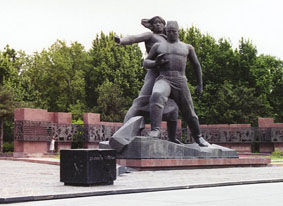
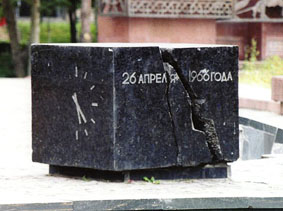
Earthquake memorial - "Courage" (Tashkent)
(Photos by Galen R Frysinger, Sheboygan, Wisconsin)
Our first step will be to look at the history of Tashkent and its documents. The discourse of this history is largely constructed around important dates and important individuals. The major source for reference for this chapter became the Library of Congress / Country Studies / Uzbekistan that helped to justify the important dates and events as well as such authors like Sokolov, Kadirova and Zasypkin. This chapter will analyze the Early Islamic Period, Mongol Period, the Rule of Timur, Russian - Soviet Period, providing some details and their significance towards the establishment of Uzbek national architectural identity.
Architecture is a visual aspect of history; that is the way in which history appears. (Zevi 1993: 165)
Uzbekistan is a land on many hybrid, contradictory historical and cultural experiences. Its culture involves foreign elements, alterities and differences. The modern term "Uzbek," as an ethnically distinct group, is very difficult to define because of this confusion and due to the fact that many peoples have conquered the region now called Uzbekistan. The early historical accounts documented the tight trade-craft relationships of Uzbekistan with Greek, Roman, Iranian, Mongolian, Indian and Chinese cultures as well as their influence on the establishment of Uzbek traditions, because of the quests for domination of these nations on Uzbek territories.
Located at the crossroads of international trade, Uzbekistan was one of the main centers of arts and crafts in the region. The wealth of the country was a constant magnet for invasions. Numerous wars were fought between Uzbek states and the other countries maintaining in perpetual conflict over the region. Alexander the Great conquered Uzbekistan in 328 B.C., bringing it briefly under the control of his Macedonian Empire.
Later, the conquest of Central Asia by Islamic Arabs, in the 7th century introduced a new religion and culture that continue to be dominant. Islam, brought by the Arabs spread gradually in the region. The native cultures were being displaced by Arab influences. Under Arab rule, Central Asia remained an important center of culture and trade for centuries.
The Mongol conquest of Central Asia took place from 1219 to 1225, which was one of the turning points in the history of the region. It brought the large-scale damage that was inflicted on cities by the warriors, which also had a negative impact on the state and cultural life of Central Asia. Cities were exposed to plunder and destruction. The architecture and the irrigation networks in the region suffered extensive damage that was not repaired for several generations.
Following the death of Chinggis Khan in 1227, and the break up of the Mongol empire, the conqueror and the new emperor of the region, Timur (Tamerlane) had emerged in the 1380s as the dominant force in Central Asia. His empire (Mawarannahr) extended its territories, reaching the Asia Minor in the West and up to India in the East. By gathering in his capital (Samarkand), numerous artisans, masters - handicraftsmen and scholars from the lands he had conquered, Timur aimed to make his capital - the best city of the world. By supporting such people, Timur imbued his empire with a very rich culture. Till now majestic constructions, made during Timur's rule testify to grandiose civil work which six centuries beforehand were made in Samarkand and in other cities, like Tashkent. (e.g Kukeldash Madrasa, XV c.) Timur had also patronized scientists and artists; his grandson Ulugh Beg was one of the world's first great astronomers, who also encouraged science, literature and art, The same century saw the rise of the great poet and thinker Alisher Navoi, the ancestor of the Uzbek literature.
In the century of enlightenment, sciences, mathematics, chemistry, medicine as well as architecture were at its peak. Uzbekistan as an enlightened nation gave us bright philosophers like Abu Nasr Farabi and Abu ali Ibn Sina, scientists like Abu Raihan Beruni, and many others. Scientific research in geology, land surveying and mathematics were combined with spiritual quest for truth and harmony. Humanistic, spiritual ideas were reflected in the architecture of that time. This architecture of the XV - XVI century in Uzbekistan was rooted in passion for life, nature, and natural forms, and was full of the vitality of the natural world. It was a living tradition, and is best experienced with all our senses by visiting real buildings that still remain. Sites of Islamic architecture in Tashkent are visually poetic, and environmentally aware; they embody harmony of place, person and materials. They also emphasize beauty their expressive and distinct forms are sympathetic to the human body, mind, and spirit. Such architecture balances the lifestyle of the people, their activities and the surroundings. It draws its sources of inspiration from natural forms, fascination with geometry, and the environmental challenges.
After the nineteenth century Uzbekistan fell under the Russian rule. During the first few decades the daily life of the Central Asians did not change greatly. The Russians substantially increased cotton production, but otherwise they interfered little with the indigenous people. Some Russian settlements were built next to the established cities of Tashkent, but the Russians did not mix with the indigenous populations. (Library of Congress / Country Studies / Uzbekistan, 2001) In second half of the 19-th century Central Asia was still considered the weak peripheral territory of imperial Russia. However, the connection of Uzbekistan to Russia had its influence on the everyday life, as it initiated the development of economy, culture and education system. This was also reflected in architecture of Uzbekistan, as a myriad of narrow winding alleys stood in sharp contrast to the new Tashkent, where principles of Russian regular town planning took root. The Russian architects had developed the new radial - circular street structure, emphasizing the rationality of geometric forms, uniformity and repetitive monotony. (Add picture or Map)
However, traces of this history remain in the architecture, allowing the past moments of the place come alive. When investigating the sources of Soviet history one immediately detects contradictions. One source says that the religion and long established cultural traditions were highly persecuted under communism; most Islamic architectural icons were destroyed or converted to soviet government purposes. The other source states the opposite, that the Soviet authorities did not prohibit the practice of Islam, but encouraged continuation of the role it played in Uzbekistan. Much of the literature available for review today was mainly written and published by the Soviet architects and historians like Kadirova or Zasypkin. It involves praising interpretations of cultural and architectural history from the Soviet perspective, which present a challenge in search for truth about the history of Uzbekistan. Another contradiction that becomes evident from the literature is that after a victory of the Great October Socialist revolution historical monuments were taken under the state protection and they had been restored. On the other hand, the surviving buildings that were returned to the people were little more than four walls. And such devastating destruction of historical icons had taken much of the flavor out of the overall city fabric.
The Uzbek poet Cholpan lived only in the first quarter of the 20th century. But his vision of this century was very precise.
THE TWENTIETH CENTURY
This has been the century of science and capability,
This has been the century of ascending humanity,
But the events demonstrate that, indeed,
This has been the century of evil and depravity.Cholpan [1924]
Denied spiritual and religious freedom by the Soviet Communism Cholpan with many other artists, poets and writers was were publicly disgraced for writing lyric poetry instead of Soviet propagandist poetry in the late 1920s and 1930s. They were detained several times, and finally killed during the Stalinist purges like other hundreds of Central Asian writers and intellectuals. (Kocaoglu 1996: Cholpan and the 20th century)
Another aspect that robbed Tashkent of its history was the earthquake, which struck on the 26th of April 1966, when the whole city was crashed to the ground and needed to be rebuilt again. The consequences were devastating, as the whole city was completely destroyed and 2.5 million square meters of houses could not be restored. This catastrophic event had triggered and stimulated the growth of the building industry in Uzbekistan. With the help from the Soviet authorities who recognized the urgency to rebuild Tashkent, the city had been reconstructed quickly (3 years) by architects and builders from other Soviet Republics. These quick rates of construction were the result of the development and installation of mass-produced architecture.
|
|
|
|
|
Earthquake memorial - "Courage" (Tashkent) |
||
With the growth of industrialization, during the Soviet Period in Uzbekistan the dominant feature in architecture became mass produced paneled concrete buildings. As the industry advanced, the size of the produced concrete slabs increased, which inevitably resulted in the reduction of flexibility of their combination and building design options. (Kadirova 1987: 137) For these reasons, industrially manufactured housing, produced during the Soviet times was rather monotonous and average in their concrete flatness. Such architectural practices are another way of oppression of the local people from the stronger, more powerful dominant communist ideology, as well as being emotionally discomforting.
Facing the overwhelming and emotionally disturbing results of this disaster, the reconstruction of the city required not only provision of housing for the victims, but also spiritual support for these people. It is known from studies in environmental psychology that modernist concrete structures make their inhabitants feel very uncomfortable. (Salingaros, 2001, Geometric Fundamentalism) Therefore attempts to improve external shape of large-panel houses by color finnishes, introduction of decorative and structural spots and ornaments softened the effect of modernism. It also allowed personalization of this new architecture to satisfy not only the need for shelter after such terrifying event, but also provide emotional resolution for the inhabitants of the destroyed city. The hands of national craftsmen masters had also returned to life unique Islamic historical monuments, like Madrasa Kukeldash (XV century) that was also damaged during the earthquake. This further strengthened people's hope for their future and provided the spiritual support they required.
We will pick up on the history again, when discussing the contemporary town-planning strategies in Tashkent in chapter 4.
So far, we discovered that the cultural and architectural history in Uzbekistan faced many obstacles. In its search for its identity the city of Tashkent had balanced out the influences and forces shaping it, adapting and appropriating the features that were imposed on it either by force or by need. The place in Tashkent is caused by different pasts that came together to create the city. Therefore it is evident that the traces of history, that are reflected in the place, are important for exploring the historico-social sense of place in the city of Tashkent, its architecture and the relationships between Tashkent and the city's inhabitants. The next chapter is going to uncover the role played by these architectural forces, their influences on the city and the people.