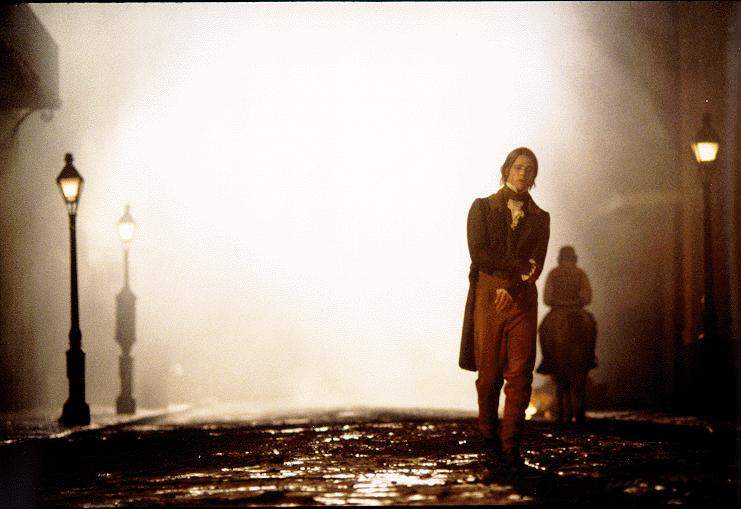
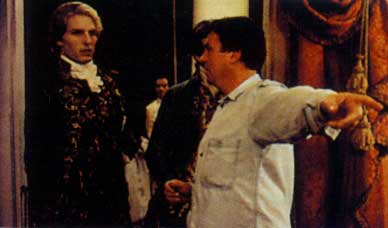
| Interview with the Vampire finally began its production schedule with 40 days of nightshooting near the bayous of Louisiana. The first few days, mainly close-ups of the actors, were scrapped when David Geffen decided the vampire make-up was too heavy. These shots were eventually picked up on a British soundstage where the production team recreated the bayou backdrops. Production for the studio shot scenes switched to London, with the starts fllying in over amid something of a media feeding frenzy. Tabloid newshounds and photographers would try every trick under the book to infiltrate the set and snap the much-sought first photograph of Pitt or Cruise in full vampire regalia. Such was the paranoia that a covered walkway-cum-tunnel was built to cover the route from the dressing rooms to the sets from prying eyes. But Jordan's precautions were in vain after a British tabloid paper managed to snap the eagerly awaited photo of Tom Cruise. Although one of the world's biggest filmstars, Tom Cruise has never been renowned for his acting ability and the part of Lestat was regarded as difficult for him, not only by Anne Rice, but by many people involved in and outside of the production. More practically, Cruise was shorter than his six-foot-tall co-star. Rumours emanated from the troubled set that Cruise's voice was proving to be too high, but Cruise himself was felt to be too short to be credible opposite Pitt. Platform boots were quickley ordered up to make the co-stars of more equal height, according to the rumours. Not so, sources on the production said, claiming that Cruise's eriod boots, which were merely part of his costume, happened to have the happy side-effect of making him taller. That wasn't the end of the problems between the stars though. They may have passed the time recreating Cruise's Days of Thunder in go-cart races, which Cruise invariably won, but the rival leads were wary and mistrustful of each other. They had been forced together on this movie by the logic of Hollywood packaging deals, but they were rivals for the same crown and they both knew it. The battle royale between the stars was only the last in a long line of troubles that had dogged Interview with the Vampire for over 18 years. Thankfully, there was a silver lining when near the end of post-production a videotape of the film was sent off to Anne Rice to solicit her opinion. The resut was double page advertising spreads in the Los Angeles Times, The New York Times and Hollywood's in-house newspaper, Variety, in the form of an open letter from Rice declaring how much she actually appreciated the movie, which you can read here. It was quite a dramatic about-face after Rice's earlier vehement statements about what she saw as horrendous miscasting. The cost of placing th advertisements would be pretty close to $100,000. All suggestions that Hollywood commerce had won out and that Anne Rice had been in receipt of a not inconsiderable sum of money to endorse the film were all rejected out of hand by all parties as false and malicious. David Geffen was pleased with Rice's Road-to-Damascus-like conversion to the film version of her work. The next test to be faced by the film would be the international press critics. Neil Jordan was particularly concerned with how the critics would react to his film. he had more to worry about than other filmmakers. Rice's earlier intervention in the production of the film had been widely noticed, perhaps even more so than the pages proclaiming her support for the film. The critics were reserved. David Denby in New York magazine found the film 'boring... and remote', while Rolling Stone was 'Dazzled, but unmoved', and The New yorker claimed that Jordan's 'virtuosity cannot hide the movie's emptiness'. British critics were less harsh but here ambivalent about the peformances of both Cruise and Pitt. According to the Daily Mail, 'Pitt reains a whining, monotonous killjoy...', while the Sunday Exress felt 'Brad, as the reluctant bloodsucker Louis...is far more suited to the role of scrubbed sexual magnet in more gentle films such as A River Runs Through It...' Other pblications were kinder. According to The Independent, 'Brad Pitt wanders the centuries looking elegant and melancholy, which is a relatively easy task given that vampirism in this version isn't disturbing.' The Guardian pegged Pitt's Louis as 'far from a grim cardboard cut-out. [Cruise] is more than equalled by Pitt, who tells his story of descent into hell...' The public voted in Interview with the Vampire by buying tickets to cinemas, with the film taking $38,7 million over its first weekend. the film was placed fifth on Variety's list of all-time biggest openings though by the end of its run, the movie was expected not to gros much more than a very respectable $110 million. |
 |
 |
 |
 |
 |
 |
| * In the scene with Louis, Lestat and the two prostitutes ("End her suffering!") there is a moment after Lestat slits the girl's wrist and fills the wine glass where he walks to Louis saying "I never knew what life was until it ran out in a red gush...[holds the glass to Louis' face, tempting him to drink]...over your lips." The line was deleted from the film, but wound up in the film's cinematic trailer and television ads. * Reportedly, in original screenings of the film there was extra footage in the scene where Louis finds the burnt bodies of Madeleine and Claudia. In this version, after the bodies crumple to ashes, Louis takes Madeleine's locket that has the picture of the little girl who resembles Claudia. * Factual errors: Neither the sun nor the moon can be directly above Paris, hence the bottom of the well would never be illuminated directly. * Continuity: In the Theatre des Vampires, the mortal girl's top is opened twice. * Continuity: Lestat flings the lid off his coffin and places the prostitute inside it, then slides the lid from the bottom of the coffin to the top without picking it up off the floor. * Continuity: At the end, Molloy exits the building with his hands empty. His car keys are then in his hand as he puts them in the ignition - without his ever removing them from a pocket. * Continuity: Given the angle at which Lestat bites the rat, its blood would have to flow toward its tail and from the left side. However, he squeezes it with its head down and on the right side. In spite of this, blood flows into the cup. * Incorrectly regarded as goofs: When Santiago walks upside down on the inside of the Paris archway, his cloak continues to hang toward his feet instead of towards the ground. Obviously this is physically impossible, but then so is walking upside down; if he can do that, then why shouldn't he be able to control his cloak? * Incorrectly regarded as goofs: After spending the period from 1859 to 1994 in a cemetery, apparently never leaving, Lestat knows how to drive a car. While not really explained in the movie, he could have learned this telepathically. * Continuity: Louis pours the flammable liquid all over the stage stairs, but when he sees the last remaining French vampire, there's a section of the stage not even touched by the fire. * Revealing mistakes: When Louis sits up after being transformed into a vampire, his colored contact lenses are clearly visible. * Revealing mistakes: When Lestat is attacking Claudia, his shirt tail flips up, revealing un-made-up skin. * Anachronisms: Louis watches Tequila Sunrise (1988) in the spring of 1988 but it was not released until December 1988. * Continuity: During the long tracking shot at the beginning of the film, Louis is seen standing on the balcony. His hair is down around his shoulders. But in the reverse shot, seconds later, his hair is pulled back in a ponytail where it is for the duration of the movie. * Continuity: When The Reporter starts his tape recorder in the beginning of the movie there is some dialogue and then Louis starts to tell his story. When the tape is inserted into the car stereo it immediately begins with Louis' story. Based on the way the movie appears to have occurred, there would have been no time to advance the tape prior to listening to it in the car. * River Phoenix was cast as The Interviewer, but died before filming began. Leonardo DiCaprio was approached to play his role, but Christian Slater eventually got the part and donated all of his earnings from the film to Phoenix' favorite charities. * Christina Ricci auditioned for the role of Claudia. * Author Anne Rice wrote the part of Lestat with Rutger Hauer in mind. Upon learning that Tom Cruise had been cast, she was quite disappointed and expressed concern that Cruise could not carry the part. After attending a screening, Rice wrote a letter of apology, quite pleased with Cruise's portrayal. * Cruise wanted a private set, and hence tunnels were built to escort the actors to and from the set. This was done so that the vampire's makeup effects would remain a secret. * Cruise was placed on an elevated platform during some scenes to reduce the height difference between his character and other vampires. * The scenes set on the riverfront in New Orleans (including the infamous "Chat Noir") were filmed on a false front built on the levee downriver from the actual French Quarter. The entire set was constructed around the old section of Jackson Barracks, a National Guard post. * The river scenes were done by removing such modern items as the Greater New Orleans Bridge and radio towers and replacing them with 18th century sailing vessels in post-production. * Many buildings and street lights were darkened for the filming by agreement with the companies and the city. The set was immediately torn down after the filming.. The Victorian house that inspired Anne Rice's novel on which this film is based is located at 503 Divisadero Street near Alamo Square in San Francisco. * Stephen Rea (Santiago) makes regular appearances in Neil Jordan's films. * The Interviewer's name, Malloy, is never mentioned throughout the movie; it only appears in the credits. * Johnny Depp was offered the role of Lestat. * Dedicated to River Phoenix 1970-1993 * Budget $50m (USA) * Gross $186,287 (Czech Republic) $116m (Non-USA) SEK 11,343,445 (Sweden) $15.911m (UK) �9.54m (UK) (19 February 1995) �2.334m (UK) (22 January 1995) $105.264m (USA) $221.3m (worldwide) Admissions 1,503,831 (France) (31 January 1995) 188,796 (Sweden) Theatrical Rentals $45.1m (USA) Filming Dates 18 October 1993 - April 1994 Filming Studio Location Pinewood Studios, Iver Heath, Bucks (UK) *Release dates USA 11 November 1994 Germany 1 December 1994 Sweden 9 December 1994 The Netherlands 15 December 1994 Denmark 16 December 1994 Finland 16 December 1994 Portugal 16 December 1994 Spain 16 December 1994 France 21 December 1994 Argentina 22 December 1994 Poland 20 January 1995 UK 20 January 1995 France 17 October 1997 (Cherbourg-Octeville Festival of Irish and British Film) |
|
 |
|