|
 |
 |
 |
 |
 |
 |

|
Spotlight
17 February, 2005
Rio Carnival 2005
This evening I can take the camera. I have been given permission by my friends. It has been a whole week of sights for me. For instance, the roof of a car loaded with three meters of a papier maché sculpture that could have been the very tip of a giant cornucopia… hard to explain that concept; or walking through a section of the city that reminds me of the souks in Morocco, full of stores and people, and where there is no space to walk. In most of these stores there are carnival items, from plastic masks to shimmering, colorful cloth, feathers, and sequins. In mandatory tourist spots municipal workers hang festoons and lighted carnival signs. Hammer sounds and bolts secure temporary stages made of tubular steel. Last Sunday I was at the Sambódromo with the usual suspects. (The Sambódromo is a long boulevard where the Carnival floats pass by, with bleachers on either side for spectators. You have to pay to get in, of course). I had the camera with me even if I had no idea what to expect. It was natural I’d start shooting with the enthusiasm of the moment. Immediately, I was told it was not worth it—this was not even half of the real thing, it was only a rehearsal. Ok, imagine a drill at the Super Bowl where everyone from ghetto dwellers to high rise tenants participate to applaud for their team and all you see is an ocean of pink, green, and orange tee-shirts in the bleachers cheering for their favorite samba school as it passes by in the avenue below. No, my friends assured me, it’s not worth it, and they are not even wearing a “fantasia.” But this evening I can take the camera.
Queen for the night
“Fantasia” means fantasy, whimsy, dream, but it is also the name for the classic carnival “costume.” And what costumes!! Or should I say… What costume??? In fact, the opener of each ala is usually a beautiful woman dressed in scanty clothes whose function is to present the wing and incite the crowds to delirium with fast paced samba steps. See photo at end of article..
(Discretion advised … )
Last night, barely stepping into the street from the apartment building here in Lapa was like entering full blast into the current of Carnival river. It was nearly 11:30 pm. and I had not been out all day. Street vendors were at temporary posts selling their wares from roasted cheese cubes to jewelry to caipirinha. Cariocas and tourists mingled, most with beer cans in hand, some with plastic flower leis around their necks. Some young people wore earrings and necklaces made of condom wrappers. Here and there a few were in costume, but everyone, invariably, had no destination and no concept of time. The makeshift stages were now sending off the traditional sounds of past enredos (samba school theme songs) and other popular music. My first taste of it was right here in the building right after I arrived. Then it was almost a lulling sound that was preparing me for what was to come. Imagine this: the kitchen window is open along with, I presume, most all others in the complex. (Remember it is summer here! )
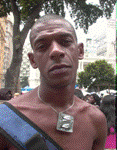
Condom necklace worn by a local to find a date
By 10 am you can already hear the fourth floor woman sing along with her favorite enredo. By 7pm, when most dwellers return from work, the open windows transform into throbbing pathways that carry clear sounds. Inevitably, by 9pm there is the all encompassing surround-sound effect when the popular telenovela is on TV. There’s no way around it. Life.
In the plaza, like a video camera, I remember how my eyes followed the movements of people who watched the stage, waved their arms and sang along. Here is the thing: everyone knows all, a-l-l the words to every song being sung. The usual suspects and I walked through groups of people in dancing chains, we joined some, we ate churrascos (skewered roasted meat). A man danced by and for himself. Men and women danced. And sang. And danced. And drank beer. But this evening I will take the camera.
To describe the impact of the Sambódromo experience is nearly impossible within the space of this newsletter. The sound of the bateria as it passes by with decibels way beyond measure beats in unison with your heart increasing its palpitation to almost orgasmic levels. I know I risk accusations of poetic excess in my prose here but, as I said, the feeling is nearly indescribable, except for the use of meager words like joy and euphoria.
I finally understood the samba school concept when I saw the first one parade down the avenue of the Sambódromo. Assume you are a Pittsburgh Pirates or a Miami Dolphins fan and you want to participate in the Super Bowl… (I said assume, didn’t I?—I can hear someone out there laughing—I don’t even know if these teams would play in the Super Bowl)… anyway, you will pay your dues to the team and work all year long with various coordinators who work on sounds, uniforms, movements. Such is the technical mechanism of a samba school. Each includes members in the thousands, and has its headquarters in a section of the city, for instance Copacabana, or Tijuca. There are two divisions of schools: Grupo de Acesso A and Grupo Especial, to which the richer schools belong. The winner of Grupo A moves up to the Grupo Especial the following year, and the last one in this group is demoted to the former. União da Ilha do Governador, for instance, is a smaller school with 3000 members, 27 wings, 200 rhythmists, and only 5 allegorical floats. Each school chooses a theme and theme song (enredo). For instance, one
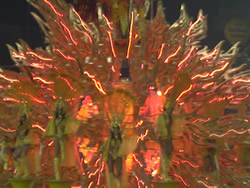
Salgueiro Samba School's
Sun Float
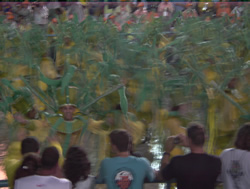
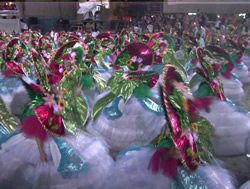 Each samba school has a wing of the famous rotating Baianas
Wing, or ala, represents sugar cane
I really enjoyed was “Fire” (Salgueiro Samba School): fire that was there at the beginning of human evolution, fire to give life (sun), fire of faith, fire that purifies the soul, fire to cook, etc. Each of these themes is represented by an elaborate float, complete with most brilliant art forms and people in the most incredible “fantasias” or costumes.
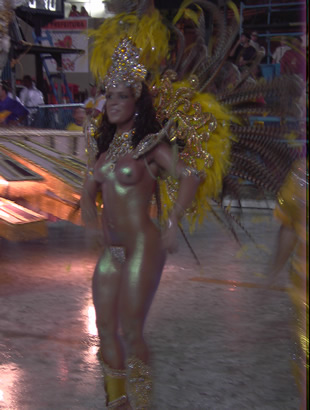
Salgueiro even had a float representing a volcano that spit out real fire. Another float was so unbelievably creative in its representation of purgatory to the point that I was so mesmerized I didn’t even take a picture of it! (Hard to believe for those of you who have suffered through my camera fits, no?) In addition, there are wings of the school, or alas, each representing yet another element of the theme, say, sun rays, so 200 people might have a fantasia that recalls sun rays, and they will parade as one unit before or after their float. Another example of a wing is in a school that had the Bounty of Brazil as their enredo so it was represented by people dressed in sugar cane. As I mentioned, “fantasia” means fantasy, whimsy, dream, but it is also the name for the classic carnival “costume.” And what costumes!! Or should I say… What costume??? In fact, the opener of each ala is usually a beautiful woman dressed in scanty clothes whose function is to present the wing and incite the crowds to delirium with fast paced samba steps.
Copyright © by Emilia Garofalo. All rights reserved. No part of this newsletter may be reproduced or transmitted in any form or by any means, electronic or mechanical, including photocopying, recording, or by any information storage and retrieval system, without permission in writing from the publisher.
Abre-alas, presenter of one wing of the Renacer de Jacarepaguá School of Samba in Marqués de Sapucaí avenue (Sambódromo)
The last group to go by is the bateria (again, preceded by their ‘queen,’ rainha da bateria). The band is the lifeline, the blood that pulsates and makes the whole school dance for nearly an hour and a half in this massive display of dazzle that slowly moves down the avenue. Its members are also in elaborate costumes, but what is so amazing to me is the energy they placed into their sound. You would think that by the end of a mile or more and for 90 minutes of total frenzy in a hot costume to boot you would be exhausted. It is only after the spell is broken under the arches that they feel it, according to the statements of one of my friends who described his experience as a participant one year as pure exhilaration and ecstasy, but completely crushing afterwards. In fact, I noticed on the last day of the week long parade, when the judging was finally over, that many were tossing pieces of their costume from the floats, much like winning gladiators, to the cheering crowds that were by now hysterical. When fireworks died down at daybreak, a silent crowd moved out of the stadium to streets that were now strewn with plumed headpieces, sparkling galoshes, and muddy spangles. I stooped to pick up a small green feather to tuck into the pages of my life journal.
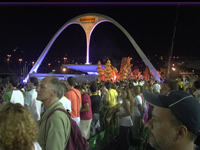
The great arch, famous symbol of the Sambódromo in
Rio de Janeiro.
|