July 3, 1863
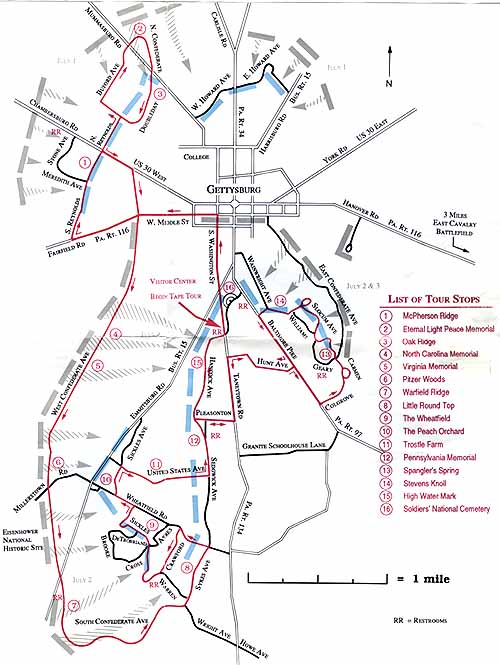
The third day of battle began with another unsuccessful attempt to take over and occupy Culps Hill. Meanwhile, a mile east of Gettysburg a Confederate Cavalry of 6,000 troopers held orders to attack the Union rear. Union cavalry with a strength of 5,000 confronted them in a hot firefight that contained and turned the Confederates back. General Jeb Stuart led the southern forces and among the Union leadership was General George Armstrong Custer.
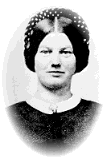 Between the Union line on Cemetery Ridge and the Confederate outposts in the town, was the home of Mrs. McClellan with her new baby. Helping her with the child�s care were her mother and her unmarried sister, Jennie Wade. Throughout July 1 and 2 Jennie baked bread for grateful Union soldiers. On the morning of July 3rd, while Jennie stood in the kitchen kneading dough, a bullet pierced the door and struck her, killing her instantly. The cries of her sister and mother attracted Union soldiers who carried Jennie�s body to the cellar. Jennie was the only Gettysburg citizen killed in the battle.
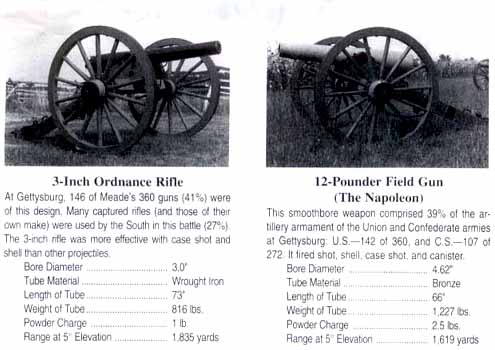
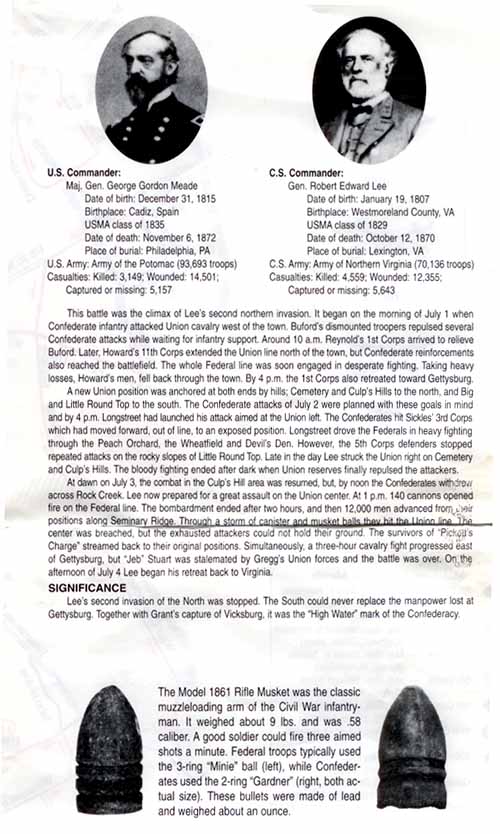
At 1:00 p.m., the largest cannonade that ever occurred on the North American continent preceded the planned charge. Unknown to General Longstreet, in charge of the famous assault, the cannon fire, which was to decimate the Union center overshot their target and did nothing more than devastate farm fields far behind the Union troops.
When the cannonade ceased 12,000 Confederate soldiers marched from Seminary Ridge in parade dress formation to launch a famous, heroic attack upon the Union center, forever ingrained and immortalized in history as Picketts Charge. The Confederate objective was a small clump of trees, 1 mile away across an open field. Once the smoke from the cannonade cleared the field, Union forces watched their soon to be combatants in awe. They admired the intense patriotism and desperate dedication of the men before them. Still, once within range, the Union artillery hit and mowed down the columns of men like blades of grass. Two out of three Confederate soldiers would not return.
Incredibly, a small number of Confederate forces reached the small clump of trees in their brave determination and held the land for a brief period of time. Their courage and heroism gave way to the devastating realities of war as Union forces engulfed them from three sides. The group of trees became known as the High Water Mark of the Confederacy. Picketts division and other elements in the attack were virtually destroyed.
Retreating back to Seminary Ridge, General Lee waited and upon seeing General Pickett and realizing the defeat that occurred, advised Pickett to reform his division in the event of a Union counterattack. Pickett, looking at Lee responded, "General Lee, I have no division." With these words, and after 3 days of devastating carnage, the battle ended with the Confederates being defeated and retreating back to Virginia the next day. Sadly, the horrors of the war would continue for another two long, bloody years.
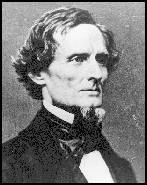
By coincidence or perhaps an omen, the next day happened to be July 4th, known as America�s Independence Day. It was on July 4th, 1776 that the first 13 colony states formally broke away from Great Britain and formed a new nation called the United States of America. In perhaps another omen that the United States should be one country, this same day, the Confederate stronghold and gateway to the west, the city of Vicksburg, MS fell to a Union general, who 2 years later, would accept the surrender of General Lee and Confederate forces at Appomatox, VA. That General - Ulysses S. Grant.

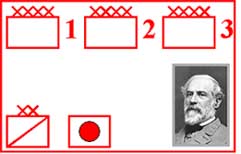
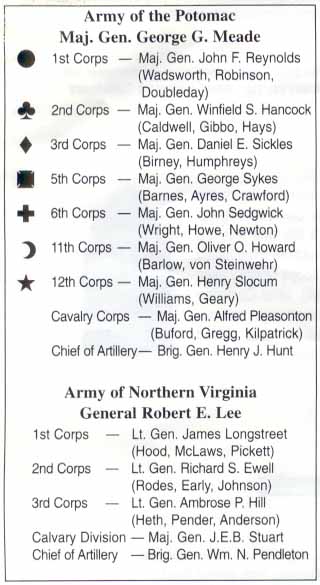
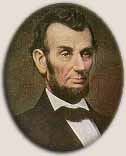 In 1861 and 1862, Confederate armies achieved many victories over their Northern counterparts. By the summer of 1863, the brilliant General Robert E. Lee was in command of the Army of Northern Virginia. He decided upon an invasion of the north, which would pull both armies from war torn northern Virginia, where most of the fighting had previously been. By invading the north and particularly, winning a victory in the north, it might cause disenchanted northerners to pressure the Lincoln administration to seek a settlement toward peace, thus ending the war. This decision eventually brought the war to the doorsteps of a small, rural south central Pennsylvania town called Gettysburg.
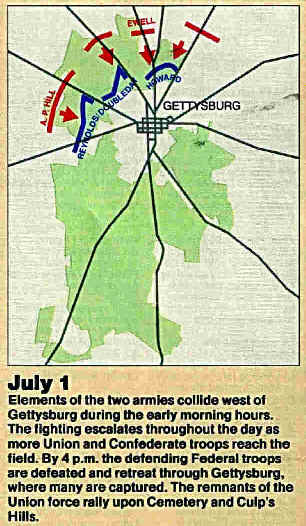
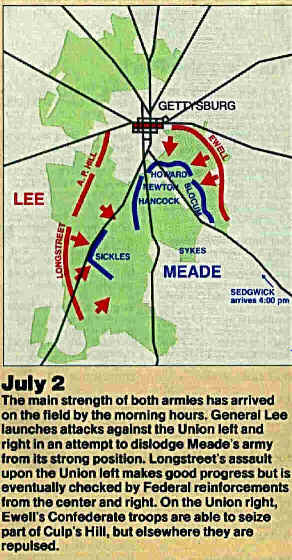
 The second day of battle was initiated by a series of uncoordinated and fragmented Confederate attacks on the Union defensive position south of the town. While simultaneous attacks were supposed to have occurred on Culps Hill and Cemetery Ridge, the attacks took place six hours apart and were unsuccessful. Though Union forces held onto Culps Hill, the Confederate forces did drive back the Union troops in areas referred to as the Peach Orchard, Wheatfield, Valley of Death and Devils Den with a staggering amount of casualties. The Confederate advance of the right flank had initially succeeded but was stopped by heroic efforts of Union forces in an area known as Little Round Top.
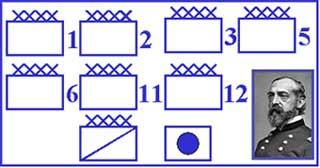
 Having been basically successful in 2 days of battle with the Union army, General Lee, believing his army was invincible and undefeatable, decided to attack what he thought to be the weakest position of the Union line the next day. At the same time General Meade held a council of war with his Corp commanders and decided to remain in a defensive position for the battle anticipated the next day. Thus the decision made by both commanders would lead to one of the most famous days of the American Civil War. Picture left: Home of widow Lydia Leister, which was used as Meade's headquarters and the Union council of war.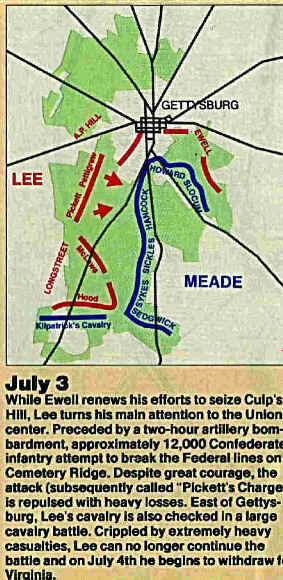
 As the two armies departed Gettysburg to continue the war elsewhere, the 2,000 citizens of Gettysburg came out of their cellars and back from their hurried escape to nearby towns. They returned to a community in shambles with almost every property damaged, houses looted, and all crops and food destroyed or stolen. Left behind were tens of thousands of casualties in and around the town. Nearly every house, barn and public building housed countless wounded badly needing attention. Many dead were left decaying where they fell, thousands of others were in shallow graves being dug up by animals. Lingering odors were sickening.