| Ramon Semidey |
 |
 |
 |
 |
 |
 |
 |
 |
|
 |
 |
 |
 |
|
|
 |
|
 |
| Click |
|
| Click |
|
 |
 |
 |
| Ramon Semidey-Soto |
| For Army man, family and ancestry were also badges of honor |
| Ramon Semidey-Soto once told his brother that if he had to live his life over, he wouldn't change a thing. Twenty-eight years in the U.S. Army as a combat engineer, serving in World War II, the Korean War and three tours in Vietnam. |
| Twenty-two years as a custodian at the Episcopal seminary and a church in Alexandria after his military career. |
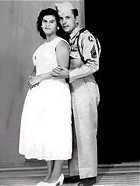
| His brief 1950s courtship of Camelia, the pretty girl who lived across the street from his mother in Mayaguez, Puerto Rico, and the couple's sudden decision to marry when Ramon was on leave in 1955. Their nine children, plus "strays" he often invited home�mostly young Puerto Rican soldiers at Fort Belvoir, homesick for homemade rice and beans. A fierce devotion to family: Any party that did not include the children was not for him. His old-fashioned ways: no dating or makeup for his daughters. His ancestral pride: Every year, the family attended the National Puerto Rican Day Parade in New York City. His corny humor: "I'm full," one of the children might say at dinner. "Glad to meet you 'Full,'�" he would reply. "I'm Ramon." "He was a happy person," his brother, Jose, summed up. Ramon left school after eighth grade to help support his family. He cut sugar cane, picked coffee beans, worked as a carpenter's helper and clerked in a food store. When the Army got its hands on him in May 1942, he was 20 years old and weighed 111 pounds. He sent his Army paychecks home to his mother. |
| After his 1945 discharge, he took up cabinet-making. But that changed in 1951, when his brother "Pedro Semidey" was killed in Korea. "It made him angry," recalled Jose. "He felt responsible because . . . he thought he was supposed to be there." Over their grieving mother's objections, Ramon reenlisted, making the Army his career. He eventually obtained his high school equivalency diploma, completed various military training courses and worked his way up the ranks to sergeant first class. In 1968, the family moved to Alexandria after Ramon got a teaching position at Fort Belvoir's combat engineering school. He retired at age 55 with a dozen medals and citations. |
| Not one to sit around, Ramon took a custodial job at Virginia Theological Seminary and later became sexton at Episcopal Church of the Resurrection, both in Alexandria. "He was wonderful to be around. And he did his job better than anybody should have a right to expect," said the Rev. James Green, the church's retired rector."I don't think he would have recognized the word 'menial.'�" Ramon's daughter Carmen Bishop said her father "was afraid to retire, because he thought he would die." He finally did quit, though, in 1995. Then 74, he and Camelia began traveling. But just two years later, his health began to fail. First it was cataracts, then cancer of the prostate and colon. He died at Walter Reed Army Medical Center on Jan. 13,2000 He was 78. For the wake, his family displayed his Army medals and draped his casket with the American flag. Their request for a military funeral was denied, the mortuary was told, because the burial was Jan. 17, a federal holiday. The news disappointed, even angered, his widow and children. "That's something he would have liked," said Carmen. Besides, added daughter Elvira Urrutia, "He deserved it." �Sylvia Moreno |
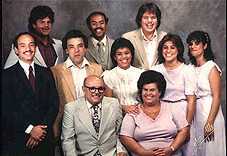
| Ramon married Camelia after a brief courtship. When he died, she and their children displayed the honors Ramon received during 28 years with the Army. |
| Ramon Semidey-Soto was known for his strong devotion to his family |
| Washington Post, Friday, December 29, 2000 |
|
| Click Link |
| This Page is in Honor of Ramon and Pedro Semidey |
|
|
 |
|
|
 |
 |
|
|
|
 |
|
|
 |
|
 |
|
|
|
|