(1483, Urbino - 1520, Rome)
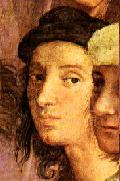
Part/Web Gallery of Art
Rafaello Santio
(1483, Urbino - 1520, Rome)
Part/Web Gallery of Art
| He is called a painter of Madonna. He constantly reproduced the Virgin and Child. "It was the family group that interested him and he pains them as splendid, healthy human beings, but with a serenity of expression, a sense of some deep inner integrity, that removes any doubt as to the holiness of the subject." <The Oxford Companion of Art> |
| 1483 | Born in Urbino where the court of Federico of Montepeltro supported Italian culture. |
| Trained by his father, Giovani Santi, a provincial
painter, Umbrian style, who died when
Raphaello
was 11. Studied with Timoteo Viti at Urbino - delicacy and poetic atmosphere |
|
| 1499 | Went to Perugia Became a student and assistant of Perugino |
| perspective, geometrical composition Sposalizio, Crucified Christ with Virgin Mary, Saints and Angels |
|
| 1504 | Moved to Florence Learned the work of Leonardo,Michelangelo and Fra Bartolommeo |
| Light and shade, anatomy, dramatic action, animated, informal | |
| 1504-05 | Madonna del Granduca, Pitti Palace, Florence - Umbrian style |
| La Belle Jardiniere, Madonna of the Goldfinch - Leonardo style(serenity) | |
| Madonna del Baldacchino - Fra Bartolommeo style | |
| Entombment of Christ - Michelangelo style(postures and anatomical development of the figures | |
| 1508- | Although he was only 25, he had such a reputation
to be summoned to Rome by Pope Julius
II. Frescos in four small stanze of the Vatican Palace He was commissioned so many that he had to employ many pupils and assistants. |
| 1511-12 | Portrait of Julius II |
| 1513 | Triumph of Galatea, Villa Farnesina |
| 1514 | Chief architect of Saint Peter's Basilica |
| 1515 | Director of all the excavations of antiquities in and near Rome |
| Designed ten tapestries for the Sistine Chapel | |
| Devised the architecture and decorations of the Chigi Chapel in Church of Santa Maria del Popolo | |
| 1517-1520 | Transfiguration, Vatican |
| 1520 | Died in Rome. Age 37. Buried in Pantheon. |