Master & Apprentice
Fra Filippo Lippi & Sandro Botticelli
| "... This is the painting that marks the break away from Lippi's early works, characterized by their Masaccesque elements, to a more mature style in which he still shows and interest in the fullness of volumes, but is already paying grater attention to the delineation of outlines. It will be this new "Towfold" tendency, as Federico Zeri has called it, that will create a sort of dichotomy in Florentine Quattrocento painting. On the one hand, the rhythmic cadence of outline drawing; on the other, the more sculptural interest in volumes - a direction that will be fully developed by a pupil of Lippi's, Botticelli." <The Library of Great Masters - Fillippo Lippi> |
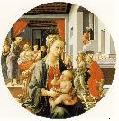 <Mark Harden> |
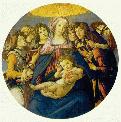 <Web Gallery of Art> |
|
| Title | Madonna and Child and Stories of St.Anne | Madonna of the Pomegranate |
| Artist | <Master> Fra Filippo Lippi |
<Apprentice> Sandro Botticelli |
| Date | 1452 | c. 1487 |
| Size | 135cm /di | 143.5cm / di |
| Original location | for the Bartolini family | for Parazzo Veccio, Florence (?) |
| Current location | Pitti Museum, Florence | Uffizi Museum, Florence |
| Meterial & Technique |
Tempera on panel | Tempera on panel |
| Subject | Madonna & Child "The group of the Virgin and Child was of special importance in Early Christian Art... not because it symbolized a sentimental idea of motherhood, but because it was a concrete symbol of the reality of the central Christian doctrine of the Incarnation. .... The Virgin was believed to have special powers of intercession and was often represented seated on the throne and cushion of Byzantine royalty." "The solemn Byzantine iconic types of the Virgin had a varied history in medieval Europe: while religious painters in Russia and the Balkans remained faithful to the traditional forms of the Orthodox Church, in Italy and the West a more independent spirit prevailed and devotion to the Virgin was expressed, as in the preaching of St. Francis and his followers, by an attempt to evoke the human beauty and tenderness of her presence. Giotto and his successors transformed the Greek types and gave to Mother and Child ever more natural and varied gestures and expressions." "The 14th c, Sienese painters ... had a particular preference for simiple and vivacious studies of the Virgin and achild, withor without attendant Angels, set against the traditional gold ground. In the 14th and 15th c. this theme was taken up all over Eruope and during this period the gold was replaced by realistic settins: a garden or Hortus Clusus smbolizing her virginity. Sometmes the group was depicted in a landscape or a fomalized interior. Raphael perfected the classical type of the Madonna and Child and painters of the later Renaissance concentrated increasingly on the domestic or sentimental possibilities of the group." <The Oxford Companion of Art> Background of Lippi's Virgin & Child Nativity of the Virgin(left) St. Anne gave birth to Virgin St. Anne met St. Joachim at Golden Gate (right) The scene represents the moment of the immaculate conception of the Virgin. Scenes from the life of the Virgin "...incidents illustrating the life of the Virgin had a partly didactic purpose. For example the story of her parens Joachim and Anne, taken from the Protevangelium of James, was connected with the doctrine of her immaculate conception." <The Oxford Companion to Art> |
|
| Symbol | Pomegranate Symbol of resurrection of Christ. In ancient Greek and Roman time, pomegranate was an attribute of the goddess of spring, the season of rebirth. Lily Symbol for the purity Express the virginity of Maria at the moment of conception "The lily also denoted purity in ancient Greece, where it was fabled to have sprung from the milk of the goddess Hera"" <The Oxford Companion of Art> Rose Symbole of love |
|
 BACK |
 HOME |