

 |
 |
 |
 |
 |
 |
 |
 |
 |
DOCTOR WHO: A LEGEND IN ITS OWN PRIMETIME
THE DOCTOR WHO STORY
The British Broadcasting Corporation's DOCTOR WHO is the world's longest-running science fiction television programme. An Unearthly Child, the first episode of the first DOCTOR WHO story, was broadcast on Saturday 23 November, 1963, the day after John Kennedy was assassinated in Dallas.
As viewers huddled round their living room fires on that cold, grey and typically British autumn evening and peered at the flickering black-and-white images on valve-powered television sets, they had no idea that they were watching the beginning of a legend. Yet they knew they were seeing something special.
They were introduced to Susan Foreman, a schoolgirl who claimed to live in a police telephone box in a junkyard, and her grandfather, an irascible old man known as the Doctor. They were amazed to find that the police telephone box was larger inside than it was outside and that it was in fact a TARDIS -- 'It stands for time and relative dimension in space,' explained Susan -- a spaceship capable of travelling in time.
Sydney Newman, head of drama at the BBC, had envisaged DOCTOR WHO as an educational series for children. The Doctor would hop back and forth through time, making history exciting and accessible for a young audience. From the very first episode, however, science fiction ideas began to creep in, and in the second story the Doctor took his ship to the faraway planet of Skaro where he came up against the Daleks.
The viewing figures made it clear that the right mixture of ingredients had been found: the wonderful, infinitely flexible TARDIS, the strong characterizations of the leading players, science fiction themes and terrifying monsters.
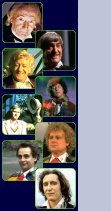
In the three decades that have elapsed since that memorable November evening, the Doctor has taken his TARDIS into more than a hundred and fifty adventures. Seven different actors have portrayed the Doctor, each of them adding something to the Time Lord's complex personality. Scores of companions, most of them young Earthlings, have been temporary time-travellers with the Doctor.
Daleks and Cybermen, the Master and the Rani -- old enemies that the Doctor has fought again and again all over the universe -- have become almost as well known as the Doctor himself. And something of the Doctor's origins on Gallifrey, the home planet of the Time Lords, has been revealed. The characters and monsters from DOCTOR WHO are now household names in Britain, but they are not unknown in other countries: the BBC has sold DOCTOR WHO to television stations in sixty nations all round the world. The wealth of information that has been generated during almost thirty years of DOCTOR WHO stories provides a comprehensive background against which new adventures can be set. Details of the DOCTOR WHO universe will be found in Part Four of this book, but here is a brief history of the programme to provide a context for later references.
1963 - William Hartnell played the first Doctor as an old man: eccentric, forgetful and bad-tempered, but also erratically brilliant, kind-hearted and iron-willed. He met the Daleks, the first of the many terrifying and megalomaniac races of monsters that were to cross his path again and again, but half of the First Doctor's adventures were set in Earth's history. The programme revealed that the Doctor had 'borrowed' his TARDIS, that he had little idea of how to navigate it and that it was defective anyway.
1966 - At the end of The Tenth Planet, the story that introduced the Cybermen, the Doctor collapsed on the floor of his TARDIS and his appearance began to change. The DOCTOR WHO producer, faced with the problem that his leading actor had to retire from the programme, invented a crucial element of the Doctor's make-up: he can regenerate his body when it wears out, allowing a new actor to take on the role. Patrick Troughton inherited the TARDIS, and portrayed the Doctor as a cosmic hobo, an untidy and deceptively simple clown.
1969 - During two and a half years, Patrick Troughton's Doctor met for the first time the Yeti and the Ice Warriors, and had several confrontations with his old enemies, the Daleks and the Cybermen. In the last of the second Doctor's adventures, The War Games, it was revealed that the Doctor was a Time Lord, a runaway from a civilization that had the power to control time and space and which has a strict policy of non-intervention in the universe -- a policy that the Doctor abhors.
1970 - After a gap of six months -- an unprecedented break in the hitherto weekly output which suggested that the programme's future had been in doubt -- DOCTOR WHO returned. The programme was now made in large, modern studios at the BBC's new Television Centre. Directors were able to call on a range of special effects and do a certain amount of outdoor shooting. Most important of all, the programme was shot and broadcast in colour. Jon Pertwee, in the role of the Doctor, was dashing and debonair, with a succession of glamorous female companions and a penchant for gadgets and fast cars.
Within the third Doctor's first year on television he had met for the first time his most implacable foe, the Master, an evil renegade Time Lord, and he had confronted the Autons and the Silurians, new monsters which he would meet again. He also joined forces with UNIT which, under its commanding officer Brigadier Lethbridge Stewart, was to become a mainstay of the programme for many years. Viewing figures rose dramatically and the first of many complaints about the programme's excessive violence were heard.
1972 - The Daleks returned to the screen in Day of the Daleks after an absence of five years. At the end of the year, The Three Doctors, a story set on the Doctor's home planet that included guest appearances by the first two Doctors, introduced the shadowy figure of Omega, the scientist who had pioneered time-travel technology. These stories helped the programme to impressive viewing figures: eight million British viewers now watched DOCTOR WHO, and for the first time most of the audience were adults. The BBC started to sell the programme to other countries.
1974 - Having come up against two new races of monsters that he was destined to meet again -- the Sontarans and the Sea Devils -- and having been released from his exile on Earth to undergo a series of adventures in space, the third Doctor suffered terrible wounds while defeating the Giant Spiders on Metebelis 3. His body started to regenerate, and when a new season of stories began at the end of the year, Tom Baker stepped into the role to become the fourth Doctor.
1975 - With Tom Baker's almost dangerously exuberant portrayal of the Doctor, as well as a new producer and script editor, DOCTOR WHO started to unleash a series of hard-hitting suspense stories. More was revealed about the origins of the Daleks and there were confrontations with Cybermen and Sontarans, but in general the fourth Doctor explored new territory in original stories. Two stories were set on the Doctor's home planet, Gallifrey; the second half of the 1970s was full of detail, most of it consistent, about the Time Lords and the Doctor's universe. The fourth Doctor's longest-standing companion, played by two actresses across sixteen stories, was herself a Time Lord.
1976 - Viewing figures for DOCTOR WHO in Britain had exceeded fourteen million in 1975, but in the following year even this stupendous achievement was topped during one story. The audience for DOCTOR WHO in Britain had never been so large, nor has it been so large since. At the same time, however, the campaign about the programme's violence and alleged unsuitability for children reached a climax; a new producer was brought in under instructions to tone down the elements of horror in the programme.
1977 - The longevity of DOCTOR WHO, its recent surge of popularity, and the preponderance of teenagers and adults rather than young children in its audience led to a flowering of DOCTOR WHO fan clubs. The first DOCTOR WHO convention was held. On screen, K9, the Doctor's robot dog, made his first appearance in stories that continued to fill in the Doctor's background and provide a coherent vision of the universe through which the TARDIS travelled.
1979 - DOCTOR WHO was launched in the United States. Some of the third Doctor's stories had already been shown, but now the BBC had signed a substantial deal with Time-Life Television, and as a result the fourth Doctor's adventures started to be broadcast nationwide. DOCTOR WHO was an immediate sensation and American fan clubs sprang up even more prolifically than the British clubs had. The first American convention took place.
1980 - John Nathan-Turner became the new and, at the time of writing, the last producer of DOCTOR WHO. Some of the features that would characterize his decade as producer became apparent immediately: greater use of video and location shooting and a succession of well-known actors as guest stars. K9 was retired.
1981 - The Master returned after a long absence -- and his machinations were the on-screen rationale for Tom Baker to relinquish his seven-year hold on the role of the Doctor. After apparently falling to his death, the Doctor regenerated for the fourth time, becoming still younger in appearance. Peter Davison became the fifth actor to play the Doctor.
1982 - After a nine-month gap, the fifth Doctor's adventures began. Among his opponents were some old enemies -- Daleks, Cybermen, the Master, Silurians and Sea Devils -- and the programme-makers continued to provide incidental snippets of information about Gallifrey and time travel.
1983 - DOCTOR WHO's twentieth anniversary was marked by a special programme, The Five Doctors, in which all five of the Doctor's incarnations, companions past and present, Brigadier Lethbridge Stewart, K9 and even the Master co-operated to unmask a traitor in the High Council of Gallifrey.
1984 - Peter Davison left the programme. Colin Baker became the sixth Doctor in The Caves of Androzani, the penultimate story of the 1984 season, when the Doctor sacrificed a regeneration on the planet of Androzani Minor to save the life of his companion, Peri, who had been poisoned with unrefined spectrox.
1985 - Colin Baker's vivid portrayal of the sixth Doctor as an erratic, vainglorious genius failed to prevent a slide in the programme's viewing figures. In spite of adventures that featured old enemies such as the Daleks, Cybermen and Sontarans, the introduction of another renegade Time Lord known as the Rani, and a special programme, The Two Doctors, in which Patrick Troughton played the second Doctor for the last time, at the end of the 1985 season the BBC announced that DOCTOR WHO was to be taken off the air. The result was a worldwide campaign to save the Doctor; the BBC bowed to the pressure.
1986 - After a seventeen month gap, DOCTOR WHO returned. The Doctor was on trial for his life, and the first three of the season's four stories were the evidence presented by the prosecution and then by the Doctor in his own defence. The final story, the climax of the trial, pitted the Doctor against both the Master and the dark side of his own character. The programme's ratings remained poor, at least compared with those of its heyday, and Colin Baker was removed from the starring role. Once again rumours abounded about the end of DOCTOR WHO.
1987 - The BBC announced that a seventh actor, Sylvester McCoy, had been appointed to play the Doctor. In a series of strongly plotted stories that moved away from reliance on cross-references to Gallifreyan history, the seventh Doctor encountered the Master and the Rani, Daleks and Cybermen, and earned renewed critical respect for DOCTOR WHO. At the end of the year and of the first series, the Doctor found a new companion in the street-credible and somewhat pyromaniac form of Ace, a teenage girl from west London, played by Sophie Aldred. Ace rapidly became one of the most popular of the Doctor's many companions, and the on-screen chemistry between Sylvester and Sophie helped to lift DOCTOR WHO on to a new level of subtlety and mystery.
1989 - Survival, the last DOCTOR WHO story at the time of writing, was broadcast at the end of the year.
1990 - John Nathan-Turner resigned from the post of producer and the BBC made no announcement about a successor. The future of the programme was once again in doubt, but in the meantime the old stories were being successfully resurrected. The BBC found that video cassettes of DOCTOR WHO stories -- even black-and-white ones from the 1960s -- were very popular and a regular schedule of video releases was started. DOCTOR WHO reruns proved to be one of the main attractions on the BSB satellite and cable television service. Publisher WH Allen, now Virgin Publishing, having turned as many as it could of the DOCTOR WHO television scripts into short novels under its Target imprint, set about commissioning full-length DOCTOR WHO novels while continuing to publish non-fiction DOCTOR WHO books -- of which TIME LORD is one.
After almost three decades of DOCTOR WHO, the programme's long life-span is at first sight its most remarkable feature. As the above brief history of the programme suggests, however, the unique appeal of DOCTOR WHO is that it can be seen as one long story. The programme grew from an imaginative but basically educational children's television show into a science fiction saga packed with action and suspense and underpinned by adult themes. At the same time gradual revelations about the Doctor's changing personality, about his home world and its powerful inhabitants, and about his relentless enemies all combined to weave an increasingly complex backcloth to the Doctor's adventures.
The flexibility of DOCTOR WHO's original premise -- a crotchety old scientist of unknown origin takes human beings from twentieth-century Earth as passengers in his seldom-controllable time machine -- ensured the programme's longevity in the fickle world of television fads. It also allowed successive producers, directors, script editors and writers of the programme to build layer upon layer of detail and mystery, and thus create a legacy of DOCTOR WHO 'facts' that can be used as the background to new adventures.
THE DOCTOR WHO UNIVERSE
If DOCTOR WHO is unfamiliar to you, these explanations of a few central themes will help you to understand references in TIME LORD.
Gallifrey - Gallifrey is a planet in the same spiral galaxy as our own -- the galaxy that we call the Milky Way. The Gallifreyans, a species that resembles human beings in physical appearance, evolved intelligence and developed civilization way before anyone else in the galaxy: the Doctor once said that they achieved space flight while humans were still living in caves.
Time Lords - As if the development of interstellar travel was not achievement enough for Gallifreyan civilization, there followed an even more golden age of technological progress. Two scientists, Rassilon and Omega, perfected the techniques of time travel and created the time machines known as TARDISes. At about the same time Gallifreyan society began to split into two and the educated, time-travelling elite minority became almost a distinct race. They called themselves Time Lords.
A Time Lord's life span is much longer than that of an ordinary Gallifreyan or human: his body has tremendous powers of recovery and is very long-lasting, and when it eventually wears out it regenerates into a new form. A Time Lord can therefore live for thousands of years. This longevity, coupled with scientific knowledge, gives the Time Lords a feeling of detachment from mere mortals. Time Lords live and work in a highly formalized society in the Citadel on Gallifrey, and pay little attention to the rest of the planet or the rest of the universe.
TARDIS - The letters TARDIS are an acronym, standing for Time And Relative Dimension In Space. A TARDIS is a Time Lord's time and space machine and represents the summit of Gallifreyan technology. It is, in effect, an artificial universe of potentially infinite size, with computing power so great that it can decipher the whole of the past, present and future of our own universe. Not surprisingly each TARDIS is an intelligence, albeit an artificial and alien one. It has the power to materialize a part of its physical structure anywhere in space and time, and it can adapt its appearance to blend in with the surroundings in which it materializes. Although its physical manifestation is usually small, it can expand its interior to any size. ('It's bigger on the inside than it is on the outside!' is the usual amazed reaction of anyone other than a Time Lord when first entering a TARDIS.)
Each TARDIS, however, is usually manned by only one Time Lord because Time Lords are solitary by nature. And because Time Lords have little interest in the universe, very few TARDISes are used. The Doctor's TARDIS is a Type 40, an obsolete model which has a number of interesting features that are missing on more recent versions. The Doctor's TARDIS is also in need of an overhaul: hardly any of its circuits work properly and the chameleon circuit, which allows the TARDIS to change its appearance, has broken completely: the Doctor's TARDIS is stuck in the shape of a blue police telephone box of the sort that used to be a common sight on London's street corners a few decades ago.
The Doctor - Although most Time Lords are content to while away their long lives in the formal splendour of the Citadel on Gallifrey, a few of them find the place intolerably dull. Some of these renegade Time Lords leave the Citadel and opt for a hermit's life in the wilds of Gallifrey; others, driven by ambition and hatred, set off into time and space to carve out empires of their own. The Time Lord known as the Doctor, perhaps the most brilliant, erratic and mysterious of them all, also 'borrowed' a TARDIS to escape from Gallifrey, but he has made it his mission to protect the weak and combat evil throughout the universe. He has developed a particular affection for the unpredictable inhabitants of the planet Earth, who are threatened throughout their history by alien invaders and by the results of their own waywardness.
Companions - Time Lords are solitary, but the Doctor enjoys company, particularly that of humans. In his travels he has met and befriended hundreds of beings, humanoid and otherwise, and sometimes he invites one or two of them to accompany him in his TARDIS. He is hardly ever without at least one companion, usually a young human. The Doctor's companions are usually confused by their adventures and have no hope of understanding the technology that the Doctor uses. Their simple-mindedness, fear and innocence often lead them into danger, thus complicating the Doctor's plans and often jeopardizing their success. Their courage and ingenuity, however, are often very helpful to the Doctor and he seems to find his companions invigorating and amusing. They provide a focus for his general concern for the well-being of the universe.
More than a hundred and fifty of the Doctor's adventures have been broadcast on television since DOCTOR WHO first appeared in 1963. William Hartnell was the actor who originally played the part of the Doctor, and six other actors (so far) have taken on the role, each of them representing the Doctor after a regeneration. Although many elements of the Doctor's character remain fixed, each new body he inhabits seems to have its own quirks; the various Doctors are identified by referring to them as the first Doctor, the second Doctor and so on.
TIME LORD allows you to create new DOCTOR WHO adventures and explains how you and your friends can take part in them -- as one of the regenerations of the Doctor, as his companions, allies and even as his opponents.
