Extreme Parchesi
A while back there
was a Casino de Hull commercial that sarcastically asked,
"What could be more fun than parchesi
at home?"
Obviously none of those people have ever played Parchesi by our house rules.
The Gear
To play the game, you will need four "men" tokens for each
player, a selection of six-
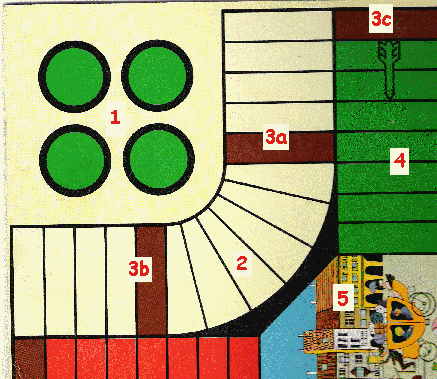
sided dice, and a parchesi board. Below is a scan of a quarter of our parchesi
board; the
layout of the board is important to
play, so be sure to use this layout exactly. The parts of
the board are:
- Home: this is where your Men start the game. Each player has a separate Home.
- the
Track: this is the row of spaces the Men move along, and where most of the
play occurs. - Benches:
these are the dark spaces on the Track. They are safe spaces where Men
cannot be captured. They occur in three positions: between (a) a Home and its
corresponding Ramp (start bench) (b) between a Home and the next player's
Ramp (middle bench) and (c) at the head of a ramp (ramp bench). Notice that
there are exactly seven moves between a Start bench and a Middle bench, and
exactly five moves between a Ramp bench and its neighboring benches. - the
Ramp: spaces the Men move on to reach the Goal after completing the Track.
Unlike the Track, only one player uses each Ramp. - the Goal.
The Rules
The object of the game is to be the first player to place all four of your Men in the Goal.
To begin the game, the players place their Men on their Home
spaces and each select a
six-sided dice (if you're short on dice, you can all use the same one, but you
lose a lot of
the flavor).
Players take turns rolling one six-sided die (1d6) and
moving their Men around the board
counterclockwise until they reach their Ramp and then the goal. But if it were
that
simple, this wouldn't be Extreme Parchesi!
STARTING: You must roll a 5 in order to move a Man from your
Home to your Start
bench. You must roll a 5 for every man you take out of your Home. You may also
use a 5
roll to make a normal move.
ENDING: You must enter the goal with an exact roll.
CAPTURING: If you move a Man onto an occupied space (except
benches) the other
Man is sent back to his Home and must start play again from the beginning.
Capturing
can be done by either passing an enemy Man or by ending on the same space.
BLOCKADING: two Men of the same color on the same bench
constitute a Blockade.
Any Man that lands on that bench after the Blockade is formed may not move
further
until one of the blockading Men is removed.
For example, say
Men arrive on a Bench in the following order: red, green, red, blue,
blue, red, yellow. In this arrangement, the green Man is not blockaded because
it arrived
before the second red man. The first three Men are free to move. Once one of
the red
Men leaves, the blue Men will also be able to move. If a blue Man leaves, the
third red
Man will be able to move, but the yellow Man will not be able to move because
the
remaining two red Men both arrived before it did.
And yes, this is complicated and hard to keep track of. That's what makes it fun :)
ROLLING 6: If you roll a 6, you move 12 spaces rather than
6, and you roll again.
However, if you roll three 6s in one turn, all of your Men on the Track are
returned to
Home (Men in the Ramp and Goal are safe). Thus the highest possible roll in one
turn is
6, 6, 5 or 29 spaces. If you roll three 6s, you may roll again to try for a 5
(or keep trying
as long as you roll more 6s); if you have Men in the Ramp, you may use a fourth
roll on
them.
MISTAKES: If you make a mistake during your turn, such as
miscounting spaces or not
making a capture, you may not correct it once the next player begins their
turn.
INTERPRETING ROLLS: You may not break up dice rolls onto
separate Men; if you
have a double or triple roll, you may apply each roll to a separate Man, but
you may not,
for example, move one man 13 spaces and one man 2 spaces with a roll of 6, 3.
Also, if a
die falls on the floor, you must play it as it lies.
PASSING: You may not pass a turn if a legal move is
possible, even if it will lead to
capture.
Strategies
LEVELLING THE PLAYING FIELD: If one player has too much of a
head start, the
other players may start moving to capture that player's Men in favor of other
possible
moves.
BENCH HOPPING: A roll of 6 will move a Man directly from a
Ramp bench to a
Middle bench or from a Start bench to a Ramp bench; a roll of 5 will move a man
directly
from a Middle bench to a Ramp bench or from a Ramp bench to a Start bench. A
good
way to open blockades.
BUDDY SYSTEM: with two Men, one is left on a bench while the
other is moved
forward to the next bench, then is moved forward to join it. The two Men guard
each
other from capture.
AMBUSH: A Man waits on a bench until another man enters that
part of the track, and
then captures it. Useful for players who have put you Home, but have to pass
your Start
bench to finish the game.
OFFENSIVE BLOCKADING: leaving a blockade in place until most
of the Men in play
are piled up behind it. A very annoying brute force approach.
RECIPROCITY: a player refrains from making an easy capture,
hoping to have the favor
returned.
WITCHCRAFT: attempting to will your die to give high rolls,
or your opponents' dice to
give low rolls. Usually involves whispered incantations and fondling of dice.
It's also
common to select a new die from the spare pool if you think yours is unlucky.
MELODRAMA: ok, this isn't a strategy, but it's an integral
part of the way we play.
Howls of anguish, victory dances, mocking hoots and other overacting are part
of the fun.
One of my personal favorites is to announce a capture with the line "you will
die a slow
and painful death." After all, this is Extreme Parchesi!