Bishounen
Theory
My personal guide to recognizing a truly great Bishounen.
~~~~~~~~~~~~~~~~~~~~~~~~~~~~~~~~~~~~~~~~~~~
 Item 0: the
Setting
Item 0: the
Setting
Originally I had postulated that you can’t make a premise
cool by
dropping a bishounen or two into it. However,
this is not
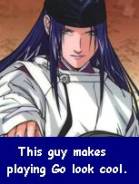
entirely accurate. Take Hikaru no Go: let’s face it, board games
like Go are not “cool” story material. It’s the characters – Hikaru,
Sai and Akira – who inject their coolness into that background.
Remember this well: Great characters can support a lame setting
– and lame characters can destroy a good one.
Item 1: Looks
This goes without saying. A Bishounen is, by definition,
good
looking. This is also extremely subjective; here are some things
to consider when designing your characters.
-
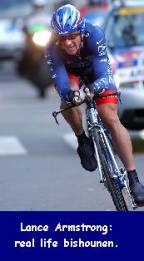
a lot of Bishounen are slim and feminine-looking, and
some are of average build, but I can’t recall one that is
heavily muscled. My advice: for body shape, look to real-
life Bishounen Lance Armstrong.
-
Facial hair is usually a no-no; it often indicates that the
character is out of the “eligible” age group. It can be done
though: QuiGonn Jinn from Star Wars, Vincent from the
Cowboy Bebop movie.
-
You can do practically anything to the hair and costume
as long as they are distinctive. A viewer should be able to
recognize the character in an instant.
Item 2: Ability
A Bishounen must kick ass; a wuss gets no respect, and also
makes for a bad story.
Important: this is not necessarily physical strength. Whatever the setting
calls for is what
the Bisho must excel at. If the story is about Go, he must be a great Go
player; if he’s a
samurai, he must be good with a sword, and so on. If your story is something
like a
romance without a physical challenge element, make something up. Mars is
a story
whose main focus is psychological, but the author made the male lead a
motorcycle racer
and fluent in English, which is much cooler than having a typical teenage punk.
There are only four circumstances when a Bisho may show weakness:
- The
Student: when the character is starting as an ordinary person and develops
as
the story progresses, he is weak and ignorant compared to other characters. He
displays his strength in his perseverance and in flashes of brilliance. By the end of
the story he will be at the top of his field. - The
Clown: the character is shown as incompetent or weak in some unimportant
area as a source of humor and to show how “normal” they are. This explains the
large number of fictional heroes who can’t cook. - The
Guardian: Good characters are susceptible to threats on people they care
about. This can lead to emotional outbursts and rash action, but note, never to loss
of courage or primary competence (in fact, the usual result is an increased burst of
power). This is good for all sorts of plot points: moral dilemmas, noble sacrifices,
self-recrimination, angst etc. Which leads to point 4: - The
Inner Struggle: when the character’s main challenge is to conquer his own
inner demons. The only circumstance where the character can temporarily display
lack of courage. The climax of this plot arc, of course, is the character working his
way back to full Bisho-ness.
Item 3: Sportsmanship
I think we all know how a Good Bisho is supposed to behave:
protecting the weak,
saving the world and so on. But not all Bishos are goody-two-shoes heroes, and
even the
evil ones must demonstrate some basic good sportsmanship in order to get
attention from
fangirls. The guidelines:
-
 Keep
promises, whether they’re holy vows or
Keep
promises, whether they’re holy vows or
assassination contracts. Following through on threats
counts. This is absolutely basic. A treacherous or
untrustworthy character will not appear desirable to
anyone.
-
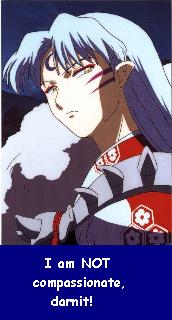
Leave the weak alone. This can be because the
character secretly cares (Sesshoumaru from Inu
Yasha) or because he thinks they’re not worth the
trouble (Dr. Jackal from GetBackers); either can
work.
-
Stick up for your allies, even if it gets you in more
trouble than stabbing them in the back. This is similar
to the first point, since loyalty and trustworthiness are
closely related. They do not, however, always go
together. Dr. Jackal in Getbackers is a perfect
example of someone who is trustworthy but not loyal
(he doesn’t fail this point because he never claims to
have allies at all). The loyal but not trustworthy types
are the ones who do things “for your own good” behind your back.
-
(bonus) A noble cause. Or at least, an objective that would be
admirable if it
didn’t put the character at odds with the hero. Avenging dead family or friends
is
usually good for this point; so is loyalty to a group or philosophy that just
happens
to be opposed to the hero. This latter case appears in Excel Saga, with
Across vs.
City Hall.
-
(bonus)Fight fair. Of course, no one expects bad guys to fight
fair, but it’s a nice
touch if, say, they won’t attack the hero while he’s unconscious.
Item 4: A Worthy Opponent
Since a Bisho must Kick Ass without picking on the weak, he
needs an opponent
virtually equal to his own ability (ideally also a Bisho). He should have to
use all of his
strength to defeat this opponent, or just barely lose. Under- or overpowered
villains will
ruin a good story. Only the Student may get trounced early in his story, so
that he can
overcome defeat. A good example of worthy opponents are Kenshin Himura and
Shinomori Aoshi in Rurouni Kenshin: they are so evenly matched that each
must use his
ultimate technique on the other, and their fight is still only decided by the
narrowest
possible margin.
Item 5: Personality
Here’s where it gets interesting. Every good character (not
just Bishos) needs a
personality, and the best way to define one is to have the character interact
with a rival,
partner or sidekick with a contrasting personality. Now, I’ve heard that the
formula for a
Bisho team is The Gloomy One, The Small Energetic One, The Playboy and the Wild
Card. However, this is only half of one possible solution; Playboy is a role,
not a
personality, and “wild card” isn’t helpful at all. I will now present my own
foolproof
formula for character personalities, starting with the basic pair.
Column A Column B
Air: intellectual, theoretical water: calm and reserved
Earth: physical, practical fire: energetic and emotional
For your first character, choose one item from column A and
one item from column B.
Assign the remaining traits to the second character. This is the basic
combination on
which the rest of your character interactions will be based. You can see that
there are two
possible combinations:
(air/water + fire/earth) or (air/fire + water/earth)
The (air/water + fire/earth) combo is by far the most
popular; you’ve seen these
characters before. (Air/water) is the straight-faced, brooding, scowling guy.
(Fire/earth) is
the loose cannon who never looks before he leaps and often causes spectacular
collateral
damage. Some examples:
Series (air/water) (fire/earth)
Rurouni Kenshin Kenshin Sanosuke
Scryed Ryuhou Kazuma
Fruits Basket Yuki Kyo
Inu Yasha Seshoumaru Inu Yasha
Yu-Gi-Oh Yugi Jonouchi/Joey
GetBackers Ban Ginji
Cardcaptor Sakura Yue Kero
Cardcaptor Sakura even says it explicitly: Yue is the
Guardian of Air and Water, while
Kero is the Guardian of Fire and Earth.
The (air/fire +
water/earth) is rarer, and usually appears in a hero and sidekick. (Air/fire)
is usually an impetuous prodigy, and (water/earth) is the zen-like,
down-to-earth
supporter. There are a few examples of this; Ed and Al in Full Metal
Alchemist, Sherlock
Holmes and Dr. Watson, Asterix and Obelix in the Asterix comics, Frodo
and Sam in The
Lord of the Rings.
These combinations cover most if not all main character
groups. They can also be
predictors of romantic pairings: this is why Captain Kirk/Spock and Remus
Lupin/Sirius
Black seem like plausible relationships; both pairs are strongly (air/water +
fire/earth).
Also keep in mind that these distinctions are relative. Pair
a neutral character with a
(fire/earth) character and the neutral one will automatically appear as
(air/water).
Similarly, Asterix appears as (air) and Obelix as (water) only in relation to
each other;
when compared with, say, Kenshin, they both appear as (fire/earth).
Speed Diagnosis Method: What element is your bisho?
Does he rely on his physical strength to solve problems? He’s EARTH.
Is he likely to trick or outwit his opponents? He’s AIR.
Does he express his emotions (positive or negative) in violent outbursts? He’s FIRE.
Does he rarely raise his voice? Does he get quiet when he’s emotional? He’s WATER.
Item 6: The Team
Now that you’ve defined your basic pair, you can start to
add more characters to the
group. To do this, take a character trait from the set other than the one you
already used.
For example, Ed and Al in Full Metal Alchemist are (air/fire +
water/earth). The next
most important character is Roy Mustang, who is (air/water). Another example is
Scryed:
Ryuhou and Kazuma are (air/water + fire/earth); interacting with both of them
are
Tachibana (water/earth) and Straight Cougar (air/fire) as well as Mimori (also
water/earth).
This brings us to what to do if you have more than four main
characters, or if you want to
duplicate a trait for some reason. There are a couple of ways to handle it.
-
Plot weight. It matters less for two characters to have
the same trait if it’s clear
that one of them is more central to the story. This is the case in GetBackers,
where
many of the characters are (air/water + fire/earth), but it’s obvious that the
plot
focuses on Ban and Ginji.
-
Parallelism. Two characters of the same trait can be
friends or colleagues, but not
enemies, sidekick/hero or partners. In Scryed, it’s obvious that Tachibana and
Mimori, with the same trait, are “just friends”. Similarly, in Yu-Gi-Oh, Yugi
and
Kaiba are both (air/water); while they are presented as rivals, they spend most
of
their time working separately toward the same goal, and when they clash, it’s
fairly clear that they’re projecting their inner demons onto each other. Yugi’s
main villains are often fire-types.
-
Up/down. Is the character happy or gloomy? Yugi and
Kaiba also work as
interacting characters because Yugi is cheerful and friendly (up) while Kaiba
is
distant and angsty (down). The difference is highlighted by their reactions to
the
equivalent characters Mokuba and Jonouchi (Earth/fire/up). (Note that, in
accord
with the above point, these two characters virtually ignore each other.)
 Case
Study: Wolf’s
Rain
Case
Study: Wolf’s
Rain
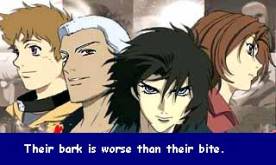
Wolf’s Rain starts out with a potentially
awesome premise: in a post-apocalyptic
world, wolves walk among humans in
disguise, searching for the route to
Paradise. Sounds interesting, right? Well,
it could have been, if it had some decent
characters. Let’s take this point by point.
Looks: Well, the character designs are pretty good, I guess.
Kicking Ass: There’s not enough of it. Sure, there
are a few fight scenes, but they’re not
very good, and they seem totally unconnected to the surrounding plot. Case in
point – in
one scene sissy Toboe suddenly attacks and kills a giant walrus they’ve
encountered, and
then goes right back to being a sissy.
The Inner Struggle: same consistency problem here.
Each of the four main characters is
revealed to have some Tragic Past, which is discussed for about half an
episode, and
otherwise totally ignored (and worse, not resolved)! The history between the
wolf-hunter
character and his dog Blue is much, much better handled.
Sportsmanship: the four main characters do OK here,
but there’s a problem with the
main villain. For the first half of the series, he shapes up as a pretty cool,
nobly grieving
Bisho Villain. After the halfway point, though, he goes totally insane and
completely
loses all his charm.
Worthy Opponent: the only real enemy is the guy
mentioned above, who spends most
of his time offstage and has space-age weaponry to pit against the main
characters who
have basically their bare hands.
Personality: The problem here is that the main
character group is made up of two
(air/water/down) and two (fire/earth/up) characters. Boring! The secondary
character
group is much better done: there’s the Lady Scientist (air/water) and the
Reporter Guy
(fire/earth) along with the wolf-hunter (water/earth) and Blue (air/fire).
This would have been a much better series if the story had
focused on this second group,
reduced the four Bisho characters to two, and made them more of a “mysterious
encounter” (you know, the kind of characters who pop up just long enough to
make you
wonder if they’re good or bad).
Case Study: GetBackers
I admit I’m not very objective about this series. I
absolutely love it! The premise is that in
some alternate world, some people have superpowers. OK, so that’s not too
original. It’s
the characters who carry this show, and they manage to do it without too much
angst, too.
Once again, point by point.
Looks: Pant. Drool. There are so many gorgeous
characters, and they’re all different!
There’s the rugged outdoorsman (Shido), the boyish casual one (Ginji) the sleek
and
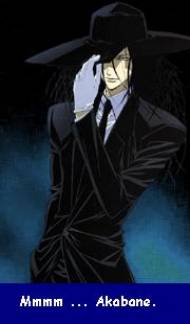
suave (Ban), the suit and tie (Akabane) and the gender ambiguous (Kazuki), plus
the
schoolgirl (Natsumi), the vixen (Hevn) and the petite (Himiko).
Kicking Ass: There are some amazing battles in this
series. And with superpowers
involved, you know there’s going to be super damage. Characters regularly get
seriously
injured (one secondary character ends up permanently blind) but continue to win
their
next major battle. There’s an action sequence in nearly every episode, which
gives the
main characters ample opportunity to show off their skills.
The Clown: A lot of the characters are played for
laughs: Ban and Ginji are constantly
bickering. Ban, normally cool and collected, is all smiles at the prospect of
money. Ginji
is scared spitless of Akabane (with good reason, since Akabane wants to kill
him) . . .
except when he actually has to fight him.
 Sportsmanship:
One of the most interesting points about
Sportsmanship:
One of the most interesting points about
this show is how characters can be allies at one point and
opponents at other points, due to the contract-work
premise. There’s often a vibe of “Sorry about this, but I
took a contract” in these encounters. In this world, it’s a
point of honor to complete a contract once it’s accepted.
I also have to mention Akabane in
this context. He’s a
cold-blooded killer, but he’s so sweet about it that he’s
impossible to hate (well, unless you’re Ginji). He doesn’t
go out of his way to attack weak opponents, but seeks out
the strongest fighters he can find (Ginji). He always
fulfills contracts, even ones for opposing sides
simultaneously. And, of course, he is unfailingly polite
and doesn’t think that trying to kill each other should be a
barrier to friendship.
A Worthy Opponent: For one thing, Ban and Ginji both
match ultimate techniques with Akabane. This rivalry is
kind of a running theme throughout the show, as are the
constant clashes between Ban and Shido. Part of the fun is the superpowers that
are so
different that one power might not be able to defend from another, such as
directed
lightning vs poisonous perfume. Another matter is that the boss villains
usually have
ridiculously powerful abilities, able even to warp the apparent fabric of
reality. As you
can imagine, that presents a bit of a challenge to the heroes . . . but they
get by.
Personality: Hoo boy. There’s so many characters I can make a summary table:
(air/water) (fire/earth) (air/fire) (water/earth)
Ban Ginji Natsumi Paul
Akabane Shido Himiko Kazuki
Makubex Hevn
And that’s just half the cast! With so many characters
there’s bound to be plenty of
overlap, but it’s handled with great dexterity. For one thing, the focus is
always on Ban
and Ginji, with the other characters of similar traits given distinctly lesser
roles. For
another thing, as described above, parallel characters interact with each other
only
minimally. Thus Ginji and Shido are friends in a casual sort of way, and Ban
and
Akabane are just as casual as enemies (you want to kill me, ok, whatever). On
the other
hand, Ban and Shido are always fighting, and Ginji, er, reacts strongly to
Akabane.
One fascinating
illustration of the “elements” system is the contrast between Ginji
(fire/earth) and his alter ego, Raitei (air/water). This total reversal leads
to the following
interactions:
- Ginji is all over Ban, but Raitei virtually ignores him.
- Kazuki (water/earth) is equally loyal to both Ginji and Raitei, but
- Shido (fire/earth) respects Raitei but feels that Ginji is missing Raitei’s essential qualities . . . well, he is, in a way.
These interactions could be predicted by the element system.
Getbackers is a fine example of how a carefully woven cast
can bring energy to a
commonplace premise. These people may have superpowers, but it’s their
personalities
that make them interesting. The only thing I would change in this series would
be to give
it a unified plot arc, instead of frittering away its potential in one-shot
episodes and short
arcs. Not that they aren’t fun, but an epic storyline would make the series
that much
cooler.
Conclusion
Well, that’s my take
(in exhaustive detail!) on how to design the perfect Bishounen, or
any main character team for that matter. How useful this is, I don’t know, but
here it is
anyway, from one anime geek to all the rest of you.