"New Homepage"

These pages have moved to a popup/banner-free site: "New Homepage"
There are no more updates here, but the files will not be deleted.

"Closeup" Lenses/Achromats

Lenses for a defined distance


The name "closeup lens" is misleading with our modern cameras!
They were additions for lenses with a close focus around 20cm to 1m in former times.
Many point and shoot cameras can focus at a distance of 3cm (FZ5) or closer.
This is a nice function in some cases, I have used it even with wasps.
Unfortunately this function is restricted to low zoom levels,
the "far" macro of the FZ5, 12x zoom, 70cm is quite unique!
If we need a defined distance (!) to the object we need specific lenses.
So the Mcon40 is a FAR-FOCUS LENS at all zoom levels for the distance of 40cm.


Like others I have gathered information about "closeup" lenses.
This is my personal reference. This is not a guideline for beginners!
M.Plonsky has answered many questions of beginners regarding macro photography some time ago
Just read his excellent article first: Bug pictures
He is working with single lenses and moved to reversed lenses lateron


On this page you will find information on:

- Classification of lenses - Working Range
- Recommended achromats Recommended
- Many achromats sold new or used at this time The Chart
- Threads front and rear
- Distance object-front lens
- Weight
- Lens diameter
- Field of view Coverage
- Depth of field DOF
- Dark corners Vignetting
- Focussing Range
- ...and some tricks with onboard flashes here: Light


Recommended lenses, sold new

..if you are in a hurry....
There are still some Nikon lenses sold new! Take them if you get them....
Minolta (55mm) lenses are recommended too, but I found only the smaller lenses on sale

Lens Diopters min. Size Pros Cons distance(mm) d. inch thread info
Canon 500D +2 butterflies not vignetting price? 500 19,7 52,58.. .
Olympus Mcon40 +2.5 butterfly not vignetting no front thread 400 15,7 55 pdf
Olympus Mcon35 +2.85 butterfly not vignetting . 350 13,8 62 pdf
Sony VCL M3358 +3,0 butterfly not vignetting . 330 13,5 58 info
Soligor 3dptrs pro +3,0 butterfly not vignetting . 330 13,5 62 info
Canon 250D +4 bugs not vignetting price? 250 9,8 52,58 .
Raynox DCR150 +4,8 bugs price vignetting 210 8,3 43 info
Raynox DCR250 +8 ants price vignetting 130 5,1 43 info
. . . . . . . .
Leitz Elpro1 +2,5 butterfly not vignetting if money is no issue 400 15,7 55 .
Leitz Elpro2 +4,9 bugs not vignetting if money is no issue 200 7,9 55 .

The following chart can help you to find the right lens
If you know the size of the desired object or the distance, there should be no problem to find an achromat for your needs

The second graph shown nearly all aspects of the achromats with the camera focussed at infinity.


The size of the rhomboids is a symbol for the fast decreasing DOF.

The Leica people did quite a good job, the native camera covers the area close to the curve.
You can shoot:
- a wasp at 5cm distance (be careful please)
- a butterfly at 12cm (might scare him away)
- big butterflies (frog) or a butterfly on a flower at 28cm
- a sparrow at 53cm
and then the tele macro takes over!

All that achromats give us is: MORE DISTANCE!... but this is important.
... and an approach to very small objects sometimes.
The zoom scale (jpg) shows, that the higher zooms are needed for the magnification.
A combination of an achromat and a teleconverter does not expand the range very much.
The minolta #2 (+4 diopt.) and a tcon17 starts to focus at 46cm with a field of 3.5cm
This can be done with a Olympus mcon40 alone with a much higher resolution
The minolta #1 (+2 diopt.) and a tcon17 starts to focus at 81cm with a field of 5.7cm
This can be done with a Nikon 3+ alone with a much higher resolution again


-- THREAD --

The FZ5 has a very bad thread of 55mm, which has to be sanded down to the beginning of the plastic thread!
52mm lenses need a stepdown adapter 55mm->52mm
58 and 62mm lenses need a stepup adapter
The raynox lenses need a snapon adapter 52-67mm -> 43mm

Used lenses: all the lenses shown above, plus:
55mm Minolta No1, No2; Olympus Bmacro(cheaper), MCON40 (same glass)
Nikon 3T, 4T, 5T, 6T
Olympus a life size - hard to find, but excellent glass!

!!! Achromats can be very expensive parts. !!!
If these lenses (or the necessary money) are not available at your part of the world, try this:
- lenses of binoculars (stereoscopic microscope): excellent achromats!
- front lenses of (old) spyglasses: often achromats between +4 and +7 diopters
First Results: Spyglass Achromat
- reversed SLR lenses eg. 135mm, 50mm
- slide projector lenses
- any kind of magnifying glass


Introduction


Achromats are the reading glasses for our far-sighted cameras(at higher zooms)
The distance to the objects is fixed through the whole zoom-range
Magnification is determined by the used zoom factor
There is no loss of light with these lenses
Each diopter increases the magnification of the object by 25%

The focal length of a lens in mm is given by 1000/diopters

The focal length is the maximum distance to the object

There is a new table for FIELD of VIEW, please use it to find the adequate lens for your purposes!


All calculations used the parameters of the FZ5: 1/2.5'' sensor, 0,005mm CoC (circle of confusion). Most results can be used for the whole FZ - family. The trends shown in the graphs are valid for all cameras


Single Lenses

Using simple (single lens +1,+2,+4,+10) close-up lenses will degrade the quality of your pictures. The center of the shots might have a tolerable sharpness, but the edges will be soft. This effect is increased if you stack these lenses. Lenses with +1 to +4 diopters "can" be used for some time if you have purchased them already. An uncorrected lens with +10 diopters is a terrible piece of glas. I would prefer to search for a good used achromat instead of buying a new "close-up set"
These excellent links help you with your decision:
Close-up lenses (shene)
Achromats (joris)

Achromats

Achromatic lenses compensate chromatic and spherical aberrations. They bring two wavelengths into a common focal plane.
These multi-element lenses help us to keep a specific distance to small (living) objects. We need them even with "0cm macro cameras", because we can't shoot animals at this distance and there is no chance to add some light.
The distance to the object rapidly increases when we have to zoom. The FZ5 has a tele-macro mode with a distance starting around 70cm. This can be fixed and reduced - see the table!
- Achromats shall not be used in macro mode! They are not used to focus even closer than 3cm (FZ5 min. 1*zoom macro distance).
- These lenses transform the normal (!) focussing range of eg. 2m-infinity to a closer range. Example MCON35: 30 to 35cm.
- The focal length of the lens is the maximum distance to the object in any(!) case. Example: Mcon40 - 40cm, reversed lens 35mm - 3.5cm
- Use autofocus in the range shown below or fix the focus and find the right distance to the object (I prefer this method).
- You need control over the aperture - another reason, not to use the macro mode.
- So use aperture priority with f:8 (or less) or manual control. You will need the added DOF.
- Start with low diopters around +2, continue with +4 diopters and stack them lateron.
- Stacking lenses: add the diopters. eg. 4T and 6T ..+1,5 +2,9 = 4,4 diopt.
    But don't stack too many of them, two of them is enough. This camera is definately "over-achromated"
    (4* minolta plus 3* elpro - 23 diopters, an expensive super soft filter)
- Fix the lens with the higher diopters at the camera and stack the lower diopter ontop
- Use a tripod, monopod or bean sack
- A macro rail on the tripod is the best way of focussing
- Look for excellent light or use bounced flashes
- Align the axis of the object to the sharp area of the picture
- Most of us will never need reversed lenses. This is close to microscopy!
- You can stack achromats between frontlens and teleconverters to get a closer view. Not recommmended! The slight increase in magnification is destroyed by the loss of resolution with the additional lenses.
- You can attach achromats in front of teleconverters (tape). This increases magnification, but using the adequate achromat should be better.
- If there is not enough Depth of Field (DOF), try to shoot non moving objects in different layers. These pictures can be stacked lateron. The first picture above is a combined shot, stacked by helicon focus.

The Chart

(please report errors or additions!)
The values of the diopters are not very precise - We should gather exact focal distances!

Brand Achromats  Thread Front Diop- focus dist-
front
ance
to
in cm
object
price optimized for weight lens

    Thread  ter mm 0,70 2m infinity   mm g mm
Leica ElproVIa (macrotar) 44mm VI same 2,50 400 25 33 40 expired 50 46g 36mm
  Elpro 1 55mm(44mm) same 2,50 400 25 33 40   50 ?g ?mm
  ElproVIb (macrotar) 44mm VI same 4,92 203 16 18 20 exp 50 54g 36mm
  Elpro 2 55mm(44mm) same 4,92 203 16 18 20  new 190$,used:euro 40-80
50 ?g ?mm
  ElproVIIa (macrotar) 54mm VII same 1,66 602 32 46 60 exp 90-135 53g 47mm
  Elpro 3 55mm same 1,66 602 32 46 60   90-135 ?g ?mm
  ElproVIIb (macrotar) 54mm VII same 0,75 1333 46 80 133 exp 90-135 ?g ?mm
  Elpro 4 55mm same 0,75 1333 46 80 133   90-135 ?g ?mm
Nikon 3T 52 same 1,50 667 34 50 67 euro 60 80-200 45g 46,5mm
  4T 52 same 2,90 345 23 29 34 euro 60 80-200 ?g ?mm
  5T 62 same 1,50 667 34 50 67 euro 82 80-200 ?g ?mm
  6T 62 same 2,90 345 23 29 34 expiring! euro 82 80-200 78g ?mm
Canon 240 48,52,55 same 4,20 238 18 21 24 exp   ?,61,?g ?,46,?mm
  250d 52,58 same 4,00 250 18 22 25 $ 72/87 30-135 54,79g ?,56mm
  450 48,52,55? same 2,20 455 28 37 45 exp achromat?? ?g ?mm
  500d 52,58,72,77 same 2,00 500 29 40 50 euro 65,79,124,140 70-300 ?g ?mm
Olympus amacro 49 no 2,50 400 25 33 40 exp 135 65g 45mm
  bmacro mcon40 55 no 2,50 400 25 33 40 $ exp/100 180 94g 50mm
  a life size 49 no 7,70 130 11 12 13 exp used:euro 60 - 80 35-135 120g 46mm
  mcon35 62 72 2,85 351 23 30 35 $ 85   135g 55mm
  close up 80 49 same 5,90 169 14 16 17   80 ?g 23mm
Sigma macro=life size 52,58 same 1,60 625 33 48 63   70-300 31,?g 47,?mm
Raynox DCR-150 + adapter 43(52.67) 49 4,80 250 16 19 21 $35-45 50-300 50g 35mm
  DCR-250 + adapter 43(52.67) 49 8,00 125 11 12 13 $ 70, see set CM-2000 below! 50-300 80g 35mm
Sony VCLM3358 58 58 3,00 333 23 29 33 48$ - euro 70   70g ?mm
Soligor 3 dptrs. pro 62 72 3,00 350 25 31 35 99$   135g ?mm
  matched macro adapt.1:1 49 ? 4,00 250 18 22 25 ?   ?g ?mm
  from slide duplicator 52 ? 10 100 9 9 10 ?$   ?g ?mm
Minolta No.0 49,55 same 0,94 1064 42 69 106 euro 49/49 50-200 ?g ?,50mm
  No.1 49,55 same 2,00 500 29 40 50 euro 49/- 24-200 ?,49g ?,47mm
  No.2 49,55 same 3,80 263 19 23 26   24-50 ?,69g ?,47mm
KonicaMinolta  CL49-200 49 same? 5 200 16 18 20 exp. . 70g 46mm
Hoya HMC AC 2 element 49,52,55,58 ? 3,00 333 23 29 33 120-140$ . ?g ?mm
  HMC AC 2 element 49,52,55,58 ? 4,00 250 18 22 25 120-140$ . ?g ?mm
  HMC AC 2 element 49,52,55,58 ? 5,00 200 16 18 20 120-140$ . ?g ?mm
  +10 2 elements 49,52,55 ? 10,00 100 9 9 10 81$ . ?g ?mm
.

.

exotic parts

Raynox DCR5320pro +2 lens 72mm 72mm 2,00 486 28 39 49 very new 50-xxx 105g 68mm
  DCR5320pro +3 lens 72mm 72mm 3,00 311 22 28 31 very new 50-xxx 290g 68mm
  DCR5320pro +2+3 set 72mm 72mm 5,00 170 14 16 17 260$ 100-xxx 395g 68mm
Kenko AC No.0 55 55 1 1080 43 70 108 exp. historic! 100-200 50g 49mm
  AC No.3 55 55 3 330 23 29 33 exp. historic! 50 ?g ?mm
  AC No.5 55 55 5 200 16 18 20 exp. historic! 50 ?g ?mm
Zoerk Typ1 52 52 12,00 83 7 8 8 euro 348 50-135 120g 36.5mm
Heliopan achromat close up 49,55,67,82 ? 3,4,5,6 . . . . expensive . .g .mm
Century Optics Achromatic diopter 58 ? 2,4,7 . . . . expensive 40-300 .g .mm
Opteka   52,55,58   10,00 100 9 10 10 $80   50-300 ?g ?mm
MBS-10 90mm none! none! 11,00 90 8 9 9 part of binocular   ?g ?mm
reverse SLR 50mm     20,00 50 5 5 5     ?g ?mm
Raynox msn-200(202) 37(52.67) no 33 30 3 3 3     60g ?mm
  msn-500(505) 37(52.67) no 56 18 2 2 2     86g ?mm
Seemolf mcon 16 55 no 6,00 160 13 15 16 bino frontlens   98g 45mm
Seemolf mcon 8 55 no 12,0 80 7 8 8 2 bino frontl.s   220g 45mm

Distance_cm is the distance between the front lens and the objects at 12*zoom.
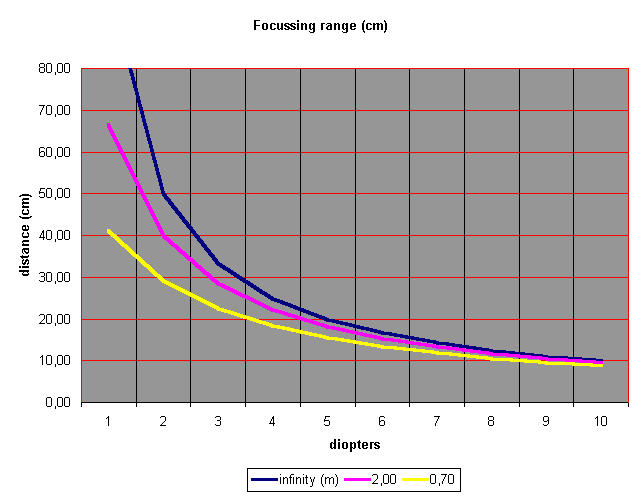
Camera setting from 2m to infinity FZ20,30 or 0,7m to infinity FZ4,5,7
Lenses with an effective lens diameter of 34mm will start vignetting below 4* zoom
(eg. Raynox lenses)
There is no vignetting with lens sizes around 47mm.
Some achromats can be combined: eg. Nikon 3T, 4T or Minolta #1,#2
Don't buy the old Elpros VIa or VIb before you are sure to get a stepdown adapter like xxmm -> 44mm.
There are not many series VI (44mm) adapters on sale!
I asked my fleabay partner and got a stepdownring 49mm -> 44mm ontop.
Nikon closeup lenses #? and Canon 250, 500 are single element closeup lenses!
I haven't seen a positive report on opteka lenses, are there any?
The Raynox MSN-xxx lenses are not recommened for the FZ cameras from my point of view
Just look at the terrible test pictures on the raynox pages

based on:
- own researches and:
http://home.planet.nl/~heuv0283/achromats.html
some bigger lenses are included here(pentax e.a.)
   This is a good reference too:
http://www.angelfire.com/ca/erker/closeups.html

Vignetting

Vignetting depends on the distance to the front lens, the design of the achromat and the camera
Diameter is not the only criterium. Some of the unknown lens parameters are more important.
Does anybody know the data of the entrance and exit pupil at different zooms for the FZ5??

If you are not stacking step rings, use this as a simple rule for the FZ5:
eff. lens size, minimal zoom
45mm , 1*
40mm , 2*
35mm , 3-4*

But there are differences!
The Raynox DCR250 (eff. lens 36mm) starts vignetting
below x3 zoom with the FZ30 and
below x7 zoom with the FZ20!

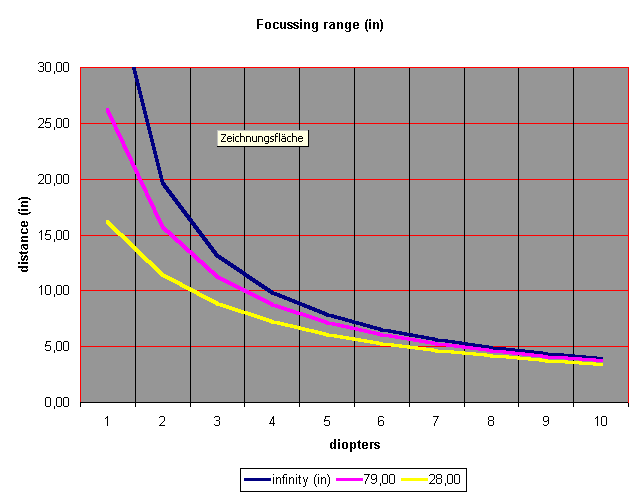
These graphs give you an impression of the available focussing range with our achromats.

FZ5: 0,7m to infinity at 12* zoom)
frc


fri

NEWS

It was reported that the nikon has stopped production of some (all) achromats. There are still some lenses available.. Time is running!
Some Olympus lenses (mcon35 and mcon40) are sold directly via ebay (US) at the moment.
If you need a lens, search for cheap used one at ebay: Nikon, Olympus, Minolta, Elpro
These lenses can be purchased new at the moment:
Nikon 3T, 4T, 5T (last orders please!)
Canon 250D, 500D
Olympus MCON40, MCON35
Raynox 150D, 250D !!sold as set CM-2000 (DCR150,DCR250 and adapter) for 80-100 $
..and
Sony VCLM3358
Zoerk

Raynox has recently added a DCR5320pro Lens-set: +2, +3 diopters - combined +5. These achromatic lenses try to fill the gap left by the discontinued Nikon lenses. DCR150 and DCR250 lenses are too strong for beginners. These lenses needed a very close distance. There are no reports on the new lenses up to now, but we can expect excellent quality with this glass. There could be some vignetting below 50mm focal length. Please consider the weight!
The "super macro lenses" MSN xxx are not covered here at the moment. These are extreme lenses with a focal length eg. around 20mm. I prefer cheap used SLR lenses (50mm f:1,4 20$) or enlarging lenses (componon,rodagon).


.....and don't forget:


Concerning our compact cameras, all achromats are equal!
But some think, their achromats are more equal.
(my elpros don't perform better at higher zoom ranges than the olympus lenses)
But the achromats were designed for specific focal lengths - these are shown in the charts above!
Vignetting starts at lower zoom ranges with small lenses (eg. raynox). There is no vignetting with bigger lenses (eg. mcon40). This expands the range, but we will need high zoom rates for macros most of the time.

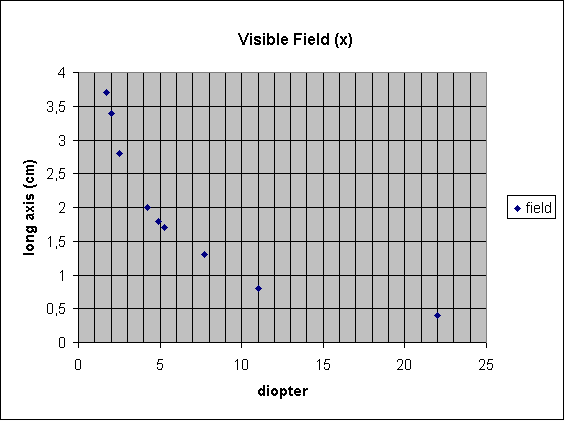
These diagramms help to determine the minimum visible fields at 12* zoom:     
    
field1

Field of view = coverage

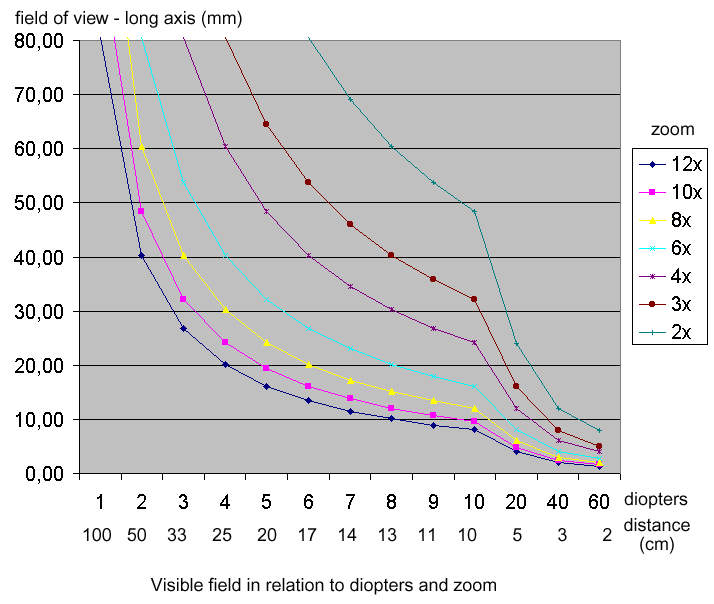
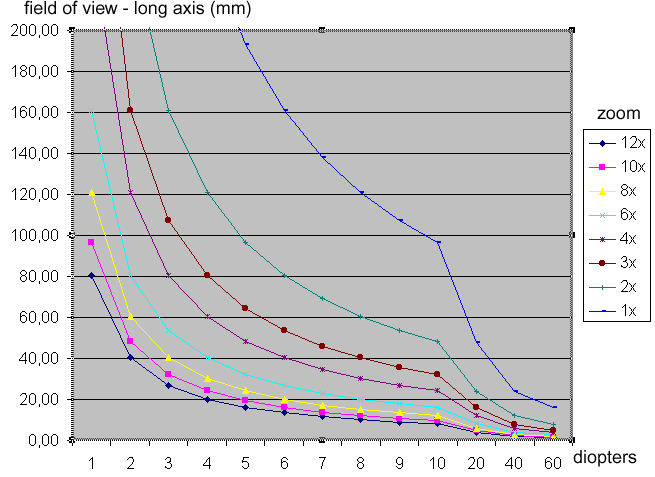
I have calculated a table now, showing the range covered by an achromat using different zoom settings
The term "magnification" will not be used here. There is no need to know the relation between the object and our nearly invisible sensors. The coverage shows, which object size covers the whole sensor.

Example: With a large lens of +4 diopters you can cover objects from 2 to 24,2 cm at the constant distance of 25cm (see above). Vignetting of small lenses will prevent lower zoom factors. The equations used: focussing to infinity! We can get a slightly bigger view with focussing at closer distances.

Field of view (long axis) in mm vs. Diopter for different zoom factors: FZ5

zoom:

12x

10x

8x

6x

4x

3x

2x

1x

distance

diopter

in cm

1

81

97

121

161

242

322

483

967

100

1,5

54

64

81

107

161

215

322

644

67

2

40

48

60

81

121

161

242

483

50

2,5

32

39

48

64

97

129

193

387

40

3

27

32

40

54

81

107

161

322

33

4

20

24

30

40

60

81

121

242

25

5

16

19

24

32

48

64

97

193

20

6

13

16

20

27

40

54

81

161

17

7

12

14

17

23

35

46

69

138

14

8

10

12

15

20

30

40

60

121

13

10

8

10

12

16

24

32

48

97

10

20

4

5

6

8

12

16

24

48

5

40

2

2

3

4

6

8

12

24

3

60

1

2

2

3

4

5

8

16

2


Field of view (long axis) in inch vs. Diopter for different zoom factors: FZ5

zoom:

12x

10x

8x

6x

4x

3x

2x

1x

distance

diopter

in inch

1

3,17

3,81

4,76

6,34

9,51

12,69

19,03

38,06

39,37

1,5

2,11

2,54

3,17

4,23

6,34

8,46

12,69

25,37

26,25

2

1,59

1,90

2,38

3,17

4,76

6,34

9,51

19,03

19,69

2,5

1,27

1,52

1,90

2,54

3,81

5,07

7,61

15,22

15,75

3

1,06

1,27

1,59

2,11

3,17

4,23

6,34

12,69

13,12

4

0,79

0,95

1,19

1,59

2,38

3,17

4,76

9,51

9,84

5

0,63

0,76

0,95

1,27

1,90

2,54

3,81

7,61

7,87

6

0,53

0,63

0,79

1,06

1,59

2,11

3,17

6,34

6,56

7

0,45

0,54

0,68

0,91

1,36

1,81

2,72

5,44

5,62

8

0,40

0,48

0,59

0,79

1,19

1,59

2,38

4,76

4,92

10

0,32

0,38

0,48

0,63

0,95

1,27

1,90

3,81

3,94

20

0,16

0,19

0,24

0,32

0,48

0,63

0,94

1,89

1,97

40

0,08

0,10

0,12

0,16

0,24

0,31

0,47

0,94

0,98

60

0,05

0,06

0,08

0,11

0,16

0,20

0,31

0,63

0,66


reverse 50mm =  +20 diopt.   35mm =  +29 diopt.   28mm =  +36 diopt.   16mm =  +63 diopt.
The coloured ranges will not be used under normal circumstances. The field of view without additional lenses is: 40x30mm for 1*zoom and around 85x63mm for 12*zoom. There is no need to use an achromat with bigger objects than 80x60mm.
..Sensor size: 1/2.5'' frame size 5,8 x 4,6 mm; diagonal 7,6mm..
diopt


diopt


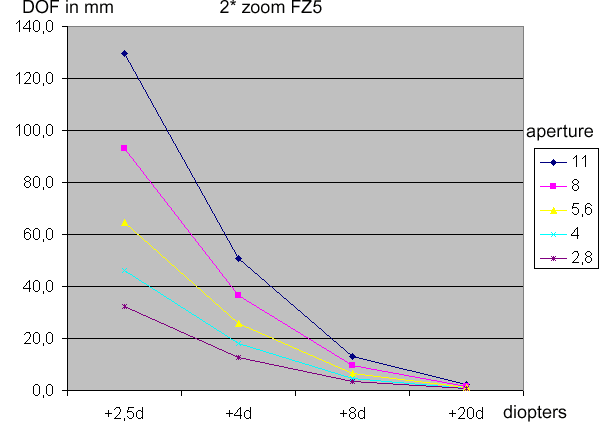
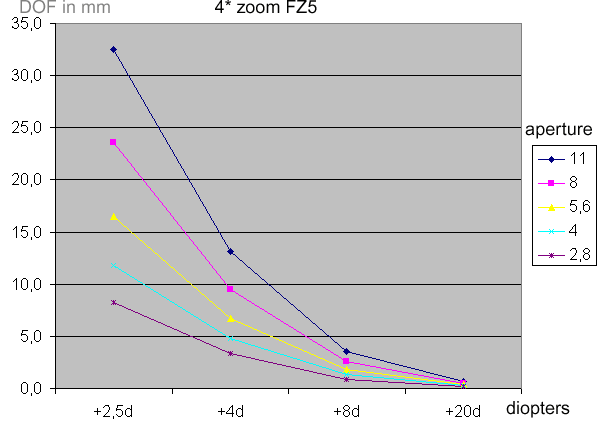
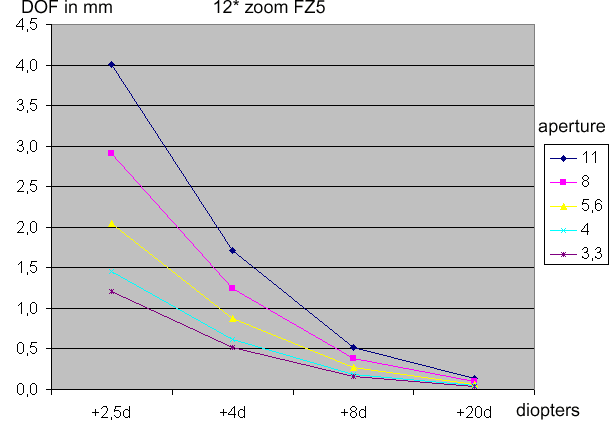
DOF

You will notice that at higher diopters the range in field of view is very small. This is accompanied by a shallow depth of field (DOF).
Increasing the diopters decreases the DOF dramatically. The smallest available aperture (f:8.0) helps a little bit:

Using a small aperture (f:8) increases the depth of field by the factor 3, compared to an open aperture.
But in this case it is 3* 0,2mm !! This means that moving the camera only for 1mm brings your object completely out of focus!

DOF diagramms for the FZ5 with achromats


The following diagramms show the available DOF at different zoom settings (2,4 and 12), with changing apertures:
Used circle of confusion: 0,005mm
F:11 is not available at the FZ5 (without tricks ;-) )

The lens formulas don't give us the exact values at very close ranges, but the curves show us the trend!

Only precise measurements would give us the exact values!


dof02


dof12


dof12

Here is a demonstration of a very narrow DOF range
Left picture: reversed lens +20diopter, FZ5 f:8.0, 12* zoom
Right picture: same setup, three pictures of the living ant combined by helicon focus
(these pictures can be enlarged by a simple click..)


Motivation: I needed specific lenses for my amber shots
I found it extremely difficult to find information about available lenses
Even manufactures hide most of their data and publish only rough estimates of their diopters
So I hope you can start faster with your projects now
...and please add your advice to improve this page


This ends our little technical excursion. Good luck with your lenses, and post your results!


Page2

This was a short view on conventional achromats.
But different lenses can be attached too: enlarging lenses, front lenses of binoculars...
..if you need more information, here is a test of my own lenses (click on the image)


 Home
Sign Guestbook Counter [email protected] impressum
All images are copyrighted by � 2006 Seemolf  last update 17.6.06
Hosted by www.Geocities.ws

1