Motion is a description of the change in an objects postion with respect to time. There are
many aspects of motion covered in Physics. The Basic quantities we use to describe motion are:
displacement, velocity, acceleration, and time. Using these quantities you can describe the basic
motion of any object. The equations we use these quantities in are related by their derivatives.
First lets define what these quantities are.
Displacement is similar to distance travelled. It is the total distance from the starting point.
In other words, the straight line from the orgin to the ending location.
Velocity is the rate of displacement, or distance divided by time. We usually use the
quantity initial velocity (Vo) and final velocity (V).
Acceleration is the rate of velocity, or the change in velocity with respect to time. (note,
there is no such thing as deceleration)
Time is the change in time that an event takes place that we are measuring. We almost
always use 0 as the initial time.
Now that we know what everything means we can start looking at the equations used to describe
motion in a single plane, like driving down a road. The four main equations are:
x = Vot + ½at²
V = Vo = at
x = ½(V - Vo)t
V² = Vo² + 2ax
As you can see the derivative of the first equation is the second equation. Therefor, the
derivative of displacement is velocity, and the derivative of velocity is acceleration. There
are many relationships like these in physics.
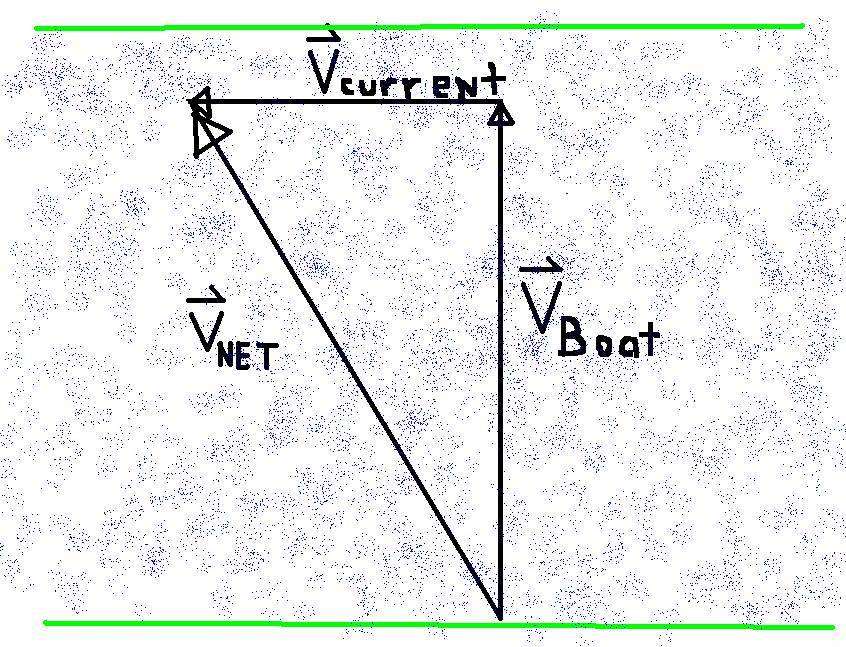
When crossing a river with a current there is motion in two directions, that of the boat, and
that of the current. We do this by making triangles of the motion.
The net velocity, that which the boat actually travels, is the sum of the two external velocity
vectors, Vboat and Vcurrent. You can find the net velocity using the pythagoriam therom or
trig if you know the angles of the triangle created.
Motion of a projectile>
An example of this is shooting a cannon ball out of a cannon or throwing a ball off a cliff.
The motion in the X (horizontal) direction and the motion in the Y (verticle) direction are
independent of eachother.