Does God Exist?
By John Clayton
To help the reader comprehend the nature of God, I would like to borrow
an analogy from the book Flatland by Edwin Abbott.1 Abbott was a mathematician
and the model is geometric in nature. It was originally written in the
19th century for the purposes we are using it for here. Flatland is the
story of a man who lives in a two dimensional world--like a sheet of paper.
In the surface of the paper there is only length and width-there is no
such thing as thickness. You and I are three-dimensional beings-we have
length and width and frequently considerable thickness. You cannot get
me, a three-dimensional being, into a two-dimensional sheet of paper. You
can draw a front view of me (a portrait), but that is not the whole me.
You can draw a top view of me which because I am bald, ends up being three
concentric circles, but that is not the whole me. If you and I were to
look at the man in Flatland, we would see him as a profile (see figure
1). He would be outlined but have no thickness.
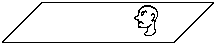
Figure 1: The man in Flatland.
One day the man in Flatland is visited by a sphere. The sphere is a
three-dimensional object just as we are, and it just so happens that it
crosses Flatland right in the man's living room. Now if you will think
about that for a moment, you will realize that for the man in Flatland
a rather incredible thing has happened. A dot appears on the man's floor
with no cause that the man in Flatland can understand. A dot in Flatland
is matter! In figure 1, the man, himself, is made up of a series of dots.
Just as a tennis ball dipped in paint and touched to a sheet of paper would
produce a dot on the paper, so too has our dot which the man in Flatland
calls matter appeared out of nothing (see figure 2). As the man in Flatland
watches, the dot becomes a circle which continuously grows in size (see
figure 3). You will see if a plane truncates (or slices) a sphere, it will
produce a circle; and the deeper the sphere sinks into the plane, the larger
the circle will become.
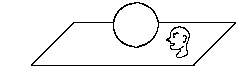
Figure 2: A sphere tangent to a plane produces a dot on the plane.
The man in Flatland sees only the dot.
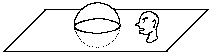
Figure 3: A plane truncating a sphere. The man in Flatland sees
a circle.
The circle becomes so large it is about to fill the living room of the
man in Flatland. He is terrified because he does not understand what is
happening. All of the laws of science which state that matter cannot be
created nor destroyed are being violated. What he sees is for him a true
miracle. Just as he is about to run in panic from the room, the sphere
reaches its equator, passes its equator, and gradually sinks out of the
plane. So what happens to the circle in Flatland? It begins to shrink,
and it becomes smaller and smaller until finally it is just a dot on his
floor and then it is gone! Another violation of the laws of science! Matter
cannot be destroyed and yet the man in Flatland has seen it happen. The
man in Flatland is being confronted with miraculous and ghost-like events
which violates his science and his common sense.
Let us suppose now that the man in Flatland begins talking to the sphere,
and he says to the sphere: "What is it like to be a sphere? The sphere
says, "I'll tell you what it's like; draw a circle on your floor."
This is not easy for the man in Flatland to do. His perception of a circle
is a constantly curving line that returns to its origin, but he cannot
see all of the circle at once. He can only see the side of the circle facing
him. The only way he could see a whole circle would be to be inside the
circle, and if he got inside he could never get out. People in Flatland
commit suicide by drawing circles around themselves that they can never
get out of. Because of this it takes along time for him to draw the circle.
The sphere is most impatient with all this because he could have done it
instantly. Finally the circle is completed and the sphere says, "Now
what I want you to do is to rotate the circle! What he has in mind is that
the man in Flatland will rotate the circle about its diameter producing
a sphere, but what the man in Flatland does is to rotate the circle about
its circumference, spinning it like a record on a record player. "No,
no--rotate it the third way,' says the sphere. "There is no third
way you fool," cries out the man in Flatland, and for him this is
true. There is no third way, no up and down in a thickness direction, and
absolutely no way for him to comprehend what the sphere is talking about
or what the sphere is. The only thing that he can understand is the world
or dimension in which he lives.
Now the reason that I have told you this little story is to give you
a foundation by which you can understand God. When you read, "In the
beginning God created the heaven and the earth" (Genesis 1:1), you
are reading a description analogous to Flatland. The concept is that, a
God, who is in a higher dimension than are we, a God who has the same kind
of relationship to us which the sphere had to Flatland, that, this kind
of being touched our little "Flatland," so to speak, and in violation
of all of our laws of science created matter out of nothing. God is so
superior to us, he exists in such a higher dimension than do we that what
is natural and ordinary to him is miraculous to us. The Bible recognizes
this concept and uses it in every single description of God.
|
 |