Women’s Wear: Bodice and
Sleeve Styles
by LuAnn Mason
Most reenactors are familiar with common bodice and sleeve styles from
the civil war era; however, bodices and sleeves are not universally interchangeable. Some
bodices are more appropriate to some fabrics or ages than others, and the same holds true
for sleeve styles.
The two basic bodice styles that were commonly used for day dresses
were the fitted (darted) bodice, and the gathered bodice. (Use of the fan front, slightly
v-necked bodice style is not encouraged, as this was a late 1840’s, early 1850’s
style, and no longer common by the 1860’s. If you are younger than age 40, this style
of bodice is absolutely inappropriate.)
See the Gallery
below for some examples of various bodice and sleeve styles.
Fitted or Darted Bodice:
Description:
This style of bodice is arguably the most common in period CdVs.
Bodices were closely fitted, with one, two, or three darts on each side, front opening,
with a dropped shoulder, nearly horizontal armscyes, and piping placed at the armscye and
waist. Please note that the center back pattern piece, as shown on the Past Patterns
pattern, is too wide at the bottom edge. Most original garments have a center back section
no more than 1.5" to 2" wide.
Age: Appropriate for all women over the age of 12 to 14,
depending on parental preference.
Materials: Darted bodices made of cotton fabrics are vanishingly
rare in original garments. If you currently have darted cotton bodices, by all means
continue to wear them until you replace them. I would strongly encourage you to consider
making any future darted bodices out of wool or silk, as those seem to be the fabrics of
choice for darted bodices in extant originals. Please note that this is a departure from
our current civilian guidelines. The guidelines will be overhauled and updated to reflect
more current research as soon as is practical.
Gathered Bodice:
Description:
This style of bodice, while less commonly seen in
CdVs, is more commonly seen in original garments. Small, controlled areas of gathers
replace the darts from the darted bodice, while the piping placement, dropped shoulder and
horizontal armscye remain the same. The gathered bodice is fitted onto a waistband
approximately 1.5" to 2 " wide, which is piped at the lower edge. These bodices
are commonly seen with decorative belts made of velvet, ribbon, or contrasting fabric.
Age: Appropriate for all women over the age of 12 to 14, depending
on parental preference.
Materials: While some gathered bodices were made of wool for winter
work dresses, the majority of cotton dresses were made in this style. Woven checks,
stripes, or plaid cottons, solid or print cottons are all appropriate for a gathered
bodice. In fact, at a recent conference, Juanita Leisch, author of "Who Wore
What", maintained that a gathered bodice made up in cotton was arguably the most
common dress for southern women during the civil war years.
From a reenacting standpoint, gathered bodices are much easier to fit,
and do not necessarily require a different pattern than the darted bodice. Replace darts
with small sections of gathering, and cut the back section in one piece, extending the
side seams straight down from the armscye instead of "cutting in" at the waist.
You can then add another small gathered section at the center back.
Sleeve styles:
Coat sleeve:
Description:
Probably the most commonly seen style of sleeve, this
sleeve is fairly fitted at the armscye, although small tucks or darts along the back edge
are common. The sleeve is also fairly close fitting at the wrist, and is not cuffed. The
typical coat sleeve "bellows" out at the elbow and can be cut in one or two
pieces, with or without a seam running down the "elbow" edge. This sleeve is
included in the Past Patterns gathered bodice pattern.
Age: Coat sleeves were commonly used by all ages.
Fabric: Coat sleeves are appropriate in cotton, wool, or silk
dresses.
Gathered or Bishop sleeve:
Description:
Another very common sleeve, the bishop or gathered
sleeve can be fitted at the armscye and flare to the wrist to be gathered into a cuff, or
may be gathered both at the armscye and cuff. Cuffs in original garments appear to be at
least 2" wide, rather than the narrower cuffs
commonly seen.
Age: Gathered sleeves are appropriate for all ages.
Fabric: Gathered sleeves are appropriate in cotton, wool, or silk
dresses.
Pagoda sleeves:
Description:
Gathered or fitted at the armscye, pagoda sleeves are
generally about 3/4 length, and have an open flare at the bottom edge. Original pagoda
sleeve dresses almost universally have the inside of the pagoda sleeve lined with white
silk, with ruching or trim applied along the interior bottom edge.
Age: As pagoda sleeves were an 1850’s fashion, they are inappropriate for
anyone under age 30. If worn by women over age 30, the fabric and style of the dress
should also reflect 1850’s styles.
Fabric: Pagoda sleeves were a high fashion distinction, and
reserved for nice or best dresses. Surviving pagoda sleeves in cotton dresses are limited
to sheer dresses of the 1850’s, where the outer layer of the dress is made of sheer
cotton in a gathered bodice style, and demilined in fitted white cotton. Pagoda sleeves on
sheer dresses were generally unlined. ALL pagoda sleeves must be worn with white cotton
undersleeves.
Miscellaneous:
1. Regardless of bodice style
or fabric, detachable white cotton collars should still be worn. The 4th Virginia ladies
were looking really good at McIver, with more than half of our women wearing their
collars. This was a true cut above what was seen on other civilians! Good job, ladies!
2. Sleeve jockeys or caps may be added to any of the above sleeve
styles if you wish. They don’t seem to be really common, in that the majority of
dresses had them, but they don’t seem to be a rarity either.
3. Belts with gathered bodices seem to be very common in CdVs; however,
leather belts are not appropriate. Original women’s belts and buckles appear to be
decorative in nature, with a center front buckle or ornament, and center BACK functional
closure. Belt buckles may be gutta percha, mother of pearl, gold, or brass, and should
reflect 1860’s styling. If you’re unsure of a buckle style, go without until
you’re able to do more research or ask questions.
Finally, on a completely unrelated note, I was asked by several people
at McIver when it is permissible to change from period clothing to "normal"
clothes.
To clarify: you should plan to be in period clothes from breakfast the
first day of the event until you are packing to leave the event.
Exceptions to this include: leaving the event to go to work, shop, run
errands, or whatever. The operative term here is "leaving the event."
Likewise, if you are packing your tent and preparing to go home, by all
means feel free to put on your street clothes to do so if you desire.
Finally, if you have kids that fell in a mudhole and are wet, cold, and
miserable, and you don’t have a period change of clothes for them, don’t make
them sit around and catch their death of cold. Let them change, then wash out their
clothes in a washtub. That’s why we have a laundry line! Once they have clean, dry
clothes, they can always change back.
And finally, if any event is bitterly cold and wet, and your kids (or
you) find that your period outerwear is just not enough to keep you warm, put on a coat.
Reenacting is a fun hobby, but it’s not worth risking anyone’s health.
Gallery
click on the small image to see the full-size image
|
|
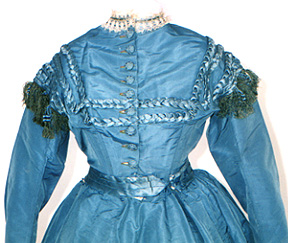
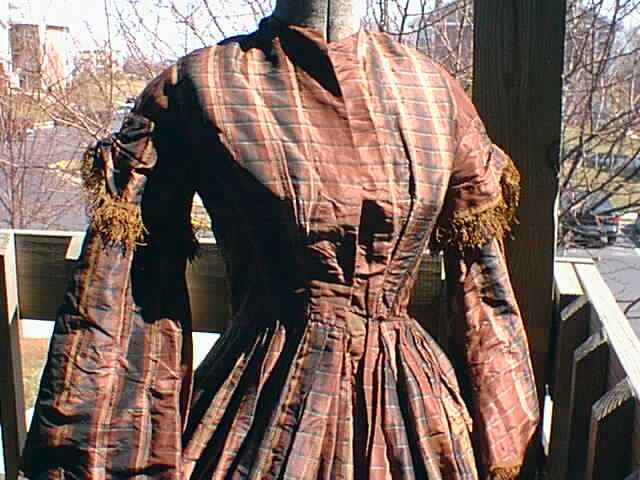
| This 1850's silk dress has a
darted bodice, coat sleeves, and sleeve jockeys. The sleeve jockeys are trimmed with silk
fringe, which was widely used in the 1850's, but not the 1860's. |
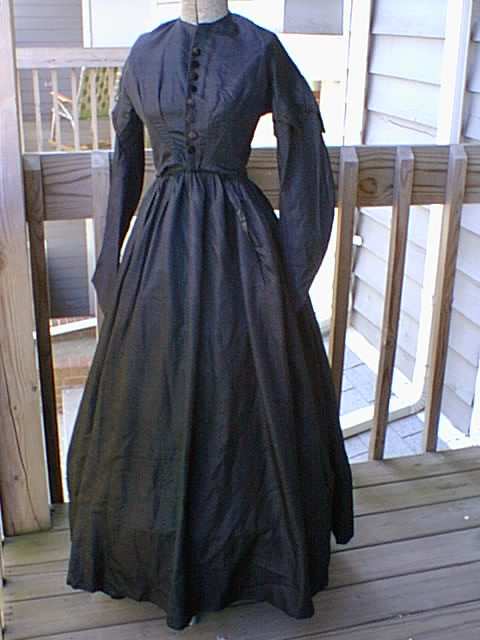
This black silk mourning dress has a darted
bodice, coat sleeves, and sleeve jockeys. |
|
 |
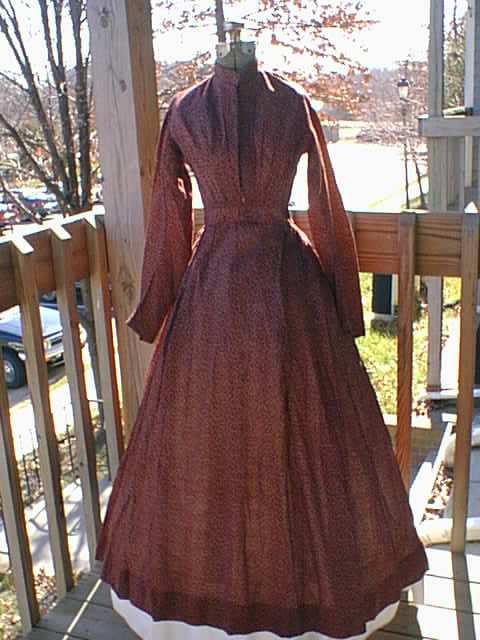
| This red cotton dress exhibits the typical
gathered bodice, coat sleeve style. Note: The small band collar is seen only in post-1864
dresses. |
This cotton print dress has a gathered
bodice attached to a waistband and coat sleeves. |
|
|
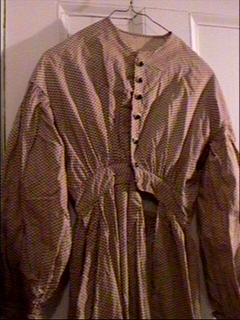
| This
cotton dress has a gathered bodice attached to a waistband, and gathered bishop sleeves. |
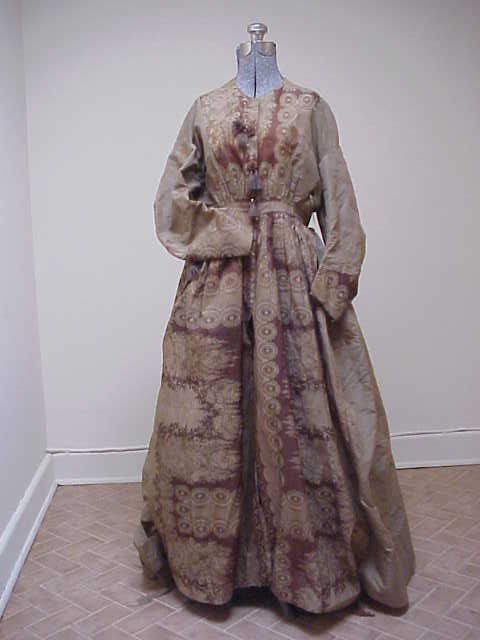
This
1850's silk dress has a darted bodice and pagoda sleeves. |