A slat bonnet: Note that the
"curtain" falls straight from the brim, rather than curving back toward the
jawline. The curved front sunbonnets are post-1880’s, and not appropriate for our
use.
A slat bonnet: Note that the
"curtain" falls straight from the brim, rather than curving back toward the
jawline. The curved front sunbonnets are post-1880’s, and not appropriate for our
use.
Bees in Our Bonnets: A Quick Survey of Women’s Headwear of the 1860s
Please DO feel free to wear any of the following on your head:
A slat bonnet: Note that the
"curtain" falls straight from the brim, rather than curving back toward the
jawline. The curved front sunbonnets are post-1880’s, and not appropriate for our
use.
 A corded sunbonnet: Nearly identical
to the plain slat bonnet, this style of bonnet uses cording as a stiffener rather than
wood or pasteboard slats. Note the straight curtain fall, with no curvature extending
toward the jawline.
A corded sunbonnet: Nearly identical
to the plain slat bonnet, this style of bonnet uses cording as a stiffener rather than
wood or pasteboard slats. Note the straight curtain fall, with no curvature extending
toward the jawline.
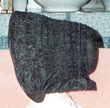 A
buckram-framed round bonnet, plain or drawn: Fabric may be applied flat to
buckram frame, or shirred over reeds, with the overall shape of the bonnet being round
along the brim edge.
A
buckram-framed round bonnet, plain or drawn: Fabric may be applied flat to
buckram frame, or shirred over reeds, with the overall shape of the bonnet being round
along the brim edge.
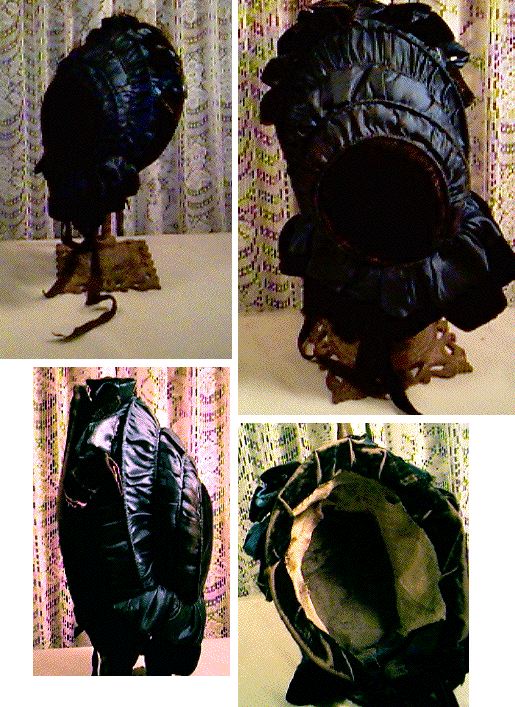 A buckram framed spoon bonnet, plain or
drawn: Again, fabric may be applied flat, or shirred over reeds. The difference in
shape can readily be seen in the "side view", where the bonnet obviously
resembles the bowl of a spoon.
A buckram framed spoon bonnet, plain or
drawn: Again, fabric may be applied flat, or shirred over reeds. The difference in
shape can readily be seen in the "side view", where the bonnet obviously
resembles the bowl of a spoon.
 A shaker bonnet, straw or silk covered buckram: Although this style of
bonnet was first popularized in the 1840’s, it remained in relatively common use
throughout the war years. One young women even mentions wearing her new silk shaker to
church in 1863, so this was by no means a bonnet worn only by older women.
A shaker bonnet, straw or silk covered buckram: Although this style of
bonnet was first popularized in the 1840’s, it remained in relatively common use
throughout the war years. One young women even mentions wearing her new silk shaker to
church in 1863, so this was by no means a bonnet worn only by older women.
A straw bonnet in any of the above shapes.
Please note:
All the above bonnets should be lined on the interior at least as far as is visible while the bonnets are being worn. These can be flat lined or shirred, light or dark silk or plain cotton being the most common lining fabrics.
Most "dress" bonnets also had two sets of ties: a "business" set meant to actually keep the bonnet on your head, and usually made of a utilitarian material such as cotton twill tape, and a "fancy" or "for show" set of ties made of wide (3" to 4") silk ribbon.
All bonnets should also include a curtain, or bavelet, which extends from the bottom of the bonnet to cover the nape of the neck. Most dressy bonnets appear to have had curtains in the range of 3" to 6", with these being pleated or gauged before attaching to the bottom of the bonnet. Frequently, the curtains of sunbonnets were much longer, extending from 12" to 24" or MORE from the base of the bonnet, to cover the neck and shoulders.
Please DO NOT put any of the following things on your head:
1) Nylon snoods being sold at the sutler’s. These are grossly inaccurate, and in no way resemble the fine hairnets which were occasionally worn by young women, or the white cotton nets worn occasionally by very young girls. If you are "of an age" (under 25), and really want to, a simple hairnet which matches your hair color may be worn, but this is NOT encouraged as it was generally a young, trendy northern fad, rather than a fashion norm.
2) White "day caps" being sold at the sutler’s unless you are over 60 years of age. Even then, all modern nylon lace and polyester ribbon should be removed and replaced with accurate trims.
3) Most modern straw hats. The exception again, being young women under 25, including young girls, who might have the wherewithal to follow a "fad". Straw hats (as opposed to bonnets) on young women were generally flat crowned, flat brimmed, with the crown height 4" or less, and the brim width not exceeding half the crown height. If worn, these should be trimmed with cotton bias binding around the edges, and with ribbon or bias binding around the base of the crown.