
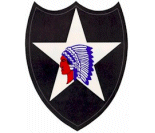
Division
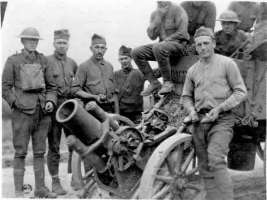
One of the few active units organized on foreign soil, the 2nd Infantry Division was formed on October 26, 1917, at Bounnont France. At the time of its activation, the Division was composed of one brigade of U.S. Infantry, one brigade of U.S. Marines, an artillerie brigade and various supporting units. During "The Great War" the Division was commanded twice by Marine Corps generals; Major General C.A. Doyen and Major General John A. Lejune. This was the only time in U.S. history when Marine Corps officers commanded an Army Division. During the winter of 1917 - 1918 the Division spent time training with French Army veterans. Though judge unprepared by the French, the Amrican Expeditionary Force was committed to combat in the Spring of 1918 in an attemptto halt a German advance towards Paris. The Second Infantry drew its first blood in Bella-Wood and contributed shattering the four-year-old stalemate on thebattlefieldduring the Chateau-Thierry campaing that followed. The Division won victories at Soissons and Mont Blanc, for which it was awarded the French Fourragire.Finally the Division participated in the Meuse-Argome offensive, which spelled the end of any German hope for victory. On November 11, 1918 the Armistice was declared and the 2nd Infantry Division marched into Germany where it preformed occupational duties until April of 1919.
Between The World Wars
Upon returning to the United States, the Second was stationed at Fort Sam Houston, Texas. It remained there for the next 23 years, serving as an experimental unit, tesing new concepts for the Army. In 1940 the 2nd was the firstcommand reorganized under the new triangular concept, which provided for three seperate regiments in each division.
World War Two
As part of the build up to Overloard, the Normandy invasion, the Second Division was transferred from Fort Sam Houston to Ireland in October 1943. On D Day + 1, June 7, 1944, the division came ashore at bloody Ohmaha Beach. While other units were stalled by German resistance, the 2nd blasted through the hedgerows of Normandy. After a fierce 39 day battle, the 2nd took the vital port of Brest, which was liberated on September 18, 1944. From positions around St. Vith, Belgium and through the Battle of the Bulge, the Second held fast, preventing the enemy from taking key roads of Leige and Antwerp. Resuming theoffensive on February 6, 1945 the Division joined the race to annihilate the fleeing Wehrmacht.
The Postwar
Expecting to participate in the invasion of Japan, V-J Day found the Second back home again. After a number of moves the 9th and 23rd Regiments where stationed in Ft Lewis, Washington. The 38th Regiment was mountain training in Colorado. Training lasted from1946 to 1948.
The Korean War
With the outbreak of hostilities in Korea, in the summer of 1950 the 2nd was alerted for movement to Asia. The Division arrived in Korea on July 23, 1950. They where the first unit to reach Korea from the States. The entire Division arrived in August 24, 1950 to relive the 24th Infantry Division at the Naktong River Line. On August 24, 1950 the 2nd was the first to break out of the Pusan perimeter. It later led the 8th Army drive to the Manchurian border. In April and May of 1951, the 2nd was instrumental in smashing the communist forces spring offensive. On April 9, 1953, the Division was moved to the rear and in August 20, 1954 they re-deployed to the United States.
The Cold War and Beyond
The Second was transfered to Fort Lewis, Washington, for only two years until August, 1955 when they where moved to Alaska. On November 8,1957 the Department of the Army announced the inactivation of the 2nd. Then in the spring of 1958 the Army announced the reactivation of the Second at Fort Benning, Georgia, this was their home from 1958 to 1965.
As tensions increased in the Korean peninsula the 2nd returned to the Republic of Korea in July of 1965. The North Korean forces begun infiltration attempts and the 2nd helped halt these attacks. Then on August 18, 1976 during a rutine tree trimming operation within the DMZ, two American officers were bludgeoned to deathin a melee with border guards of the North. The United Nations Command tasked the Division to spearhead its response to the incident, know as Operation Paul Bunyon, Today the Warriors of the Second Infantry Division are spread out across the Western Korean Peninsula and Straddle the famous 38th parallel. The Division's mission has remained the same for almost half a century: To assist in detering North Korean Aggression. Accordingly the Second Infantry Division stands, "SECOND TO NONE".