BACK
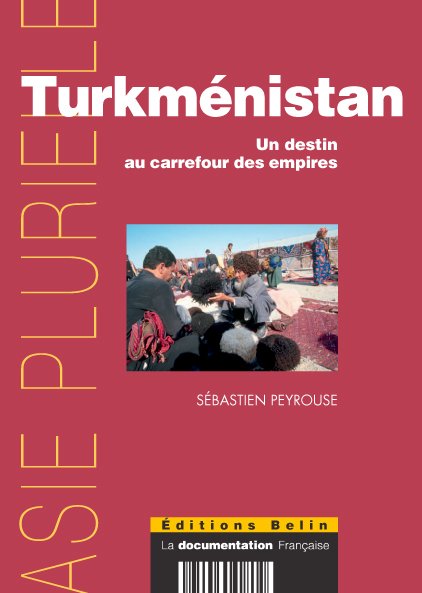
Turkménistan. Un destin au carrefour des empires
[Turkmenistan.
A Destiny at the crossroad of empires]
Paris,
Belin, coll. "Asie plurielle", 2007, 184 p.
|
In
the world, there exist some obscure countries which, by their history and
the position that they are called to fill in the 21st century, draw
considerable interest.
Turkmenistan
is without a doubt one of these places. Who in the broad public is now
familiar with this country, situated on the southern border of the former
Russian empire and cast into the shadow of its Slavic “big brother”
for many decades after its integration into the
Soviet Union
? Yet even before drawing the eyes of an expansionist
Russia
, the territory that is today
Turkmenistan
had a prestigious ancient history, which saw the procession of all great
empires and conquerors of the famous
Silk Road
. From
Parthia
to Gengis Khan, from Alexander the Great to Tamerlane, the history of the
country resembles a colorful tale that recounts the most epic moments of
the old continent. With numerous archaeological relics and natural riches,
the future most likely holds the development of a tourist market.
|
|
Yet
the Turkmen territory and its population have most often constituted the
periphery of great empires, and not their centers. Were future Turkmen passive
subjects under the influence of their neighbors more than actors from their own
history? Or does this vision only reflect ancient historiographical prisms that
do not allow for the unity of Turkmen history? Does being in the heart of the
old continent necessarily signify being in its political and cultural center?
The late construction of the Turkmen nation, under the influence of radical
social and political processes installed by the Soviet regime, increases the
complexity of a reflection on the identity traits re-elaborated in a retroactive
and instrumental manner. How did the little-known Turkmen nation constitute
itself, having mixed with diverse populations through the centuries – Persian
then Turkic – and contradictory cultural contributions from
Iran
on the south, from Transoxiana and Siberia on the east, and from
Russia
on the north? How did it specify its great historical figures and moments,
often common to the entire Central Asian region, and inscribe them into the
national pantheon? What place is Russian-Soviet heritage destined to occupy,
which in spite of its denunciation remains significant for any visitor to the
country? Finally, what role will Islam, regional and clan divisions, and
national minorities play?
In
1991,
Turkmenistan
gained an independence for which it did not ask. The dissolution of the Soviet
Union by the three “Slavic” presidents was seen as abandonment by
Moscow
, which was urged to give up the peripheral republics for their own.
Notwithstanding, the future of the country seemed promising. With a population
of less than five million people, the new state, declared the “Kuwait of
Central Asia,” knew it was rich in hydrocarbons in an energy-hungry world.
Despite the constant insistence of the authorities that the 21st century would
be the one in which
Turkmenistan
finally realized its destiny, reality proved more somber than expected. The
Soviet economic system was largely maintained, but lost its logic once the
republican entities became isolated from one another. As the Turkmen state was
already one of the least developed in the
Soviet Union
, two decades of independence viciously impoverished the population. Examples
include the domination of cotton farming, quasi-absence of a private sector,
ecological problems, and the elimination of public services. The political
system turned out to be a sad reprise of Stalinist themes, such as personality
cults, quasi-complete cultural autarky, international isolation, nationalist
megalomania in the public discourse, enormous state architectural projects,
massive corruption in administrative organs, and attempts to reshape nature.
However,
Turkmenistan
’s place on the international stage is strategic. The Caspian sea is predicted
to become a rising energy zone,
Russia
continues to dominate the economy of the region, and new neighbors allow for
once-unthinkable alliances.
Iran
, like
China
a faithful partner to
Turkmenistan
, is increasingly present. Even
Pakistan
and
India
announce how much
Central Asia
remains an incontrovertible place for the rising Asian powers. The environment
of the still-unstable Afghanistan, like that of Uzbekistan, seen as the “caldron” of
Central Asia, invites a reevaluation of the regional role Turkmenistan could
play if the country ends its harmful isolation. The death of Saparmurat Niyazov
in December 2006 and the assembling of a new government more open to foreign
governments clarified the international stakes and reopened the energy “Great
Game” for Turkmenistan.
Contents:
Introduction
Première
partie. Espace, histoire et culture
Chapitre
1. Le territoire turkmène, unité et diversité
Chapitre
2. De l’Antiquité aux khanats, une histoire riche en soubresauts
Chapitre
3 : L’impact sans précédent de la modernisation russo-soviétique
Chapitre
4. La « construction » de la nation turkmène
Deuxième
partie. Politique et société
Chapitre
5. Une indépendance modelée par la mégalomanie de S. Niazov
Chapitre
6. Contre-pouvoirs et changements politiques
Chapitre
7. Société et culture : les enjeux de la reconstruction
Troisième
partie. Penser de nouvelles stratégies
de développement
Chapitre
8. Économie, écologie et santé publique
Chapitre
9. Le Turkménistan, futur « Koweït » de l’Asie centrale ?
Chapitre
10. Trouver sa place sur la scène internationale
Conclusion
Bibliographie
BACK