Back
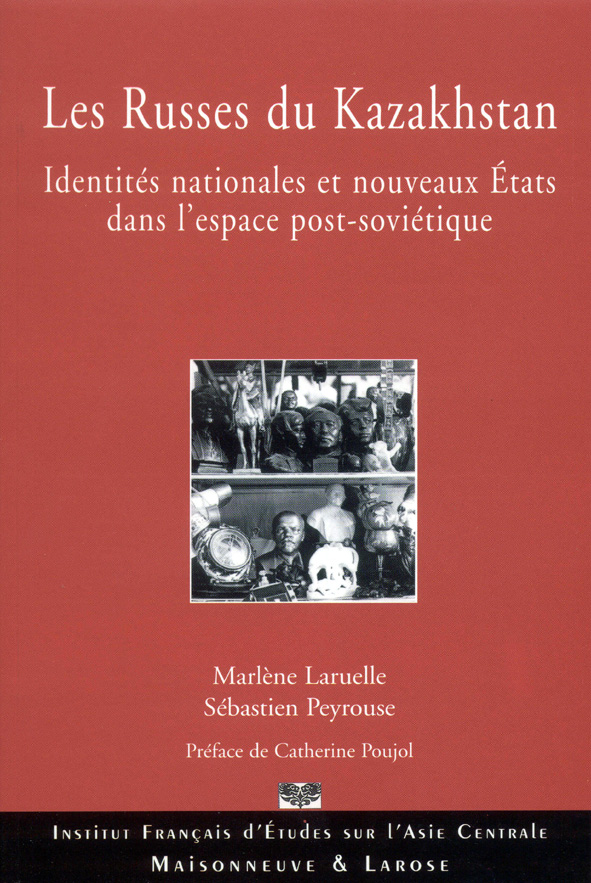
Les Russes du
Kazakhstan.
Identités nationales
et nouveaux Etats dans l’espace post-soviétique
[Russians
in Kazakhstan. National
identities and new States in the Post-Soviet space]
co-authored
with Marlène Laruelle, Preface by Catherine Poujol, Paris,
Maisonneuve et Larose - ifeac,
2004, 354 p.
|
This
book is based on materials collected during several long stays in
Kazakhstan
between 1999 and 2005, with the principal field-research conducted in 2000 and
2003 in several cities of the republic. The main sources are local periodicals
and books devoted to the topic under consideration, especially the newspaper
published since 1994 by the Russian minority organization “Lad,” and
interviews with leaders of the Russian movement and with ordinary Russians
living in
Kazakhstan
. The book develops three main points: the
non-homogeneous nature of Russian community in
Kazakhstan
, the development of non-ethnic allegiances that could explain the failure of
local Russian political parties, and the difficulties the leaders face in
choosing between the defense of political rights or cultural rights of the
country’s first minority. While dealing with these points, the authors focus,
first, on the place of nationality question in the Kazakhstani public debate and
the political activities of the Russian minority; second, on linguistic and
ethnic Kazakhisation; third, on the Russian identity narratives and rewriting of
history; fourth, on the Cossacks’ issues and their secessionist claims; and,
finally, on emigration trends and the narrative of a “return” to Russia.
|
|
|
|
|
In
the aftermath of the collapse of the Soviet Union, former dissident Alexander
Solzhenitsyn denounced both its breakup and the independence of the new states,
such as
Kazakhstan
. In a speech at the Russian State Duma, he denounced the independence of the
Russian Federation
, which would abandon 25 million Russians. Indeed, in December 1991, many
Russians residing in the other fourteen former Soviet republics suddenly found
themselves living “abroad.” The transformation of the internal borders,
until then considered administrative divisions, into internationally recognized
external borders, gave rise to questions and concerns.
This was the case especially among the Russians who became a minority in
a titular state ruled by another nationality. This book aims to highlight the
situation of, and around, the Russian minority in
Kazakhstan
and to reveal the political, social, and identity transformations this country
has experienced since independence. More than fifteen years after the collapse
of the
Soviet Union
, the Russian issue that, according to some analysts, could have destabilized
the area, eventually underwent a more peaceful evolution. This issue seems to
have been gradually solved through a double phenomenon — emigration of
those who wanted to leave the country and de-politicization of those who
preferred to stay or had no choice.
As
in the other Central Asian states, the Russian minority in
Kazakhstan
became further de-politicized in the 2000s. The political movements and
parties, like those of the Cossacks, “Lad,” and “Russkaya obshchina,”
failed to mobilize the millions of Russians living in the republic. Numerous
relevant sociological studies testify that the majority of Russians living in
the Near Abroad have no connections with these associations, which supposedly
represent them. Many Russians have never even heard of them nor feel that they
could defend them. These associations used to disseminate very pessimistic views
on the situation of Russians in the Near Abroad.
They gave a gloomy assessment of their future, either massive
repatriation to
Russia
or complete assimilation into a hostile, culturally alien state. They refused
to admit that a critical segment of Russians prefer the integrationist strategy
and do not view
Russia
as their motherland. Moreover, many Russians in
Kazakhstan
developed their own ways to deal with their new minority status. These include
cultural and linguistic acculturation, passive loyalty to the new state,
formation of a double “Russian-Kazakh” identity, and, above all,
indifference to any nationalist rhetoric, whether Russian or Kazakh.
Since
1991, Kazakhstan, and neighboring post-Soviet Central Asian states in general,
used in their political discourses rhetoric on their fight for independence and
mandate to choose their own political and economic paths. For Kazakhstani
political authorities, massive Russian and European emigration corresponded more
to their dreams than to post-imperial disengagement with
Russia
. Ethnic diversity in
Central Asia
decreases, whereas the mono-ethnic character of the states is increasingly
reality. However, these phenomena allow the political authorities to be held
accountable for their duties. Soon it
will be increasingly difficult to blame the Soviet regime or the Russians for
the lack of democratic, industrial, agricultural, and ecological choices, or to
blame contemporary failures and difficulties on their presence. Building a
nation-state was not easy for
Kazakhstan
. This huge territory has a sparse population.
The titular nationality was, until very recently, a minority in their own
state. The national language
competes with Russian for usage, even among the Kazakh population.
Russians were — and in some areas near the Russian boarders, still
are — a majority. Yet, even with such handicaps,
Kazakhstan
succeeded in preserving its territorial integrity and Kazakh national identity.
The price to pay for this success remains important. The consequences of
political authoritarianism, the exclusion of national minorities from public
life, and cultural impoverishment have not yet been properly assessed.
The
“Russian question” in
Kazakhstan
raises several more general questions. It first invites to question the nature
of “Russian colonialism” in Siberia and
Central Asia
and, in return, to question Russian identity and its paradoxical relationship
to the imperial territory. If Turkistan was a classic “colonial” space, what
about Northern Kazakhstan, Ural, and Altay, where the history of the population
is actually the history of the Russian progression in
Siberia
? Second, the issue of minorities opens the debate on the future of independent
Central Asia
, which must deal simultaneously with its ethnic diversity, its geopolitical and
economic enclosure, and the rise of authoritarianism. Finally, the presence of
Russians in
Kazakhstan
confirms the formation of a pattern common to the whole post-Soviet space,
confronted with processes of identity adjustments between territory, population,
and state and of new relations between center and periphery. Whatever the future
of Russians in the Near Abroad, their return to their homeland that started in
the 1970s is probably a major, long-term component of
Russia
history.
For
the first time in five centuries, the space occupied by Russians is decreasing.
What, then, will stop Russian emigration from the CIS republics in
Russia
? Does the collapse of the Soviet Union suppose a possible implosion of the
Russian Federation
in areas where Russian and autochthonous populations live together? Does the
departure of Russians from
Siberia
to the central regions of the Federation encourage this evolution? Russians do
not view
Kazakhstan
as a part of the empire occupied from the 19th century as Turkistan was, but as
a space conquered during the Russian progress in
Siberia
. Although control over part of present day Kazakhstan was established only in
the 1860's, the regions of Ural, Northern Kazakhstan, and Altay, marked by
Russian old-believers’ presence since the 17th and 18th centuries, are always
cited as the first historic references of the “Russianness” of Kazakhstan.
Renouncing a territory that is such a strong national symbol then raises a
complex problem. To refuse Russians the right to consider themselves as natives
in this area can also be viewed as a challenge to the Russian presence beyond
the Urals. The Caucasus,
Siberia
, and the Volga–Ural area, populated with non-Russian peoples and autonomous
administrative entities, could follow the “Kazakh pattern” in the future.
Contents:
Préface
de Catherine Poujol
Introduction
Chapitre
I. Le champ du politique. La fermeture démocratique du Kazakhstan et ses aLéas
sur la question nationale
A.
Une décennie de vie politique kazakhstanaise
1. 1991, une
indépendance peu réclamée
2. L'établissement
d'un régime présidentiel fort
3. Le tournant
autoritaire de l'année 1995
4. La
liquidation de l'opposition
5. Une liberté
d'expression et d'opinion de plus en plus bâillonnée
B.
La place de la question nationale dans le débat public
1. Les partis
nationalistes kazakhs : répression et instrumentalisation
2. Nation
kazakhe ou nation kazakhstanaise ?
3. L'Assemblée
des peuples : une folklorisation de la question nationale
4. La spécificité
russe de la question nationale
C.
La nébuleuse associative autour de la minorité russe
1. De la
diversité des associations russes : l'entente impossible
2. S'ouvrir ou
se fermer ? Les relations avec les autres partis et associations
3. Quelle représentativité ?
Echec électoral et schismes internes
Chapitre
ii. L'enjeu de la "kazakhisation" du pays : deux peuples, deux
discours ?
A.
La question de la citoyenneté, première revendication des Russes
1. Citoyenneté
et/ou nationalité
2. Le problème
de la double citoyenneté
3. Les
difficultés nées du changement des passeports
B.
Le statut de la langue au cœur des polémiques
1. Les langues
russe et kazakhe sous le régime soviétique
2. L'arsenal législatif
de l'indépendance
3.
L'accentuation de la kazakhisation linguistique
4.
L'argumentation des associations russes
C.
La difficile question scolaire
1.
L'enseignement des langues kazakhe et russe à l'école
2. Les
tentatives de kazakhisation du système scolaire et leurs conséquences
3. Des
solutions en voie d'ethnicisation ?
D.
Vers une politique ouverte de "préférence nationale" ?
1. Des mesures
de discrimination officieuses ou officielles ?
2. La
kazakhisation des domaines politique et administratif
3. La sphère
économique et la question nationale
Chapitre
iii. Histoire et religion au service de l'affirmation nationale russe
A.
La réécriture de l'histoire et ses enjeux
1. La
kazakhisation de l'histoire et du territoire
2. Une
colonisation russe decriée
3. La période
soviétique : le "génocide" ?
B.
La réponse historiographique russe
1. Le maintien
d'une analyse coloniale
2. La réhabilitation
de la domination tsariste
3. La
nostalgie de la grandeur soviétique
C.
La bataille mémorielle pour la possession de la steppe
1. L'obsession
pour la terre : le mythe du pionnier
2. La lutte
pour la possession symbolique du sol
3. La spécificité
historique et identitaire de l'Altaï
D.
La place ambiguë de l'Eglise orthodoxe dans la "question russe"
1. Approfondir
le lien entre russité et orthodoxie
2. Eglise et
associations russes : des emprunts thématiques mutuels
3. Eglise
orthodoxe et pouvoir politique, des intérêts partagés ?
E.
Les multiples perceptions de l'islam : allié ou ennemi ?
1. De l'islam
tolérant des Kazakhs…
2. … à
l'islam intégriste "étranger"
Chapitre
iv. Question cosaque et jeux territoriaux dans le Nord du Kazakhstan
A.
Le renouveau cosaque, enjeux politiques et identitaires
1. Pour un
bref historique des Cosaques du Kazakhstan
2. La conquête
d'un statut juridique spécifique : l'exemple russe
3. La question
identitaire : un peuple spécifique ?
B.
Le "folklore" cosaque : des déchirements internes au Kazakhstan
1. Des débuts
houleux : résistance de l'Etat kazakh et dissensions internes
2. Trois
communautés, trois rapports au politique et à la question nationale
3. Les débats
historiques cosaquo-kazakhs
C.
La question territoriale : sécession ou autonomie ?
1. Fidélité
à la Russie ou au Kazakhstan ?
2. Le sécessionnisme
à l'œuvre dans le Nord et l'Est du pays
3. La question
de l'autonomie culturelle
Chapitre
v. Ni Kazakhstanais, ni Russes de Russie ?
A.
Le dilemme : partir ou rester ?
1. Des départs
de population massifs
2. Le discours
sur l'émigration : accepter ou condamner ?
3. Un projet
original : le "premier convoi"
B.
Vers la constitution d'une identité spécifique ?
1. La
complexité de la situation juridique
2. Le
nationalisme ethnique des associations russes du Kazakhstan
3. Les
fondements d'une identité "pied-rouge" ?
C.
Des enjeux en réalité internes à la Fédération russe
1. Le lobbying
russe en faveur de la diaspora
2. Les débats
terminologiques : compatriotes, diaspora, Russes de l'étranger ?
Conclusion
Bibliographie
Chronologie
Annexes
Index
Back